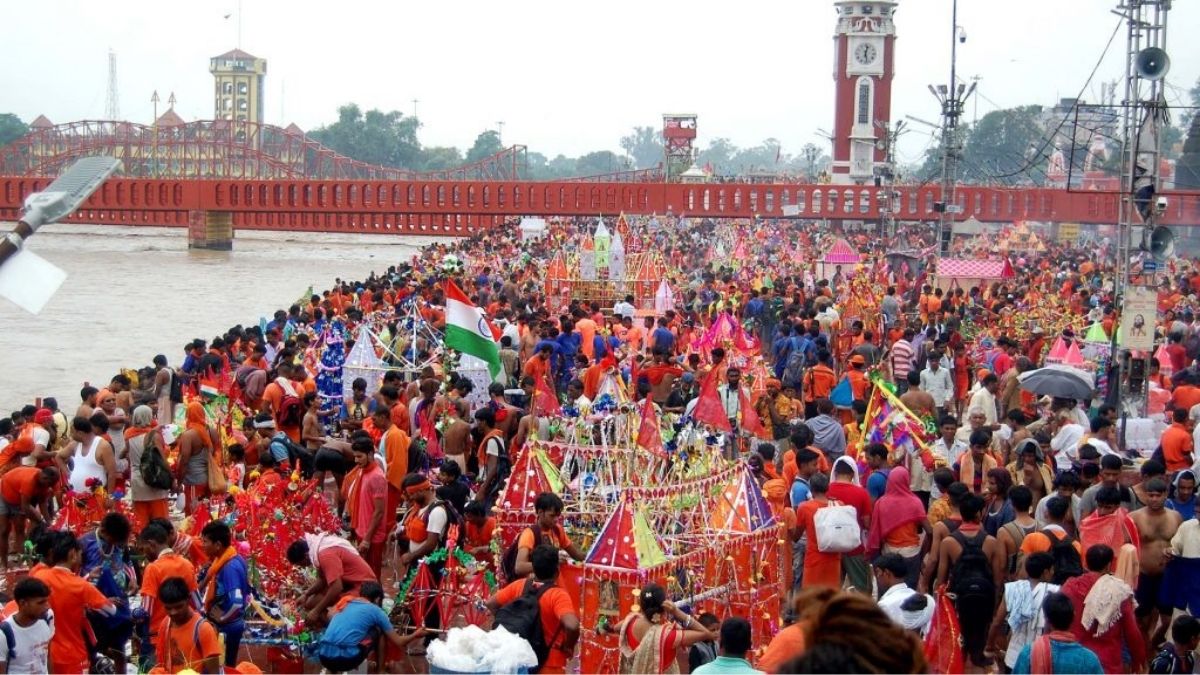
Millions of Shiva devotees travelling to the Ganga to collect sacred water and carry it back to temples (Photos: District Haridwar)
The Kanwar Yatra is one of the largest annual religious pilgrimages in northern India. Every year, millions of devotees travel to Haridwar and other points along the Ganga River to collect holy water and carry it back to Shiva temples in their hometowns. Many undertake the journey barefoot, observe dietary restrictions and follow strict personal rules as part of their devotion.
In 2026, the scale reached another record. Police estimates say that around 48 million Kanwariyas collected Ganga water from Har-ki-Pauri in Haridwar, up from approximately 45 million in 2025.
Seeing the rising number of pilgrims, officials in several states made special arrangements along the routes used by the marchers, including creating a dedicated space for them to move on the roads. However, better arrangements for the Kanwariyas have failed to address several troubling issues that spring up each year during the pilgrimage.
Across western Uttar Pradesh, Uttarakhand and parts of Delhi-NCR, incidents involving vehicles, shopkeepers, police personnel and other civilians have repeatedly shown how quickly minor confrontations can turn violent when large groups of Kanwariyas become involved. Also, an increasing number of these groups play extremely loud, almost deafening music, often all night, in clear violation of the laws and social norms.
The issue is not the religious practice itself. Nor can the actions of a small section be attributed to millions of peaceful pilgrims. The deeper concern is that violence, vandalism and intimidation have appeared repeatedly around the yatra, often in the presence of police, and yet those ‘pilgrims’ involved in these incidents get away scot-free, with not even a case being filed against them, let alone them being prosecuted.
However, the wider public is expected to absorb extraordinary disruption in the name of maintaining the pilgrimage.
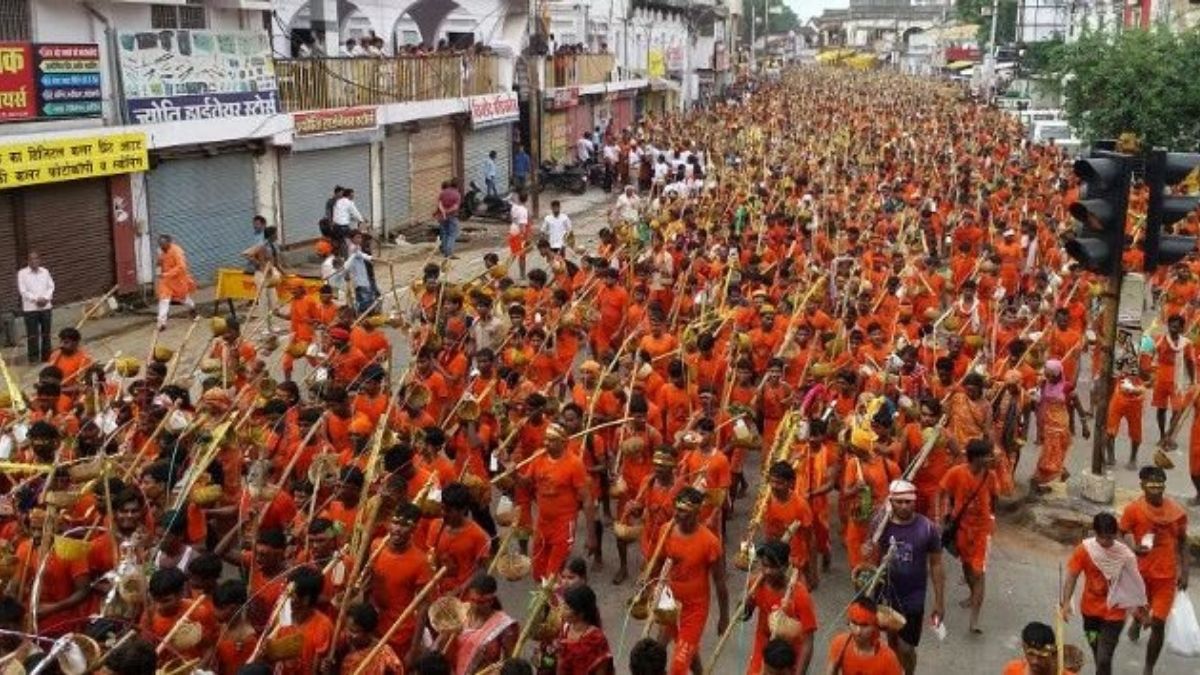
The annual Kanwar Yatra transforms towns and highways across northern India, bringing together vast numbers of pilgrims
Also Read:Kanwar Yatra- Saffron-clad Shiva devotees on a spiritual journey
Fatal confrontations enroute
While many of the cases involve the so-called pilgrims breaking up vehicles or other material properties, some of them turn to physical violence against people and at times leading to death of the persons that cross the marchers.
One such case occurred on July 31 in Hapur district of Uttar Pradesh when Mohammed Azeem, 24, was killed by the ‘pilgrims’ after his pickup truck was involved in a minor accident with an autorickshaw carrying Kanwariyas in Garhmukhteshwar, about 70 km east of Delhi.
He was allegedly pulled from his vehicle and beaten by the Kanwariyas following the collision. A purported video of the assault circulated widely, showing Azeem being attacked in the presence of a police officer. He was first taken to a hospital in Meerut and later shifted to Delhi after his condition deteriorated. He reportedly died on August 4 without regaining consciousness.
A collision should normally result in police investigation, insurance claims or criminal proceedings where necessary. Instead, according to the allegations, it escalated into a physical assault that ultimately proved fatal.
For his family, the consequences are irreversible. Azeem reportedly left behind a wife, an infant son and a bedridden father.
The incident has caused outrage even amongst some Kanwariyas. “We come here with faith and follow many rules during the journey. If someone damages a Kanwar or causes an accident, it is wrong to react with violence. The police should handle such matters. A few people’s actions should not bring a bad name to everyone who is walking for Shiva,” says Rishabh Singh, one of the Kanwariya from Faridabad tells Media India Group.
Singh adds that incidents such as Azeem’s death also affect the way ordinary people view pilgrims on the road.
“When something like this happens, people start looking at every Kanwariya with suspicion. That is unfair to those who are following the rules. We should be the first people to tell the police if someone is creating trouble, because protecting the dignity of the yatra also means protecting other people’s lives,” Singh adds.
Also Read:Sawan Shivratri: Celebrating Shiva beyond Kashi and Kedarnath
An oft-repeated pattern
Azeem’s death did not emerge from nowhere. In 2026, other incidents included the reported vandalism of vehicles after minor collisions with Kanwars and the alleged assault of civilians. An incident involving a school-van in Lucknow also generated controversy after the vehicle carrying minor children was reportedly attacked by men said to be associated with the pilgrimage. Such claims require careful verification against police records before being presented as established fact, but they form part of a wider pattern of clashes being reported during the pilgrimage.
In Bareilly, also in UP, authorities demolished restaurants selling meat-based dishes along a Kanwar route and arrested the owners. Officials claim that the establishments were operating in violation of restrictions on non-vegetarian food along the religious route.
The incident illustrates another dimension of the problem, namely the ability of a religious procession to reshape the economic activity of an entire area, an issue that has been raised for several years and involving numerous Hindu festivals.
The administration has the authority to impose reasonable restrictions for public order and safety. But enforcement becomes socially sensitive when it disproportionately affects businesses belonging to a particular community.
2025: A year of repeated violence
The previous year’s Kanwar Yatra provides perhaps the clearest evidence that the 2026 incidents were not isolated. In July 2025, a series of violent episodes were reported from Uttar Pradesh and Uttarakhand. In Meerut, Kanwariyas reportedly vandalised a school bus after alleging that it had collided with pilgrims and damaged their Kanwars. The bus windows were broken and the driver was allegedly threatened.
The incidents were not confined to civilians. At Mirzapur railway station, a CRPF personnel was reportedly assaulted after an argument with Kanwariyas. In this case, seven people were arrested, four of them minors, according to reports. At Shivrajpur police station in Kanpur, a confrontation involving Kanwariyas escalated into an attack on a home guard and damage to police property. Police later identified suspects using CCTV footage and arrested five people.
In Basti, Kanwariyas reportedly blocked a national highway, damaged police barricades and attacked police vehicles after an argument over alleged objectionable remarks. A police officer was reportedly injured by a stone thrown during the confrontation. In Haridwar, police and Kanwariyas also clashed over route diversions. In a separate incident at a toll plaza, a bus allegedly brushed against a Kanwar, following which pilgrims pelted the bus and a police vehicle with stones. A police sub-inspector was injured and two Kanwariyas were arrested.
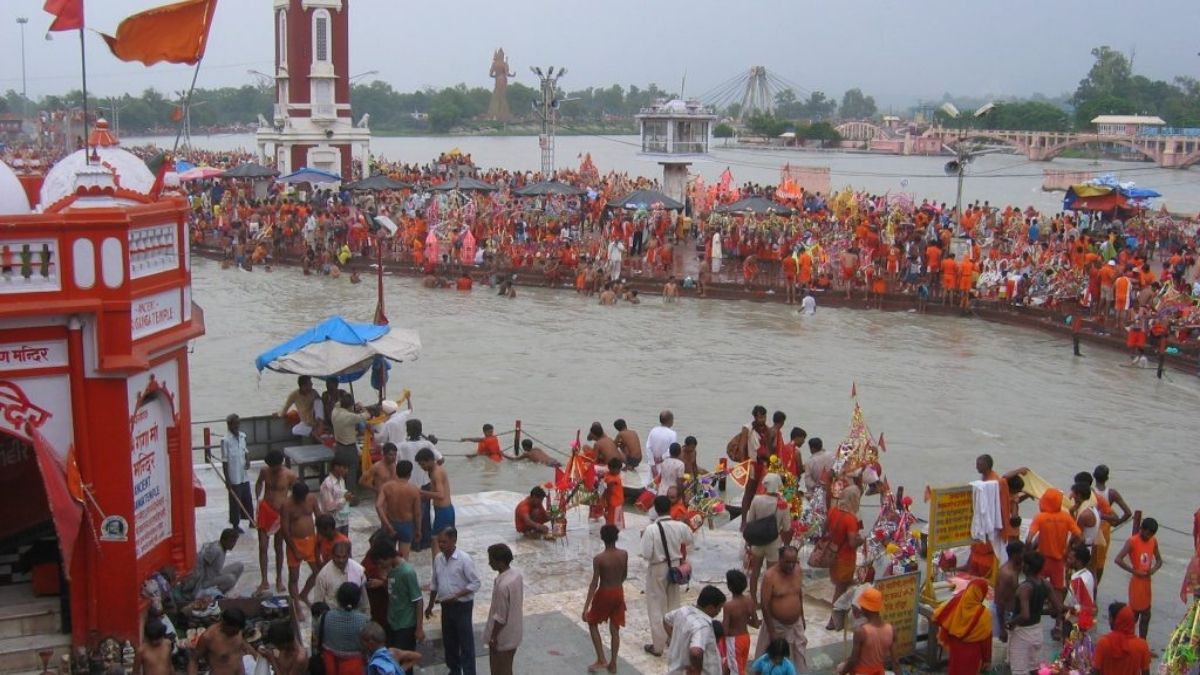
Haridwar becomes a major gathering point during the Kanwar Yatra
There were other incidents of Kanwariyas using violence with impunity from various other parts of UP and Uttarakhand, incidents that have been condemned by their own fellow-pilgrims.
“The Kanwar Yatra is supposed to teach patience and discipline. We walk for days, face heat and exhaustion and still try to remain calm. Breaking vehicles or beating people is not part of our religious practice. If there is a dispute, we should report it instead of taking the law into our own hands,” Golu Saxena, another Kanwariya from Delhi tells Media India Group.
The incidents were sufficiently serious for the Uttar Pradesh Police to place restrictions on Kanwariyas carrying tridents, hockey sticks and similar objects during the pilgrimage. The decision came after several incidents involving vandalism and clashes, another move that has been supported by some of the marchers.
Saxena says restrictions on carrying potentially dangerous objects should not be seen as an attack on the pilgrimage.
“If carrying a stick or another object can create fear or be used during an argument, there is no reason to insist on carrying it. We come to complete a religious journey, not to fight. Such restrictions can actually help genuine Kanwariyas because they reduce the chances of a small argument becoming a major incident,” Saxena adds.
These incidents matter because they show that the problem was not simply about communal tension or attacks involving Muslims. Kanwariyas also attacked other Hindus, women, police personnel, security forces, motorists and fellow pilgrims.
That makes the central problem one of crowd behaviour and accountability, rather than merely communal conflict.
Also Read: Religious leaders promote wave of misogyny cloaked as morality
Violence in Bihar too
Violent incidents involving Kanwariyas are not limited to Haridwar and western Uttar Pradesh. Incidents have been reported from Bihar, too, where thousands of devotees begin their journey at Sultanganj, collect Ganga water and walk around 105 km to Baba Baidyanath Dham in Deoghar, Jharkhand during the annual Shravani Mela. The route attracts millions of pilgrims and has become an important part of the religious and local economic life of the region.
The route has also witnessed tensions. In 2025, a clash between Kanwariyas and local shopkeepers was reported along the Sultanganj-Deoghar route in Bihar’s Banka district, leaving several people injured and leading to arrests. The incident showed that even long-established pilgrimage routes can see local disputes escalate when large crowds and religious sentiment come together.
“In Bihar, people along the Sultanganj-Deoghar route have lived with the Kanwar pilgrimage for generations. Local people provide food, water and places to rest and pilgrims depend on them throughout the journey. There can be disagreements, but the relationship between pilgrims and residents should remain respectful. The yatra cannot succeed by creating fear among the people living along the route,” Mihir Jha, a Kanwariya from Dargahpur, Begusarai, Bihar tells Media India Group.
At the same time, the Bihar-Jharkhand route highlights an important distinction. The presence of millions of pilgrims does not inevitably have to result in widespread confrontation with local communities. Much of the route’s economy is built around serving the devotees, with temporary shelters, food stalls, medical facilities and other services operating throughout the pilgrimage.
Top court’s warnings ignored
Violence around the pilgrimage is not new or even recent. Almost a decade ago, in August 2018, the Supreme Court reacted strongly to incidents of vandalism and destruction of public property associated with Kanwariyas and other protests. The court described the situation as serious and said that damage to public property could not be permitted.
The remarks came after incidents including the vandalism of a car in New Delhi after it reportedly brushed against a Kanwariya.
Many of the pilgrims recognise the issue and call for better enforcement of law as well as a better behaviour from their fellow marchers.
“Our purpose is to take Ganga water to the temple and complete our religious vow. It does not give anyone the right to stop another person’s life or business. If a shop sells something we do not want to eat, we can simply go somewhere else. Religion should make a person more disciplined, not more aggressive,” Hari Dev, another kanwariya who has been to Haridwar from Delhi tells Media India Group.
Dev says religious discipline should also apply when pilgrims cause inconvenience on the road.
“Walking for so many days teaches you to control your anger and tolerate discomfort. If we lose that control the moment a vehicle comes near us or a shop does not have what we want, then the real purpose of the pilgrimage is defeated. Patience should be part of the yatra just as much as devotion,” Dev adds.
Another recurring feature of several incidents is the behaviour of police during the violence. Videos and reports from 2025 showed Kanwariyas damaging vehicles and confronting police personnel even as officers attempted to intervene. In some cases, arrests followed. In others, police were seen attempting to pacify those attacked rather than immediately restraining individuals involved in vandalism, a response that that has been .
“A religious procession cannot become a zone where normal law enforcement is suspended. Police have to balance crowd safety with the protection of individual citizens, but that balance should never mean ignoring violence. The responsibility is to identify those who break the law and act against them without treating the entire pilgrimage as criminal,” adds Saxena.