
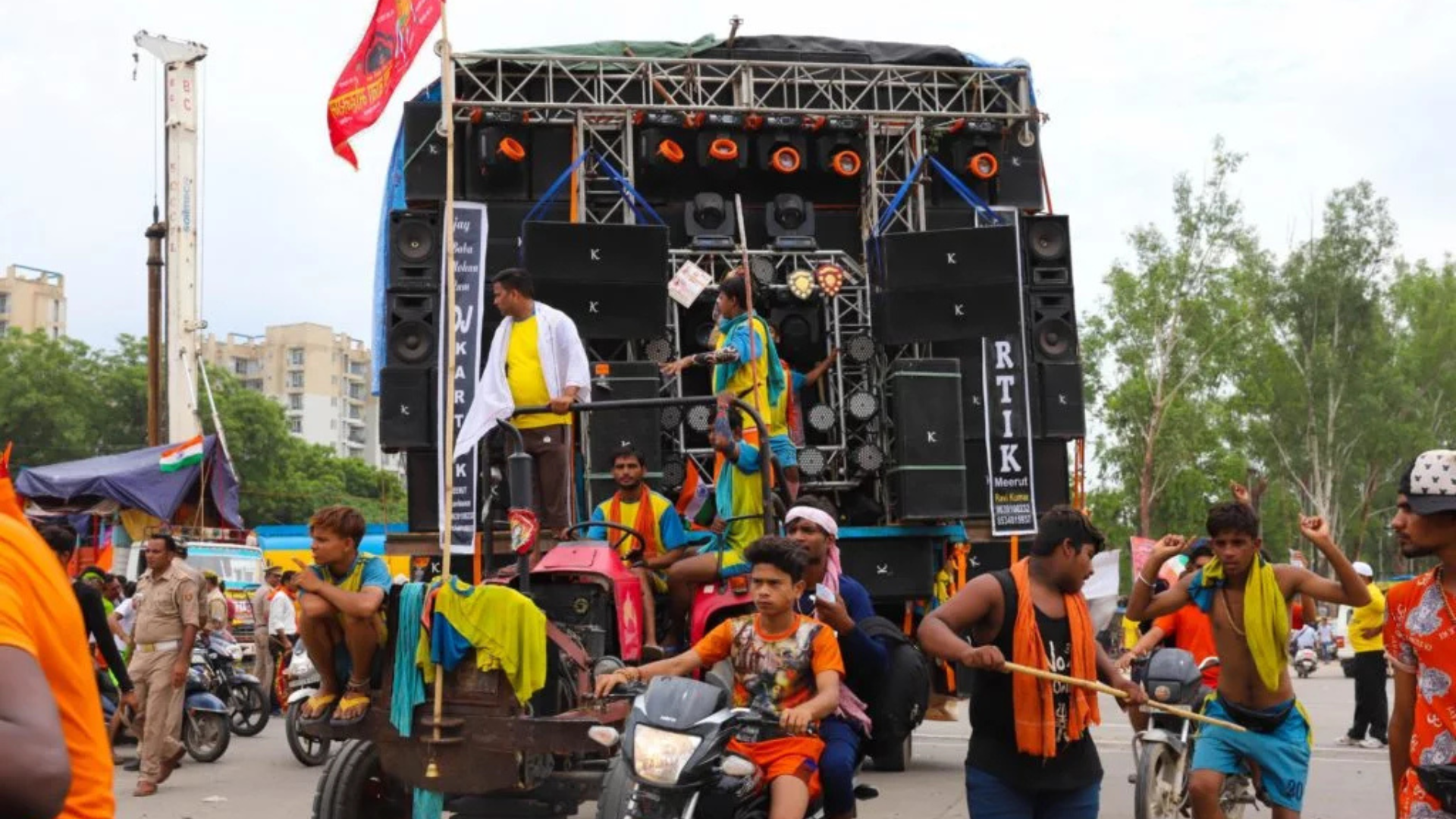
Indian festivals often cause high levels of noise pollution (Photo: Media India Group)
As the city’s arteries begin to pulse with the day’s first traffic, a rising clamour radiates over the streets, echoing across residential colonies and school compounds alike. From the incessant honking of impatient commuters to the thunderous reverberations of construction machinery, India’s urban soundscape has become an ever-present and ever-growing backdrop, one with profound and increasingly, measurable consequences for public health.
As data from 2024 unveil, the question facing policymakers, medics, and citizens is worryingly clear: is India, quite literally, becoming deaf?
According to the National Programme for Prevention & Control of Deafness, hearing loss is now the most common sensory deficit among Indians. The programme, spanning 587 districts across 36 states and union territories as of 2024, seeks to tackle what remains an enormous public health burden.
Early World Health Organisation (WHO) estimates suggested that over 63 million Indians suffer from significant hearing impairment, at least 6.3 pc of the population. This figure, now over two decades old, is believed by experts to understate the scale today, especially as unregulated urbanisation and modern lifestyle trends take hold.
A 2024 epidemiological analysis confirms the gravity that is in several industrial and high-traffic sectors, noise-induced hearing loss (NIHL) prevalence among adult workers is approaching or exceeding 50 pc with exposure to persistent noise above 80 decibels. Equally worrying are studies among construction workers and professional drivers, where the estimated prevalence rates range from 13 pc up to 22 pc, depending on the region, the duration of exposure, and job profile.
India’s urban noise is not merely a by-product of its population boom and economic surge; it is an environmental crisis accelerating beneath the surface of progress. Government-sanctioned ambient noise limits, designed to protect hearing health, are being routinely breached in nearly all metro cities.
In May 2024, official noise monitoring in Jaipur, Rajasthan, found levels in ‘silence zones’ such as hospitals and schools hitting 66-63 decibels in the daytime, well above the 50 dB legal ceiling. Residential localities often clock 75 dB, and commercial hotspots touch or exceed 75 dB at night. A logarithmic increase in decibel measurement means the difference between 50 dB and 75 dB is not just incremental, but thousands of times more injurious over time. Mumbai, which serves as a bellwether for India’s urban noise crisis, regularly registers persistent daytime noise levels in the 70–90 dB range, with transport junctions spiking to 95 dB, levels comparable to a power tool or subway train.
For Delhiites, these realities are not abstractions, they resonate daily.
“There is no respite. Every morning, the honking begins before dawn and only grows through the day. Even meditation indoors is disturbed by distant traffic and religious processions with loud speakers. My grandparents struggle with sleep and now I am worried about my pet dogs. We have stopped stepping out without earplugs during festivals,” Sejal Khanna, Marketing Executive, Bharti Real Estate in New Delhi, tells Media India Group.
Yet, what is perhaps most alarming is the silent, creeping impact on India’s youth. “NIHL is one of the most underestimated public health concerns in India today. From my experience on the ground, as someone working closely with both urban and rural populations, I have seen a sharp rise in cases of early auditory stress, especially among the youth. Continuous exposure to high decibel traffic, loud music via earphones, and construction sounds in expanding urban regions like Delhi-NCR is silently eroding auditory health. Unfortunately, we lack mainstream dialogue and preventive education around this irreversible condition. What is more alarming is that symptoms often go unnoticed until it is too late,” Kamna Singh, Founder, Shubkamna Welfare Foundation, an NGO at the frontline of advocacy and intervention, tells Media India Group.
Public health data increasingly bear out these claims. Among young adults and adolescents, habits such as prolonged use of personal audio devices, often at unsafe volume settings, combine with routine urban noise exposure to push up rates of hearing fatigue and early-stage NIHL. The World Health Organisation notes that exposure to just 85 dB for extended periods can cause irreversible hearing loss over time.
India’s regulatory regime, itself a robust framework on paper, is hindered by lack of awareness and patchy on-ground implementation. The Noise Pollution (Regulation and Control) Rules, 2000 establish clear decibel limits and empower local authorities, yet a 2024 policy update in Delhi reflects just how difficult enforcement can be. Recently, the Delhi government expanded the powers of local civic bodies, making it possible for assistant municipal commissioners, SDMs and traffic police to issue spot penalties, in hopes of decentralising and improving response speed.
The National Green Tribunal’s recommendations are slowly being codified, aiming for swifter and more accountable responses to complaints.
“With local authorities now empowered, we can take action right at the source,” the Delhi Environment Minister remarked on notification day.
“Our actions on noise complaints are twofold. We do respond to complaints registered via helplines and online portals, but we also take suo motu action, especially during public festivals or reported areas of repetitive violation. We have dedicated patrols in peak periods looking for unauthorised loudspeakers, DJs, or pressure horns, common in both urban and suburban areas. Still, our challenge is proof on the spot, measuring noise levels precisely, and dealing with public resistance, especially at night. Penalties can be imposed, but public education remains key for real change,” a Delhi Police Office, who preferred anonymity, tells Media India Group.
Delhi Police’s standing order from April 2025 now requires prior written permission for any use of loudspeakers or sound-amplifying devices in public, particularly at night. The noise thresholds are strictly codified: 55 dB by day and 45 dB at night for residential areas, with a cap of 50 dB around schools and hospitals during the day. These limits are routinely breached, especially during festivals and political rallies, placing officers often at the complex crossroads of law enforcement and cultural tradition.
“Convincing people to think of silence as a right and noise as a pollutant is a psychological shift. We work with municipal ward officers and traffic police to identify key pressure points such as school zones and hospitals, where traffic noise is extreme. In Greater Noida and Jewar, we have pushed for ‘No Honking’ signs. Our current proposals include planting green noise buffers, Miyawaki-style urban forests, to create natural sound shields between homes and highways,” Singh adds.
NIHL in India is not evenly distributed. Industrial workers, construction labourers, and traffic personnel stand at disproportionately high risk. One 2024 study found that nearly half of industrial workers exposed to sound above 80 dB sustained measurable hearing loss, a rate climbing with age and years of exposure. Initiatives to provide affordable earplugs and conduct on-the-spot occupational health briefings have been welcomed, but face resource limitations.
Based on recent United Nations Environment Programme (UNEP) reports and other official sources, the following Indian cities are recognised as the noisiest in the country, with several also featuring among the noisiest globally:
- Moradabad (Uttar Pradesh): Recorded noise levels up to 114 dB, making it not only the noisiest city in India but also the second noisiest city in the world after Dhaka, Bangladesh.
- Kolkata (West Bengal): Recorded at 89 dB, one of the noisiest cities in both India and the world.
- Asansol (West Bengal): Also measured at 89 dB, matching Kolkata’s noise levels.
- Jaipur (Rajasthan): Registered at 84 dB.
- Delhi (National Capital Territory): Noted at 83 dB in several locations across the city.
