
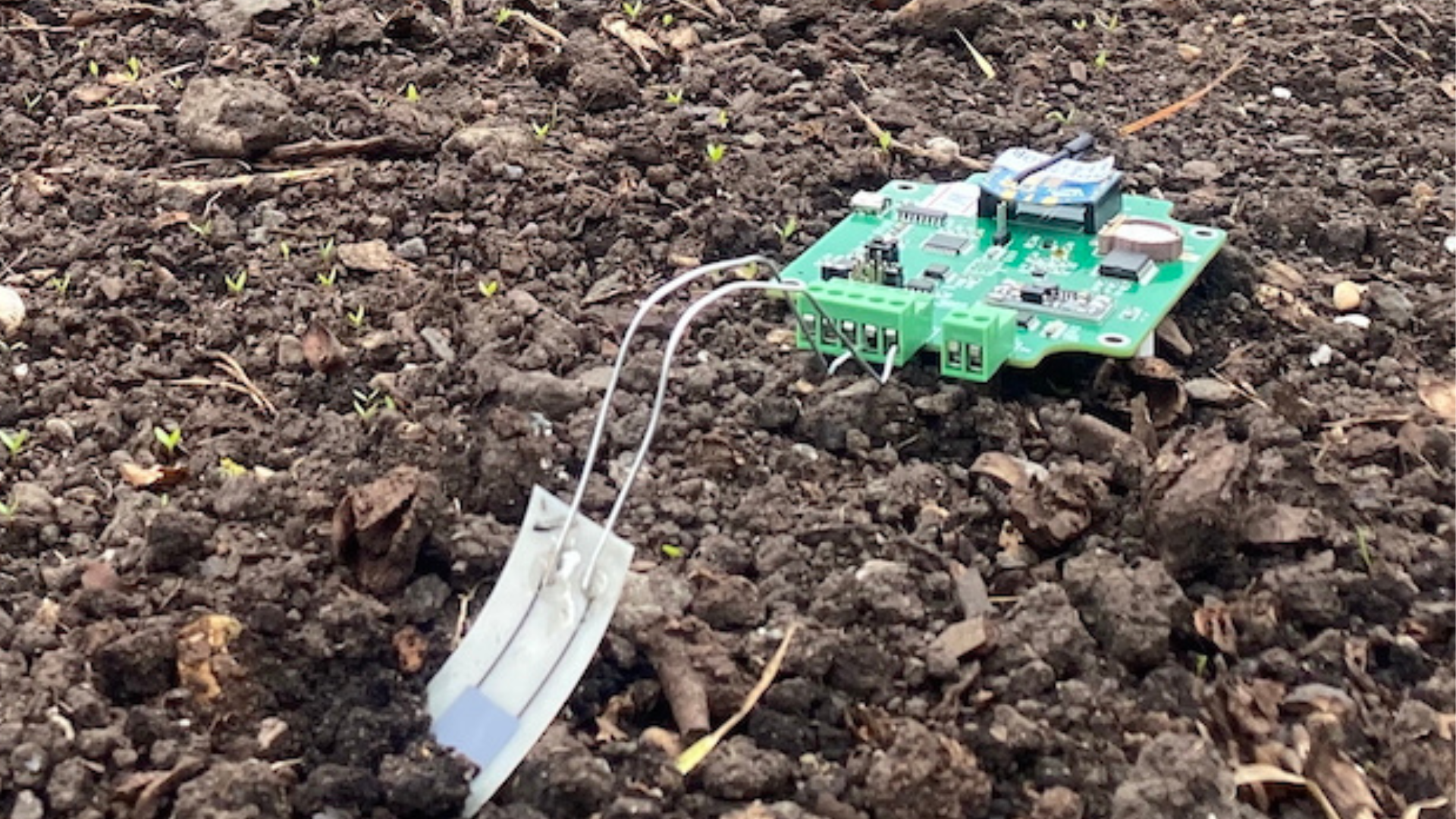
The technology addresses the urgent need for sustainable food production as global populations rise and climate change
Researchers from the University of Glasgow, a public research university in Scotland, have developed innovative biodegradable soil sensors that could revolutionise agriculture by enhancing crop yields while minimizing electronic waste.
In a press statement, the university says that these sensors, created in collaboration with the Łukasiewicz Institute of Microelectronics and Photonics, are designed to decompose into plant nutrients, effectively acting as fertilisers.
The statement adds that the technology addresses the urgent need for sustainable food production as global populations rise and climate change poses challenges to traditional farming methods.
University says that the biodegradable sensors work alongside conventional electronics to monitor crop health, significantly reducing electronic waste and enhancing the reusability of existing systems.
Additionally, the environmental impact assessments indicate that this approach improves sustainability in agricultural practices.
The statement adds that these sensors are part of a broader movement towards ‘digital agriculture,’ which utilises networked sensors to monitor crop conditions and the current sensors, typically made from non-recyclable materials, contribute to environmental harm when discarded.
The statement says that in contrast, the new biodegradable sensors can be incorporated into the soil after use, enriching it rather than contributing to landfill waste.
The university adds that the research team outlined their findings in a paper published in ACS Applied Electronic Materials, detailing a sensor that combines a biodegradable patch with a reusable electronic module and the manufacturing process employs screen printing techniques similar to t-shirt printing, making it low-cost and energy-efficient, ideal for large-scale deployment in agriculture.
The statement adds that the sensors utilise conductive tracks printed on biodegradable substrates and feature a sensing layer made from molybdenum disulfide, ensuring all materials break down naturally.
According to the statement, lab tests confirmed that these sensors reliably track soil pH levels over two weeks and can detect harmful substances like ethephon.
“Reliable food production is one of the world’s most pressing problems, with more than 800 million people around the world suffering from malnutrition today. Digital agriculture could be the key to maximising our ability to produce enough food for a growing population,” says Dr Joseph Cameron, co-author of the paper, James Watt School of Engineering, University of Glasgow.
“The system we have developed could go a long way towards cutting down the carbon footprint of digital agriculture. The sensors themselves can be ploughed back into the fields to help nurture crops, and the electronic modules with less environmentally friendly printed circuit materials can be reused for several years. Our analysis suggested that replacing the sensors once every three months could reduce the environmental impact of the system by 66 pc, and 79 pc over five years compared to disposing of the entire device each time,” says Andrew Rollo, co-author, James Watt School of Engineering, University of Glasgow.
“We urgently need to find a way to make digital agriculture more sustainable in the years to come. Currently, around 80 pc of the world’s electronics head straight to landfill once they have reached the end of their useful life, which creates massive environmental and public health challenges from the toxic materials which many of them contain. We are keen to continue expanding our biodegradable sensor’s ability to detect other key indicators of plant growth and soil health. That could include adding sensitivity to ‘forever chemicals’ like PFAs, which have significant environmental impact,” says Jeff Kettle, Professor, James Watt School of Engineering, University of Glasgow.
The statement that this research is part of the EUR 1.8 million TESLA project aimed at developing fully sustainable agricultural monitoring systems powered by solar cells and supercapacitors made from eco-friendly materials. The project involves international collaboration with institutions from Canada, Finland, Poland, and Switzerland.
