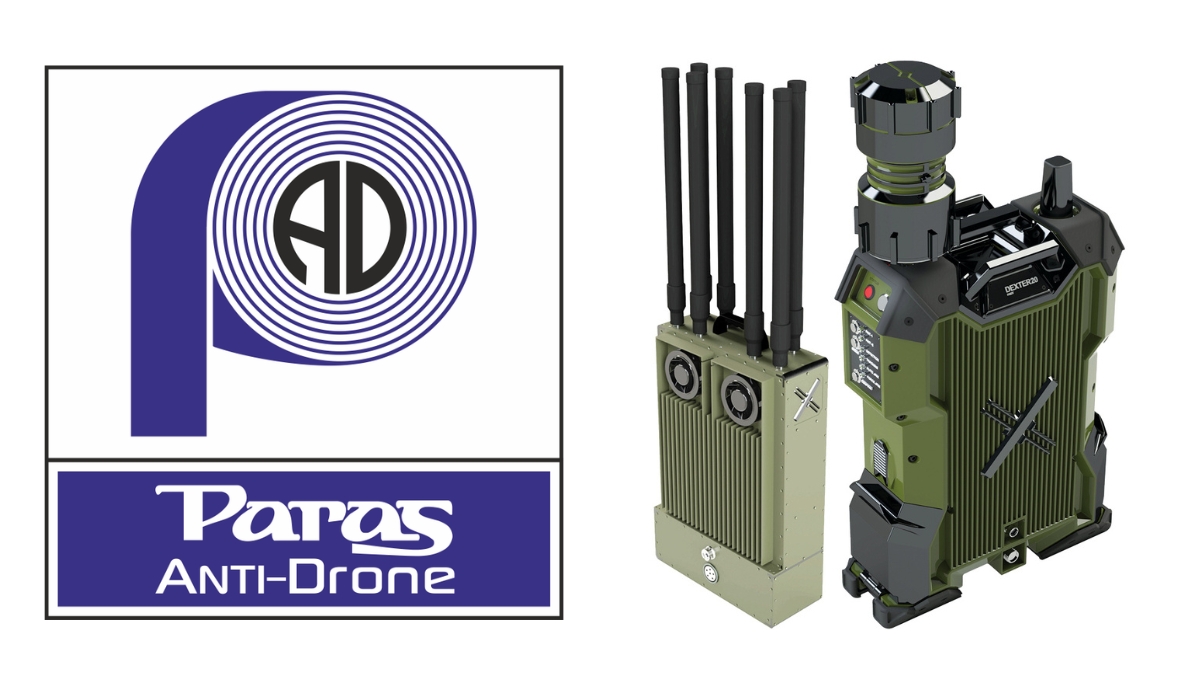
Paras Anti-Drone’s advanced counter-UAS systems are designed to tackle evolving drone threats with reliable detection, tracking and mitigation capabilities
How has your partnership with Cerbair progressed since the USD 2.2 million order announced last year?

Ashutosh Baheti
The partnership with Cerbair has progressed extremely well and has evolved into a strong example of how complementary capabilities can be combined to address rapidly evolving drone threats.
One of the most important milestones has been the successful joint development and gradual adoption of our Chimera counter-UAS technology. The initial order validated not only the technology itself but also demonstrated that counter-drone solutions developed in India can compete successfully in highly demanding international markets.
What makes the Cerbair partnership strategically important for Paras Anti-Drone?
What makes this relationship particularly valuable is that it goes beyond a conventional supplier-customer engagement. Paras brings expertise in counter-drone technologies, RF systems and threat mitigation capabilities, while Cerbair contributes operational experience, software integration capabilities and access to international markets.
This combination has helped create solutions that are both technologically capable and operationally relevant, ensuring that the systems address real-world operational requirements rather than purely technical objectives.
What have been the key achievements beyond the initial order?
One of the biggest achievements has been the growing interest in indigenous counter-UAS technologies among international customers. The response to Chimera has reinforced our belief that technologies developed for demanding operational environments in India can successfully address global security requirements as well.
This growing acceptance of Indian-developed counter-drone technologies is encouraging and reflects the increasing maturity of the country’s defence technology ecosystem.
What opportunities do you see for future cooperation with Cerbair?
Looking ahead, we see considerable opportunities for expanding cooperation across next-generation CUAS technologies, advanced RF systems and future threat-mitigation architectures.
As drone technologies continue to evolve, international collaborations that combine technological innovation, operational expertise and market access will become increasingly important in addressing emerging threats.
Also Read: MKU partners with Indonesian Republikorp to expand defence manufacturing
How important is Eurosatory as a platform for Paras Anti-Drone?
Eurosatory is one of the most influential defence and security exhibitions globally because it brings together defence organisations, government agencies, technology providers and operational users from a very large number of countries in one place.
For companies working in rapidly evolving sectors such as CUAS technologies, events like Eurosatory serve as much more than product showcases. They provide direct access to users who are dealing with real-world operational challenges and can therefore offer valuable feedback on capability requirements, deployment experiences and emerging threat trends.
How does feedback from global users influence your product roadmap?
One of the most valuable aspects of Eurosatory is the opportunity to understand how drone threats are evolving across regions. While the underlying technology challenge may be similar, customer priorities often differ between defence users, homeland security agencies and critical infrastructure operators.
What is your current focus within the CUAS ecosystem and are you moving towards fully integrated multi-layered solutions?
The CUAS ecosystem is evolving rapidly, and one of the most important developments is the growing recognition that effective drone protection requires multiple complementary capabilities working together.
Our current focus is on strengthening core counter-drone capabilities across detection, identification, tracking and mitigation. We are also working towards the development of multimodal capabilities and extending our sensor solutions. These remain the foundational elements of any effective CUAS architecture and continue to receive significant attention as threats become more sophisticated.
How are customer requirements changing in the CUAS market?
We are seeing increasing demand for solutions that can operate across different deployment environments, ranging from defence installations and critical infrastructure facilities to public venues and other sensitive locations.
This requires systems that are flexible, scalable and capable of adapting to different operational requirements while maintaining effectiveness againsta wide range of drone threats.
Also Read: Agniveer: One rank, one uniform, three paths
Are customers increasingly seeking integrated security architectures?
Different users adopt different approaches depending on their operational needs. Some may deploy standalone CUAS systems, while others may choose to incorporate them into larger security or surveillance frameworks.
Our role is to ensure that the underlying counter-drone capabilities are robust, reliable and capable of supporting a wide range of deployment models, regardless of how customers choose to integrate them.
Which international markets are showing the strongest interest in your CUAS offerings?
We are seeing growing interest in CUAS technologies across multiple regions, which reflects the fact that drone-related security challenges are becoming increasingly global in nature.
Europe has emerged as an important market for advanced counter-drone capabilities, and our partnership with Cerbair has provided valuable opportunities to engage with customers across the region.
What is driving demand in Europe and other international markets?
Growing awareness around critical infrastructure protection, public-event security and broader security requirements has contributed to increased interest in CUAS technologies.
We are also observing strong interest from markets where critical infrastructure protection, border security and airspace security are becoming increasingly important priorities.
Also Read: Forces face moral dilemma over Artificial Intelligence in defence
Where do you see the next growth wave coming from?
The next growth wave is likely to be driven by a combination of defence requirements and civilian security applications.
Airports, energy infrastructure, transportation networks and other critical assets are increasingly evaluating counter-drone technologies as part of their broader security architecture.
How much are you investing in R&D for counter-drone technologies?
Counter-drone technologies operate in one of the fastest-evolving segments of the defence and security industry. Unlike many traditional systems, the threat environment changes extremely quickly, which means innovation cannot be treated as a periodic activity. It has to be continuous.
For this reason, sustained investment in research and development is fundamental to remaining effective. We have been investing in and improving our technologies on a continuous basis.
Which areas are receiving the highest R&D priority?
Our priorities currently include enhancing detection capabilities, improving RF intelligence and mitigation technologies, strengthening situational awareness capabilities and developing solutions that can adapt to increasingly complex threat environments.
We are also focussed on improving operational flexibility so that systems can be deployed effectively across a wider range of environments and use cases.