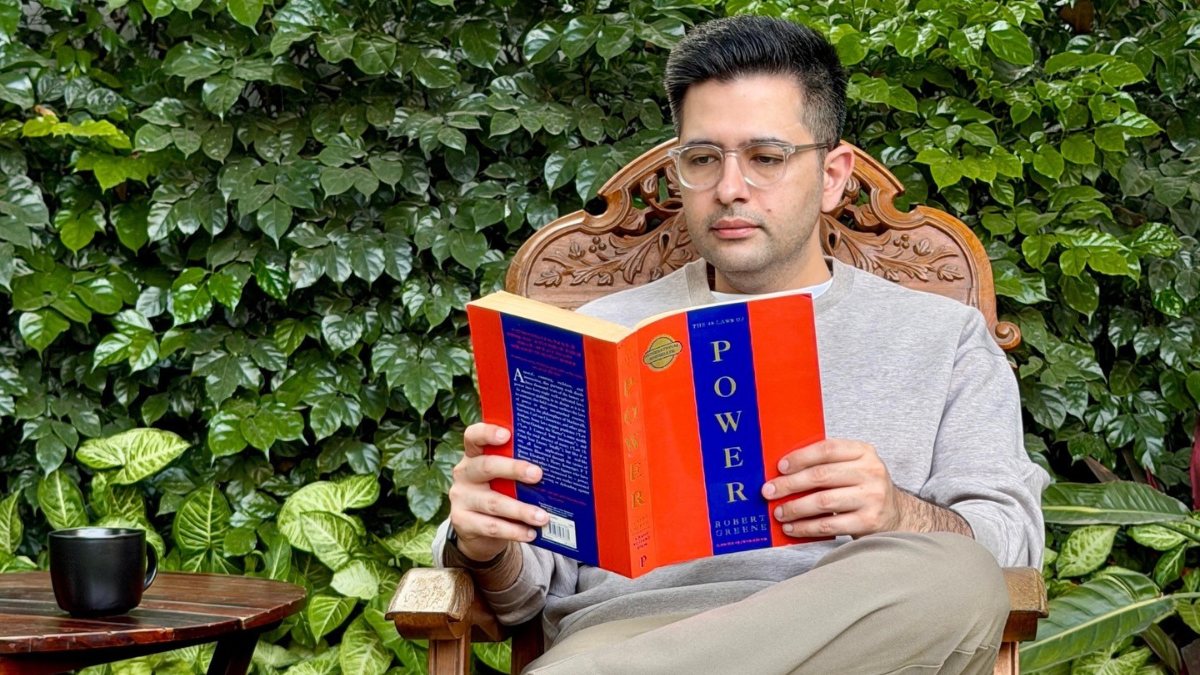
Raghav Chadha had been stripped of his platform, his party designation, and most critically his voice in Parliament (Photo: Raghav Chadha Instagram)
On the morning of April 2, the Aam Aadmi Party sent a letter to the Rajya Sabha Secretariat seeking the removal of Raghav Chadha as its Deputy Leader in the House and recommending that he should not be allotted any time for speaking from the AAP’s quota. His replacement was Ashok Mittal, founder and Chancellor of Lovely Professional University in Jalandhar, a man virtually unknown outside the corridors of the Upper House.
The move was surgical in its precision. After becoming the youngest Rajya Sabha MP in 2022, Chadha had become the party’s leader in the Upper House in 2023, replacing Sanjay Singh. Now, with a single letter, that entire arc had been reversed. Chadha had been stripped of his platform, his party designation, and most critically his voice in Parliament.
What followed in the next 72 hours was among the most publicly brutal internal party confrontations Indian politics has seen in recent years: a sitting Chief Minister calling his own MP “compromised,” a senior colleague alleging a scrubbed social media history, cryptic Instagram posts featuring a book called The 48 Laws of Power, and a young politician reduced to defending himself via reels while his party leadership dismantled his reputation in press conferences.
Also Read: BJP reclaims Delhi after 27 years: A city divided in hope & concern
Chadha joined AAP at its inception in 2012, helping draft the Delhi Lokpal Bill as a young chartered accountant barely out of his training at Deloitte and Grant Thornton. He became the party’s national spokesperson, then its youngest treasurer, then contested from South Delhi in the 2019 Lok Sabha elections and lost. But 2020 was the real turning point when he won the Rajinder Nagar assembly constituency with a margin of 20,058 votes, polling 57.06 pc of the total votes.
Then came Punjab. Chadha was largely credited with AAP’s success in the 2022 Punjab elections, when the party won 92 of 117 seats. His influence in the government remained strong until the end of 2023. He was widely regarded as Kejriwal’s most polished public-facing asset.
In Parliament, Chadha performed with consistent flair. His speeches on gig workers, mobile recharge pricing, paternity leave, and menstrual health attracted attention beyond the usual parliamentary press gallery. He was deliberate in his choice of subjects issues that played well with urban youth. After he raised the need for low-cost food at airports and the rights of gig workers, the BJP government opened 11 UDAN Yatri cafes across airports where tea is available for INR 10 and samosa for INR 20. The government also asked food delivery firms to drop the 10-minute delivery rule.
This was on-the-ground impact. But impact, in a party culture built entirely around collective loyalty, counts for less than alignment. And Chadha, it would eventually become clear, had stopped being aligned.
As Rishab Sharma, a political analyst who has tracked AAP’s internal dynamics closely, explains: “Most political parties in India tend to function like family-run enterprises, and the same is true of Kejriwal’s AAP. However, with Kejriwal largely absent from media cycles after losing the Delhi elections, a vacuum in visible public leadership appeared within the party. Chadha tapped into this space effectively. Through his commendable parliamentary interventions and focus on issues that resonate with India’s youth be it gig workers or mobile recharge costs he tapped into a broader mass appeal,” Sharma tells Media India Group.
The rupture, when it came, was not sudden. It had been building since 2024 through a series of conspicuous absences. Chadha’s sudden absence from the political scene in the run-up to the Delhi polls and during party supremo Kejriwal’s arrest in the Delhi liquor case did not go down well with the party leadership. Chadha had said he was in the United Kingdom for treatment of an eye ailment.
Also Read: Arvind Kejriwal resignation: Delhi divided on next Chief Minister
He was perceived as silent during Kejriwal’s incarceration by the CBI in the alleged liquor scam. He continued his silence when both Kejriwal and Sisodia were released in the same case, and skipped the celebratory rally and press conference, drawing fire from fellow AAP leaders.
In a party where loyalty is demonstrated through visible, public acts of solidarity appearing at rallies, signing opposition motions, walking out of Parliament in protest, these absences were not neutral omissions.
Sharma says that this rising visibility and independent personal branding may have made several leaders within AAP feel threatened, including Kejriwal himself.
“In many ways, Chadha appeared to be building a political identity distinct from the party structure. This situation highlights both the insecurities within the leadership and the broader vacuum of mass leadership in AAP,” says Sharma.
It is a damning diagnosis not just of Chadha, but of the party that cultivated him and then found itself threatened by its own creation.
Punjab factor
AAP’s victory in Punjab in 2022 was historic by any measure: 92 of 117 seats, a vote share exceeding 42 pc, the total collapse of both the incumbent Congress and the Shiromani Akali Dal. Chadha, as the party’s Punjab in-charge, absorbed enormous credit for the campaign’s organisation and strategy.
But the post-victory period generated its own turbulence. His influence in the government remained strong until the end of 2023. However, his interventions were reportedly resented by Punjab leaders, and the tables turned later, with CM Bhagwant Mann becoming the undisputed leader of the AAP camp in the state.
Harshit Mehta, a political analyst with a long focus on Punjab’s political geography, is direct in her assessment of what Chadha’s chapter in the state actually amounted to.
Also Read: Tough triangular tests await political titans in Punjab
“I don’t think there is much for the AAP to lose due to this specific Chadha incident in Punjab. Although Chadha is often credited with helping AAP win the Punjab elections and for playing a key role in running the show there for a while after the victory, he has always lacked mass appeal in Punjab. He was, in effect, operating as a super CM when Bhagwant Mann was still new to the political landscape. However, this also attracted significant criticism, with allegations of ticket-selling and other forms of subterfuge. For now, the AAP needs to be more concerned about its governance record in the state rather than the Chadha issue,” Mehta tells Media India Group.
Punjab heads towards assembly elections in 2027 and AAP’s governance record on farm debt, drug rehabilitation, fiscal sustainability of power subsidies, and management of a state carrying a massive fiscal deficit will be the real battlefield. Whatever Chadha’s contribution to the 2022 campaign, the ground-level political work of retaining Punjab’s trust will be fought by Mann. Not by a Rajya Sabha MP from Delhi who, by Mehta’s reckoning, never truly had a mass base there to begin with.
AAP MLA Atishi, who was briefly the Chief Minister of Delhi after Kejriwal stepped down following his arrest, has claimed that Chadha may join the BJP soon, suggesting the party uses a mix of tactics inducements, pressure, and temptation to poach leaders from competitors, and that perhaps Chadha was also on the verge of defection.
Watching the upheaval from the sidelines, netizens alleged that Chadha had “completely cleaned up his X timeline all his old posts critical of Modi or the BJP have disappeared and that only two posts mentioning ‘Modi‘ remain on Chadha’s timeline, and both are in praise of the Prime Minister.
Sharma says that Chadha also leveraged social media astutely. Even after his removal from the deputy leader position, he chose to respond via a reel-format video, showing his strong understanding of social media-led political communication.
The paradox is precise: the same platform that built Chadha’s political brand has now become the evidence trail dismantling it. The man who understood digital communication better than almost anyone in AAP had left fingerprints on his own repositioning.
Amid ongoing tensions with AAP, Chadha returned to social media with a curious post highlighting The 48 Laws of Power a book by Robert Greene, stressing its message, “Never outshine your superior. Always make those above you feel comfortably superior and show that you desire to impress and please them”.
In his post, Chadha wrote, “Somebody gifted me a book this week. Funny how timing works”.
The post was widely interpreted as a veiled acknowledgement of exactly what Sharma had diagnosed that Chadha had outshone his master and was now paying the price. He followed it with Bollywood-inflected declarations: Ghayal hu, isliye ghatak hu (I am hurt and hence fatal) and Picture abhi baaki hai (the film is not over yet).
Harshita Mehta, Political Analyst says that Chadha is a pawn in politics for both, AAP and BJP.
“Kejriwal gave Chadha big responsibilities but he failed to deliver. Now the chapter is over for him and AAP. His statement like Ghayal hoon, Ghatak nahin whatever, shows his immaturity,” Mehta tells Media India Group.
Also Read: Delhi’s BJP administration beyond the headlines
Over the past decade, every political rupture in India triggers the same question on whether the person, in this case Chadha, is heading to the BJP? The allegations this were explicit, the deleted posts provided circumstantial texture, and Atishi’s hints were barely veiled.
“Raghav is not a hard-core politician. BJP will avoid taking him in the party as he has no ground base. BJP prefers leaders who have their own base like Scindia, Hemanta, Narayan Rane, Neetish Rane. Raghav has nothing to gain but everything to lose after leaving AAP,” says Mehta.
Mehta says that in one line is it not possible that Chadha will join BJP? This is a calculated plan by AAP.
“Kejriwal is 100 pc smarter than Amit Shah and BJP. Chadha is educated and knows very well that the peak time of BJP is finished. So in one line, it is a Dhurandhar of AAP joining BJP. After the Supreme Court decision, Kejriwal is not defensive he is in attacking mode with BJP. He knows very well that the peak time of BJP is finished. The upcoming time for BJP will be in decline. Coming back to AAP’s strategy, AAP is very strong in Punjab, same as in Delhi in the second elections. Kejriwal’s concern is not Punjab now he is shifting his goals to the centre, especially in the next elections in Uttar Pradesh,” says Mehta.
Party insiders point out that going forward, Chadha was likely not to be formally suspended from the party to “keep him from martyr status” and would be allowed to continue as one of its 10 MPs in the Rajya Sabha unless he chooses to leave. It is not yet curtains for Chadha and politics is a strange animal that can take turns weirder than any film. As Chadha says, the film is far from over.