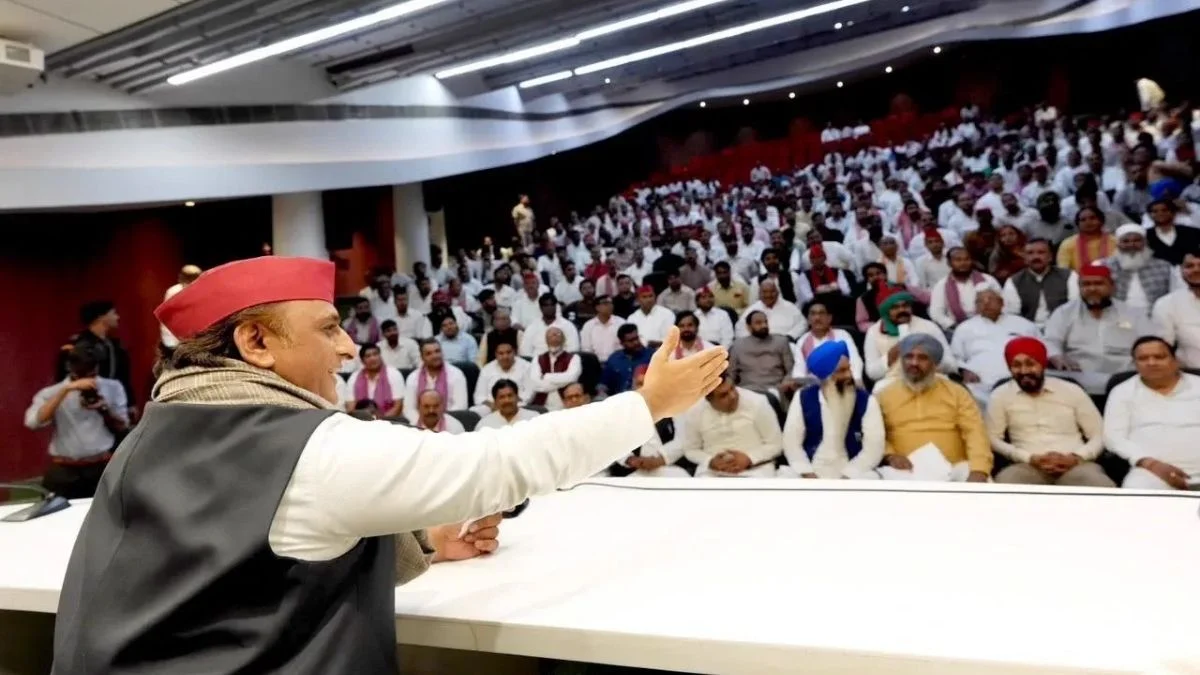
Samajwadi Party’s electoral gains in the Uttar Pradesh Legislative Council elections strengthen its position ahead of the 2027 Assembly polls (Photo: X/Samajwadi Party)
The Samajwadi Party’s (SP) performance in the October Uttar Pradesh Legislative Council elections has given the opposition party fresh political momentum ahead of the Assembly elections scheduled for 2027. Winning five seats, including the Lucknow Graduates constituency, while retaining Varanasi, has demonstrated its ability to challenge the ruling Bharatiya Janata Party (BJP) in constituencies considered politically significant.
The results have also raised questions about the BJP’s organisational strength, the durability of the SP’s PDA (Pichhda, Dalit, Alpsankhyak) social coalition and the ability of opposition parties to maintain unity.
For the SP, the results offer encouragement following its performance in the 2024 Lok Sabha elections, when it won 37 seats in Uttar Pradesh. The party will have to consolidate its traditional support base, attract voters beyond its established constituencies and manage competing political interests within the opposition.
Praveen Rai
Praveen Rai, Political Analyst at the Centre for the Study of Developing Societies (CSDS), an autonomous, non-profit social science and humanities research institute based in New Delhi, believes the Council results reaffirm the SP’s position as the principal challenger to the BJP in the state.
“The results show that the SP continues to be the main political competitor to the BJP. They also vindicate that its success in winning 37 seats in the 2024 Lok Sabha elections was not a bolt from the blue. I believe the party has established itself as one of the principal contenders for the 2027 Assembly elections. However, its chances will depend on the chemistry and arithmetic of electoral alliances and how strongly the issues raised by these alliances resonate with voters,” Rai tells Media India Group.
Also Read: Ahead of general elections, a spree of political biopics line up on big screens
Rai, however, cautions against interpreting the Council results as evidence of a major shift in the SP’s overall support base. The electorate participating in MLC elections, particularly graduates and teachers, does not reflect the demographic composition of voters in Assembly constituencies.
“The voters who elect MLCs do not mirror the demographics of the electorate in Assembly seats, so it is difficult to identify perceptible changes in the SP’s overall support base from these results. However, I believe they broadly indicate that the PDA alliance of Backward Classes, Scheduled Castes and minorities remains intact for the party,” he says.
The PDA formula has been central to Akhilesh Yadav’s strategy of expanding the SP’s reach beyond its traditional Yadav and Muslim support base. Its success in the 2024 Lok Sabha elections strengthened the party’s confidence in this social coalition. However, maintaining this combination across the state’s diverse Assembly constituencies will be a different challenge.
Rai points out that while the results have energised the SP, the BJP continues to enjoy considerable political confidence in the state. “The results indicate that Yogi Adityanath’s government continues to instil confidence and remains the first choice of voters in Uttar Pradesh. However, the BJP could face local anti-incumbency sentiments in a significant number of Assembly constituencies. The SP has gained encouragement from these results, but it still faces an uphill task in consolidating PDA votes and attracting Hindu voters away from the BJP to cross the electoral threshold required to win the state,” he says.
He believes the SP must avoid complacency after its recent victories, strengthen caste alliances and address the perception of being a party primarily associated with Muslim politics.
Also Read: Election Commission in the dock over Bihar Elections 2025
Alliance management remains a major test
Beyond the BJP, the SP faces challenges within the opposition camp. Its understanding with the Congress, the efforts by the Bahujan Samaj Party to reclaim Dalit voters and the emergence of other political players seeking greater representation could complicate the party’s electoral calculations.
Bilal Sabzwari, a senior journalist and political analyst, and a visiting faculty at AJK MCRC, Jamia Millia Islamia, a leading university in Delhi, says that the 2027 Assembly elections will test Yadav’s ability to turn the PDA formula into a broader political alliance at the grassroots level.
“I do not see the 2027 elections as merely a contest between the SP and the BJP. Yadav’s challenge is to bring together OBCs, Dalits and minorities under the PDA formula while building a strong social alliance on the ground. The 2024 Lok Sabha elections demonstrated the potential of opposition unity and social consolidation, but the political calculations for Assembly elections are much more complex,” Sabzwari tells Media India Group.
Bilal Sabzwari
Sabzwari points out that the SP will have to balance the ambitions of several political players while maintaining its alliance with the Congress. The Congress is seeking a greater share of seats, while the BSP is attempting to rebuild its Dalit support base. Asaduddin Owaisi, leader of AIMIM, a regional party, is raising questions about Muslim political representation, while Chandrashekhar Azad, a Dalit leader, is seeking to establish a stronger independent position in Dalit politics, particularly in western Uttar Pradesh.
“These developments make Yadav’s task more complicated. He has to manage different political ambitions, maintain opposition unity and ensure that internal disagreements do not benefit the BJP. The political and legal situation surrounding Azam Khan, a controversial Lok Sabha MP, also remains important, particularly because of its implications for the SP’s representation among Muslim voters and its position in Rampur,” he says.
The departure of Jayant Chaudhary’s Rashtriya Lok Dal (RLD) from the opposition camp to join the BJP-led alliance has also altered the SP’s traditional political calculations in western Uttar Pradesh. Farmers concerns, Jat-Muslim relations and the representation of backward communities are likely to remain important factors in the region.
Nevertheless, Sabzwari believes the SP has opportunities to strengthen its position. Its efforts to reach non-Yadav OBC communities and non-Jatav Dalit groups, along with its emphasis on social justice and the caste census, provide the party with a foundation to expand its support.
Also Read: Subsidy promises in Indian elections: Freebies or empowerment?
While the MLC results have given the SP an opportunity to question the BJP’s electoral management, they do not necessarily indicate that the ruling party is heading towards defeat in 2027.
Ashik Gosaliya, an independent analyst specialising in geopolitics, geo-economics and strategic affairs views the results primarily as a setback for the BJP’s political narrative rather than a reliable indication of the Assembly election outcome.

Ashik Gosaliya
“The MLC results have exposed weaknesses in the BJP’s electoral management, particularly its inability to meet its reported target of eight seats. The SP’s victories in Varanasi and Lucknow carry symbolic significance because of their association with Narendra Modi and Yogi Adityanath. However, I would not interpret these results as a state-wide electoral trend. Council elections involve restricted electorates and provide insights into local mobilisation, candidate selection and organisational efficiency rather than the voting behaviour of the entire population,” Gosaliya tells Media India Group.
Gosaliya also identifies the Ram Temple donation controversy and the SP-Congress alliance as factors that could influence the political contest. He believes the controversy surrounding alleged misappropriation of temple donations and the subsequent Special Investigation Team (SIT) investigation could create a credibility challenge for the BJP.
On the opposition side, he sees seat-sharing as a potential source of friction. “The SP-Congress relationship will be a decisive variable. Their coordination delivered substantial gains in the 2024 Lok Sabha elections, but Assembly seat-sharing is a different challenge. If the Congress pushes for more than 100 constituencies, Yadav could face pressure to give up seats where the SP has stronger local prospects. Without effective vote transfer and organisational coordination, the alliance could undermine its own potential,” he says.
Gosaliya also expects the BJP to face anti-incumbency in some constituencies, particularly in Ayodhya, Gorakhpur and parts of eastern Uttar Pradesh. However, he does not consider a BJP defeat likely under the present political configuration.
“Despite the political damage reflected in the MLC results, I consider a BJP defeat at the state level unlikely under the present circumstances. My projection is 272–290 seats for the BJP-led National Democratic Alliance (NDA), although this will depend on opposition coordination, the BSP’s electoral role and the effectiveness of BJP’s candidate selection. The MLC results have damaged the BJP’s political narrative, but whether that damage translates into an Assembly defeat is an entirely different question,” he says.