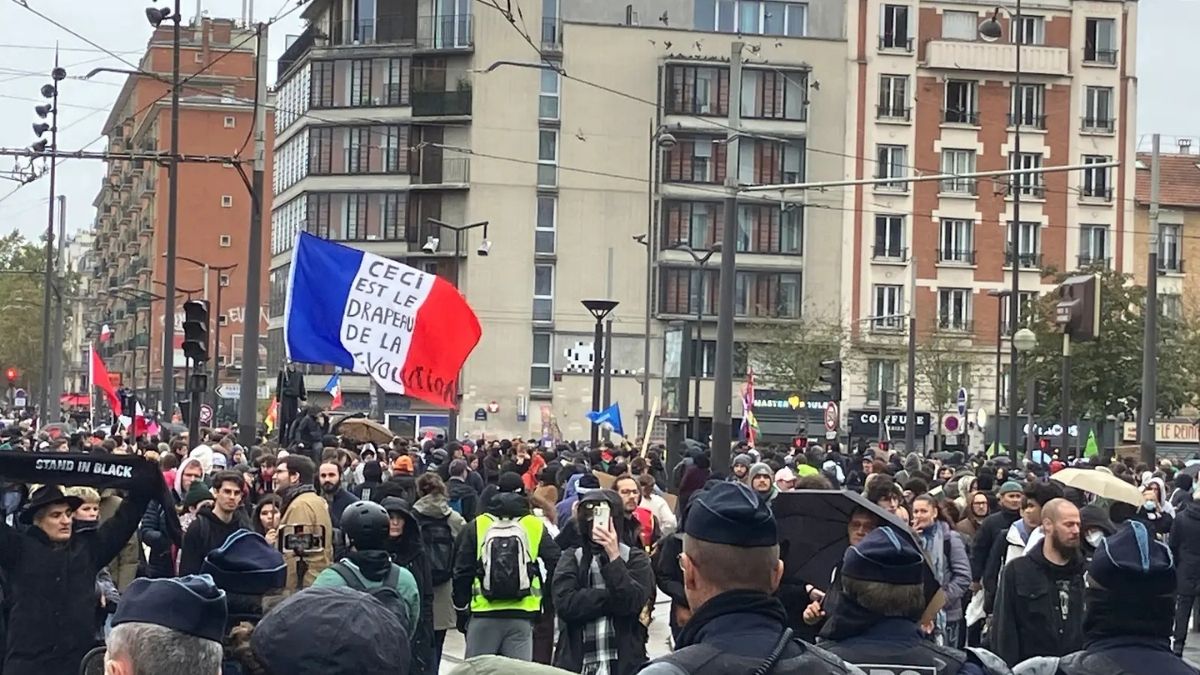
Demonstrators march through a French city as public frustration grows over government spending priorities, social welfare and economic inequality (Photos: Media India Group)
Europe is heading for yet another prolonged winter of discontent as protestors have been gathering on streets across the entire European Union region, with several protests descending into unprecedented violence, such as in France, Belgium, Italy, Spain and Portugal.
Many commentators and politicians have been quick to pin the violence and the entire series of demonstrations that have gripped several countries in the region simultaneously, blaming the rising number of migrants (read Muslim migrants) in EU. Some others On the other hand, conspiracy theorists have dreamt up a conspiracy mounted by ‘foreign hands’ against the EU using the migrants to destabilise the region and lead to a civil war.
However, most of the problems of the EU are totally home grown and long-term, preceding the so-called ‘invasion of Europe by Muslim migrants’. The European Union has traditionally been and projected itself as one of the most equal societies in the world, with high spending on education, health, housing and social welfare, paid for in most part by taxes, corporate and individual.
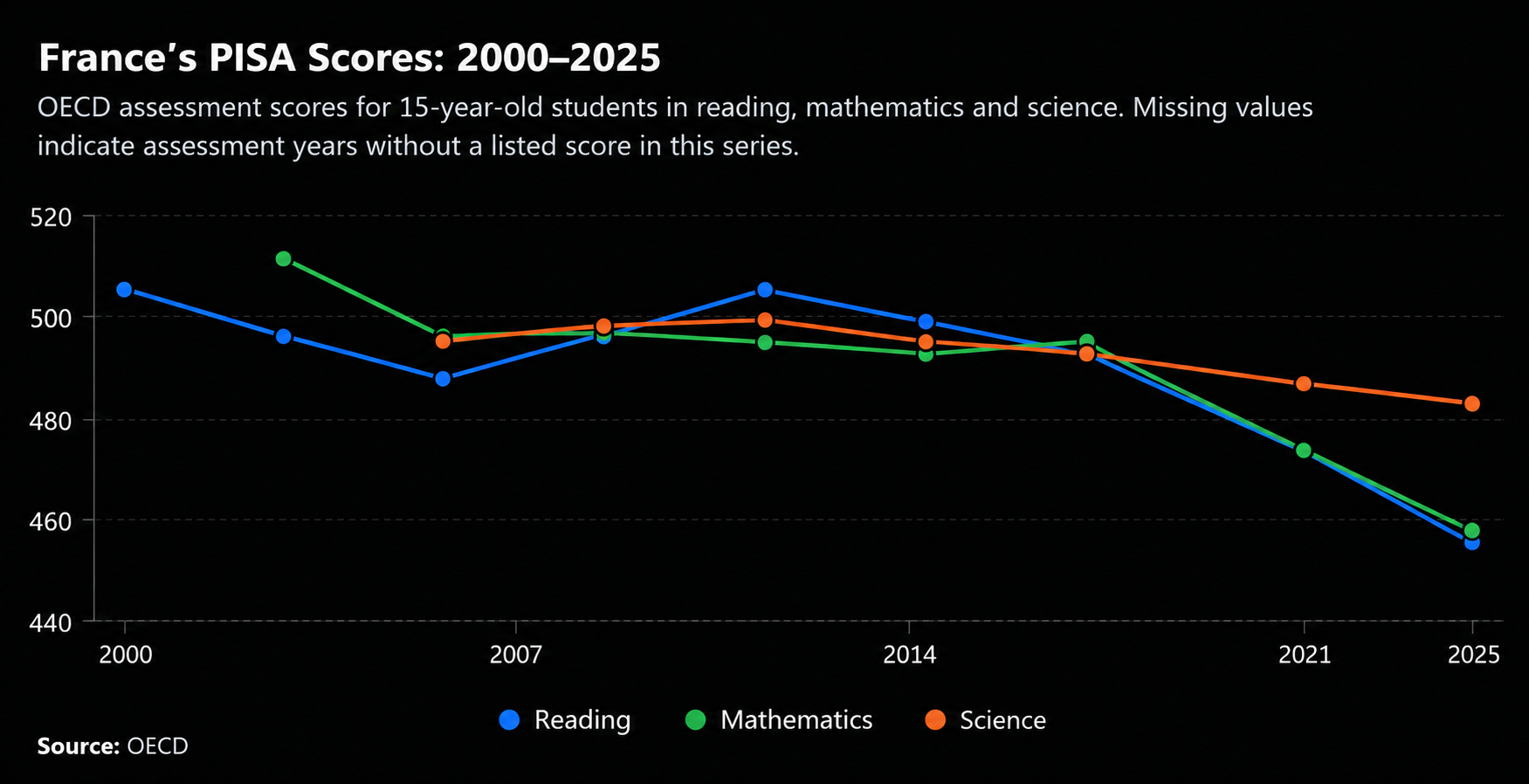
OECD PISA scores show declining reading, mathematics and science performance among French 15-year-olds
However, ever since the economic crisis of 2009, the EU leadership seems to have lost its way and adopted a rather Americanised eonomic policy, cutting government spending across board and cutting or abolishing taxes on businesses and the wealthy that constitute an upper niche of the society.
The protestors are mainly mobilised against these economic policies that have seen spending cuts across education, health, housing as well as widespread unemployment and sharply rising inequality.
Take France, for instance. The country accused of being the most ‘cushioned’ for its people and migrants, has seen its budgets for a variety of sectors cut sharply. In education, the French government has historically spent about 5.5 pc of the Gross Domestic Product (GDP) on education. However, in the past decade, the share has fallen consistently and this year it is pegged at 4.4 pc as per the World Bank.
This cut in funding has led to a severe deteriation in the quality of education, which itself is borne out by the latest PISA tests, that measure members of the Organisation of the Economic Cooperation and Development (OECD), which show that the performance of 15-year-old students in France has dropped to its lowest level since the assessment began in 2000.
Similarly, the government expenditure on housing and community amenities in France has declined from 1.9 pc of GDP in 2010 to around 1.4 pc currently.
The picture for healthcare is even more dramatic as France is facing a huge deficit in healthcare and social security due to its ageing population and declining share of working population. France spends about 31 pc of its GDP in social security and healthcare. The number of beneficiaries, both due to retirement as well as unemployment, has increased, while the number of contributors has declined rather rapidly.
In 2010, France had approximately 1.8 working contributors per 1 retiree and this year, the ratio of active workers to retirees in France is approximately 1.7 active workers per retiree, with roughly 17.4 million retirees. This ratio has fallen sharply over the decades, down from about 3.1 active workers per retiree in 1970 and 2.6 in 1990. Projections by the government say that the ratio could reach about 1.62 active workers per retiree by 2070.
According to the World Bank’s Old-Age Dependency Ratio in 2010 stood at about 25.9 pc, meaning just under 26 people aged 65 or more for every 100 people aged 15–64 years.
This year, the ratio of older dependents to the working-age population has risen to over 40 per 100 working age persons, and according to some estimates it is as high as 62 or more than double the ratio barely 15 years ago.
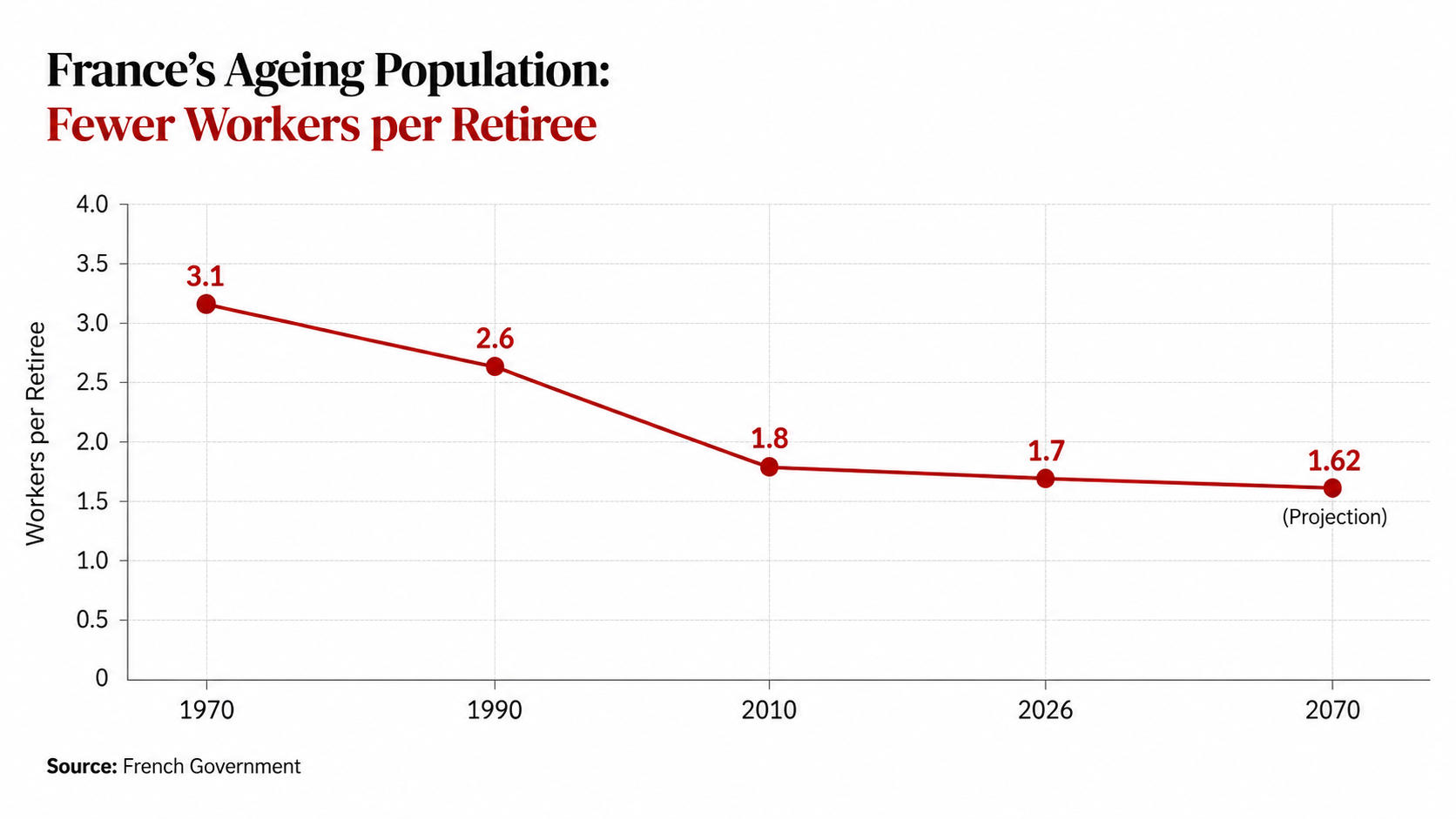
France’s active workers-to-retirees ratio has fallen from 3.1 in 1970 to 1.7 in 2026 and is projected to drop to 1.62 by 2070
All of these changes hurt the average French citizen, irrespective of race, religion or country of origin. And to make the situation worse, while the government, notably that of President Emmanuel Macron, has cut social spending across board, it has also abolished wealth tax and cut other taxes on wealthy and businesses, leading to high degree of dissatisfaction which has been highly visible for the past several months.
Moreover, each year the government has been weilding the axe on its spending pointing at high deficit, which was about 5.1 pc of its GDP last year, the highest in Europe.
France is not alone in this situation. Governments across the EU have largely followed the same policies, leading to similar problems in various societies and nearly identical reactions by their citizens.
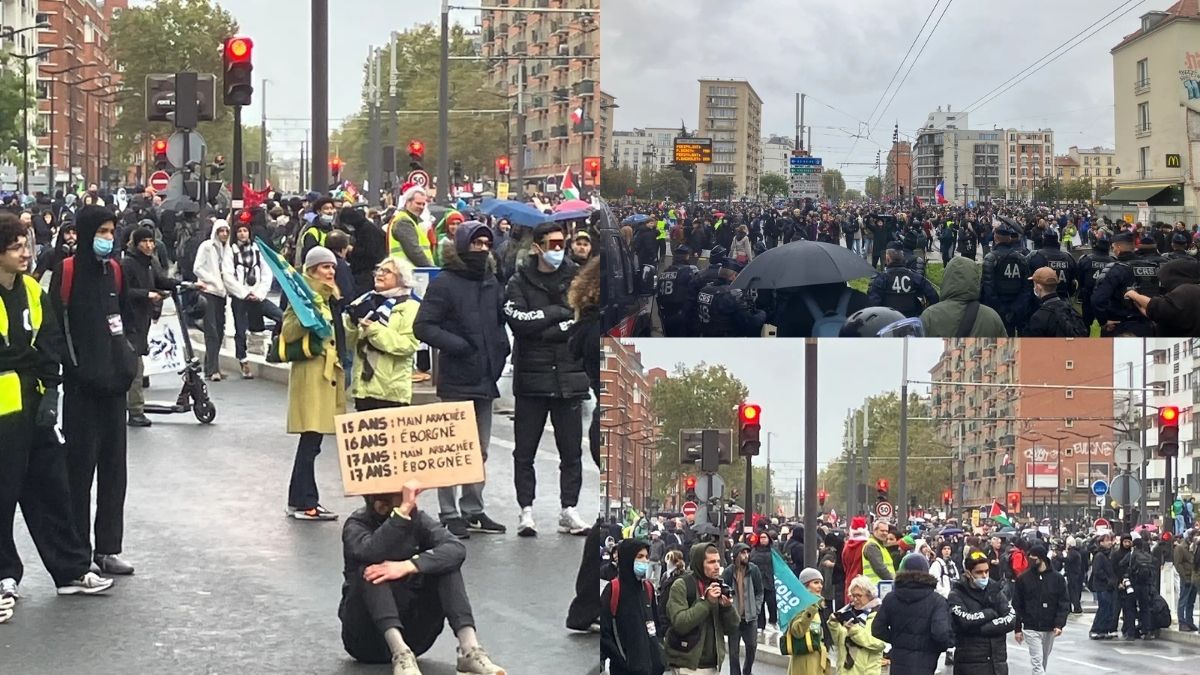
Protesters gather on the streets of Paris amid growing public discontent over economic policies and the rising cost of living across Europe
While the EU leadership has been crying hoarse about cutting costs to balance the budget, it has not shied away from funding a largely fruitless conflict that has been going on between Ukraine and Russia since February 2022. In the past four years, the EU nations combined have spent over EUR 232 billion in financing Ukraine, with a large chunk of it devoted to arming the nation. The EU support has continued even though the there is little verification of how Ukrainian President Vladimir Zelenksy has been spending this largesse, amidst serious accusations of widespread corruption.
Moreover, the Ukraine conflict has also led to record high energy prices in the EU nations, once again hitting the poorest and most vulnerable sections of their societies the hardest. Even though there have been several protests by locals in many countries against their governments financing Ukraine at the cost of their own citizens, there is little certainty over how long will EU continue in this mindless exercise, whose gains from a European citizen’s perspective stand at zero.
Instead of finding faults with students or laying the blame at the doorstep of the migrants, the EU leadership will do well to look inwards at their own policies and change their course of action at the earliest. Once they acknowledge the source of the unrest and begin to address it, only then can they even hope to restore peace and order. Else, they need to be prepared for incessant social tensions, with no gains for any, notably the most vulnerable.