
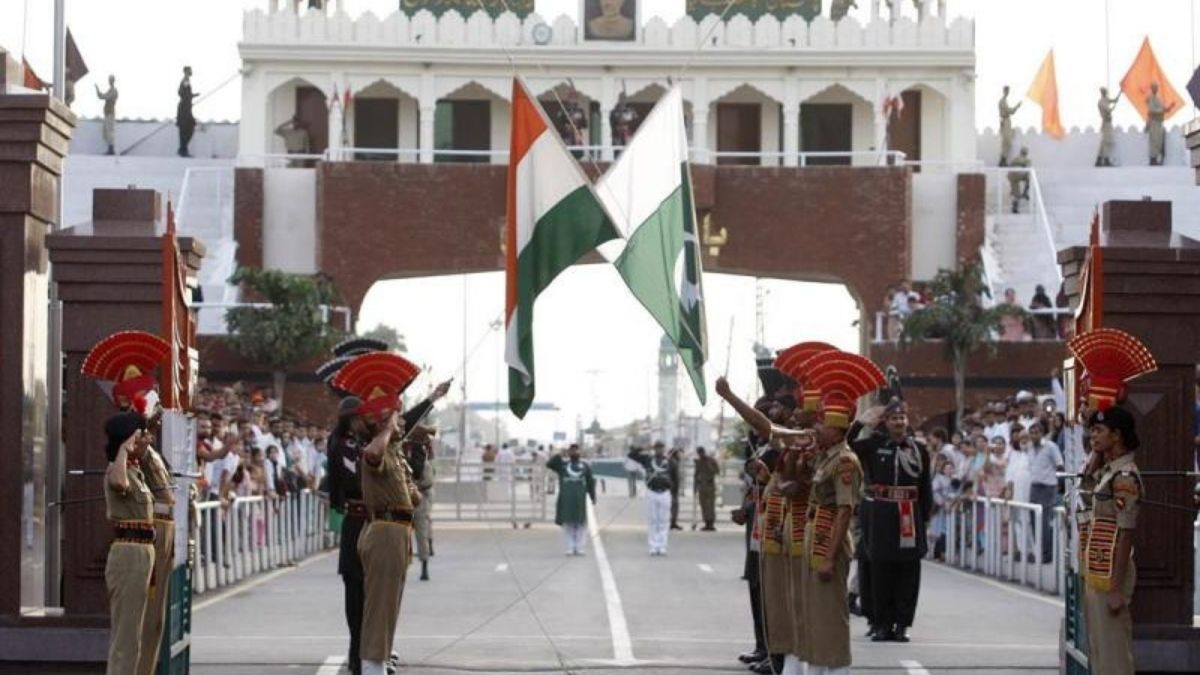
Attari-Wagah border near Amritsar, where India’s BSF and Pakistan Rangers perform the joint military drill (Photo: India Cine Hub)
Just recently, India and Pakistan, twins separated by birth, celebrated their respective Independence Days. Celebrations of 80 years of independence have been accompanied by questions of what has changed and what hasn’t. One thing that certainly hasn’t changed is the state of Pakistan’s hostility towards India.
For eight decades, a narrative of perpetual hostility towards India has shaped Pakistan’s foreign policy, that is frequently reactive and confrontational. This may have emanated from domestic political compulsions of upping anti-India rhetoric, but in the real world, they have profound implications for Pakistan’s relations, and not just with India. The effects of this narrative are visible in Pakistan’s conduct within multilateral forums.
Post the Pahalgam terror attack last year, India-Pakistan relations have dipped to an all-time low with zero diplomatic engagement. In the aftermath of the attack, India’s decision to place the 1960 Indus Waters Treaty (IWT) in abeyance serves as a critical geopolitical turning point and a stark lesson for Pakistan regarding its long-term national security, environmental strategy, and foreign policy, and a major diplomatic and security bargaining chip to pressure Pakistan into stopping cross-border militancy. Pakistan can no longer assume that decades-old treaties are permanent or safe from geopolitical retaliation.
Also Read: Indus Water Treaty: Why terrorising Indus water won’t help Pakistan
Pakistan is entering a critical phase that could define its relevance and trajectory over the next decade. The challenges it faces today, political instability, economic distress, and rising internal pressures, are precisely the challenges that it has faced every year right from 1947.
But maybe it is time for the Pakistani political and military establishment to review what this confrontation over 80 years has really achieved for Pakistan and its people and whether it is not the time for a reset in its ties with India, especially for the sake of its people.
But the reset will be anything but easy. First and foremost, it must overcome a stiff, almost existential opposition from Pakistan’s powerful military which has falsely projected India as the single biggest danger to Pakistan and its existence since 1947. Every time, the Pakistan military establishment has seen its elected governments move to normalise ties with India, it has staged a coup d’etat and put the politicians in prison. This story has been repeated so often that it is now almost programmed into Pakistani military’s SOPs!
Yet, the task of improving ties with India can perhaps be delivered only if there is a fundamental shift in Islamabad’s security and diplomatic framework. As India and Pakistan remain locked in a deep freeze in their relations, how to cut the Gordian knot in the worsening ties with India and how to reap the moment in seeking a plausible breakthrough will therefore require sensibility, flexibility and diplomatic skill by Pakistani government.
When India carried out a military operation in May 2025, following the Pahalgam terrorist attack, Pakistan realised its nuclear deterrent had failed to deliver security. Instead, nuclear weapons have emerged as a problem for the country as their presence constrained Pakistan’s response options by introducing constant risk of misperception and inadvertent escalation.
Economic warfare
While the political and diplomatic relations between the two nations have suffered, the brunt of worsening of ties has been taken by the bilateral trade, which has plummeted since 2019, following Pakistan’s suspension of trade relations and India’s withdrawal of “Most Favoured Nation” status, increasing import duties on Pakistani goods to 200 pc. Ironically, both countries continue to trade indirectly through third countries such as the United Arab Emirates, with India exporting an estimated USD 1.2 billion in goods and services to Pakistan last year, while USD 3 million in of Pakistani exports went in the other direction.
Official direct trade between India and Pakistan is severely restricted and near zero following major diplomatic freezes and import bans enacted in 2019 and tightened further in 2025. While bilateral trade once neared USD 3 billion, formal commerce is now largely limited to vital humanitarian exemptions like specific pharmaceutical raw materials. Experts estimate billions in goods, up to USD 10 billion annually, continue to move indirectly. Products are rerouted through third-party transshipment hubs like Dubai, Singapore, or Colombo with altered paperwork.
Also Read:UK-India FTA: A triumph for bilateral trade diplomacy
Changing dynamics
Pakistan’s rivalry with India now is no longer just territorial or ideological, it is also psychological. The Pakistani military has long projected the rivalry against Indians as being driven by a deep sense of being “wronged” at the time of partition, the corollary being a “desire” to compete with and trump Indians at any cost. It is this bitterly competitive urge and provocative thinking that drives Pakistan’s military establishment to ignore India’s obvious demographic, economic and military supremacy and project themselves as equal rivals.
For last nearly eight decades, Pakistan was the fixed axis of India’s strategic consideration but with China becoming New Delhi’s primary economic, security and strategic concern, Pakistan is no longer the organising principle of Indian foreign policy. In fact, India is using its diplomatic skill on reinventing ties with Bangladesh and other neighbouring countries. Pakistan may have lost India’s strategic focus, and core neighbourhood foreign policy priority but India cannot afford to see Pakistan becoming a failed state and allow it to evolve as strategic threat especially as India’s primary northern and long-term strategic competition is firmly anchored on its border disputes with China.
Contrary to what many people would like to believe, Pakistan is not of much significance as far as the broader public discourse in India is concerned. Following Operation Sindoor, India has largely shifted from active hostility to a deliberate policy of strategic indifference toward Pakistan, treating Islamabad as a residual, secondary challenge rather than the core organising principle of its foreign policy mechanism. New Delhi prioritises broader global ambitions and managing its competition with China over bilateral engagement with its western neighbour.
Mistrust between the two nations is so deep that even if Pakistan were to offer reconciliation, India would hesitate as it has had bad experiences earlier. Sadly, nothing appears to have changed in Pakistan in these years. Often portrayed as the “core issue” between the two countries, Kashmir is, in fact, a proxy, a canvas upon which Pakistan projects its anxieties, ambitions, and unresolved traumas. The demand for Kashmir is not driven by demographic realities, economic interests, or strategic logic. It is driven by a need to avenge Partition, assert Islamic triumphalism over India, and claim moral victory for the very idea of Pakistan.
Also Read: With focus on FTA, redefining EU-India partnership
Improving ties with India therefore will require Pakistan to shift its core security policies, specifically by taking verifiable actions against cross-border militant groups and moving past the deadlock over the 2019 revocation of Jammu and Kashmir’s special status. Refusing to accept the new reality will not help Pakistan and as its diplomatic space is shrinking, it must revisit its India policy and use the available window to rebuild ties with India. While Pakistani leadership has occasionally signalled openness to dialogue and renewed trade, India maintains a firm stance that formal talks cannot happen while terrorism persists.
Can Pakistan cut the proverbial Gordian knot to bring a paradigm shift in its relations with India, or it will vanish in the past. Sanity demands that Pakistani leadership must understand that its hostile policies toward India only hit the people of Pakistan and how it must cut the Gordian knot in the worsening of Indo-Pak ties and seek a plausible breakthrough to defreeze its ties with India.
The good news for Pakistan is that some Pakistanis policy makers, thinkers and strategists have increasingly been talking of the need to reach out to India and reconnect or recouple its economy with India’s. They can also take heart from the fact that despite the deep freeze in the bilateral ties, India has kept a window of discussions and negotiations open in the form of Wagah Border near Amritsar which remains the only place in the long land border where the two nations keep an eye-to-eye contact and which can be used for a much-needed breakthrough and put the derailed ties back on track. The bad news is that there aren’t many takers for this advice in the Pakistani establishment, notably the military.
Even if India were to show some flexibility, there is little reason to believe that Pakistani establishment would end hostility towards India – simply because the ideological compulsion would not allow it. As such, reimagining India softening its policy on Pakistan is hard and India rethinking moving fast is even harder.
(Sunil Prasad is the Secretary General of Brussels based Europe India Chamber of Commerce. The views expressed here do not necessarily reflect those of Media India Group.)
