
A string of recent incidents has reignited the debate around civic sense among Indian citizens, both at home and abroad
They say cleanliness is next to godliness, but for many, that wisdom seems to have faded into the background. A string of recent incidents has reignited the debate around civic sense among Indian citizens, both at home and abroad.
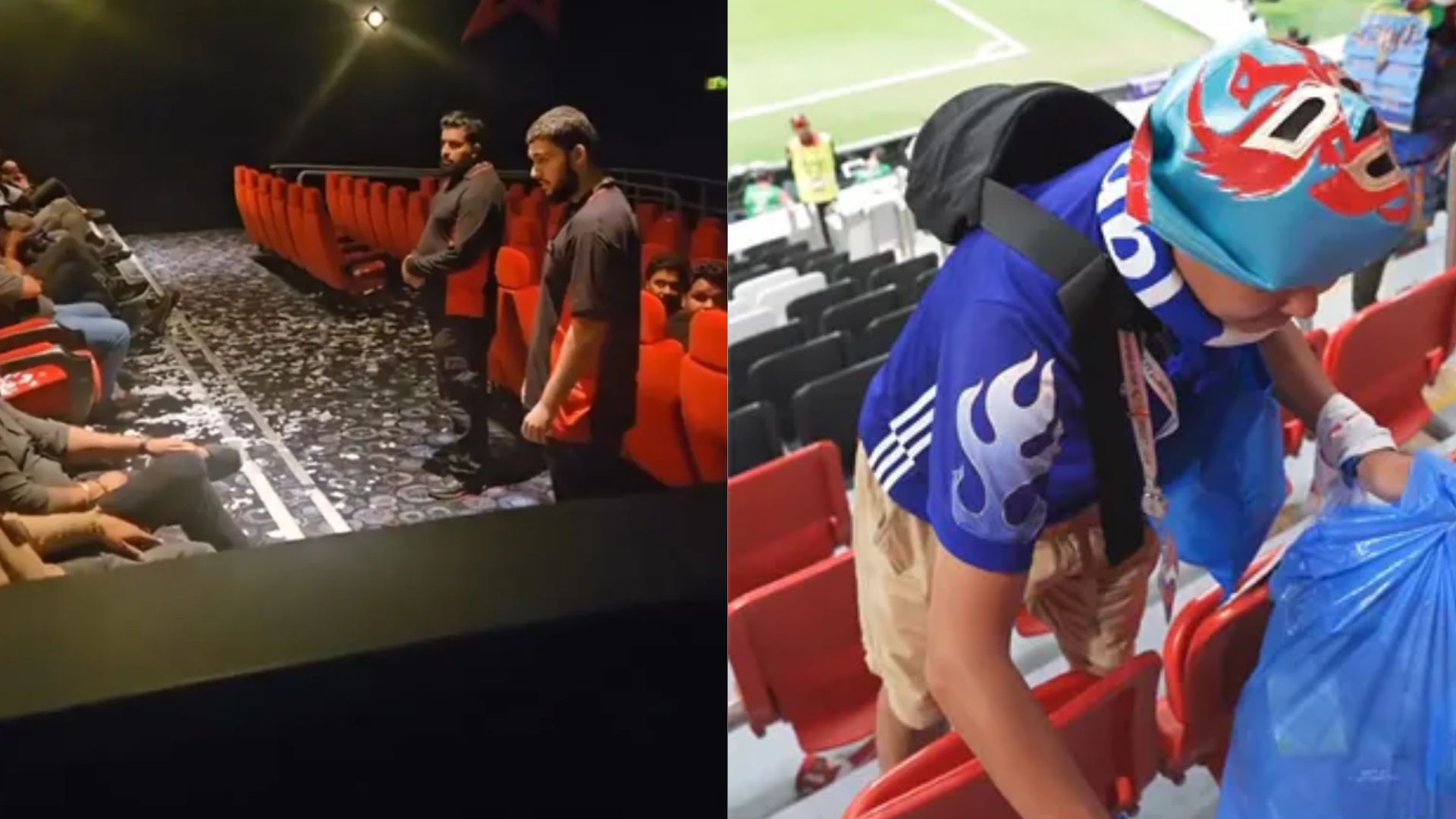
In July, a screening of an Indian film at a Cineworld theatre on July 26 in United Kingdom (UK) was abruptly halted after audience reportedly left behind a trail of trash. A video that has since gone viral shows cinema staff confronting a group of Indian-origin moviegoers, as confetti and litter covered the floor.
In the footage, two men are seen arguing with the staff, refusing to apologise for the mess. One of them defends the action by saying, “If you had put up a sign outside, we would not have done that.” The staff member’s sharp response “So, basically, you are saying you do not have common sense?” has since echoed widely across social media, sparking criticism and concern.
This is not an isolated episode. From Himachal Pradesh’s Kangra district, another video has been making the rounds, showing a foreign tourist doing what many believe should be second nature, picking up plastic waste near a scenic waterfall.
As the tourist collects wrappers and discarded bottles, a group of Indian visitors is seen sitting nearby, making no attempt to help. “I sit up here and ask people to pick them up. I do that! I have no problem cleaning here,” the tourist says in the video.
The clip has triggered a storm of reactions online. One X user commented, “Shameful that a foreigner is more concerned about preserving nature’s beauty, while our own people continue to litter. This is not the government’s fault, it is ours. We need to change if we ever want a truly clean country.”
Psychology behind absence of civic responsibility
As such incidents continue to surface, another video is also going viral, this time showing an Indian man calling out the behaviour of his fellow countrymen in public spaces. Captured by Instagram user Ankush, the clip shows an incident at the lounge of Abu Dhabi Airport. In it, an Indian man is seen talking loudly on the phone. Despite being told by the bartender to lower his voice, the man continues undeterred. Ankush expresses his frustration and questions the lack of civic sense among Indians, claiming he has witnessed similar incidents that reflect a broader insensitivity in public behaviour.
He goes on to compare this with what he has observed in countries like the United States and South Korea, where loud public conversations are uncommon and greater value is placed on maintaining decorum in shared spaces.
In response to these incidents, many have shared their views on why civic sense is often missing. According to Rumaisa Lone, a customer executive at Teleperformance, a French multinational company, the problem begins from childhood.
“I think a big part of it comes down to how we are raised. At home, we are taught to keep our own spaces clean, but no one really tells us to treat public spaces the same way. There’s this mindset of ‘yeh mera thodi hai’, so people just do not feel responsible. And honestly, basic civic habits like not littering or standing in queues are not really enforced when we are growing up. To be fair, when people see that the system itself is not working, like there are no dustbins around or the public toilets are filthy, they feel like, ‘What is the point of even trying?”, Lone tells Media India Group.
She adds that the absence of a sense of community also plays a significant role in reinforcing the lack of civic responsibility among Indians.
“It is like we have a split personality, our homes are spotless, but just outside the door, there is garbage. Psychologically, I think we do not really see public spaces as ours. There is a lack of community feeling. Maybe we have just grown up seeing chaos outside and accepted it as normal. And then there is this attitude of, ‘What difference can I make alone?’ So, no one bothers,” adds Lone.
However, Anubhav Chauhan, a final-year MBBS student at Noida International Institute of Medical Sciences (NIIMS), believes that the absence of civic education in schools has played a major role in the lack of civic sense among Indians.
“Indians, in general, have just gotten used to not having basic civic sense. I think the biggest reason is that it is never taught in schools. If we start teaching civic habits from a young age, like they do in Japan, it could really make a difference. Also, people who do not basic civic rules should be penalised. There has to be some accountability,” Chauhan tells Media India Group.
These behavioural patterns don’t just spark criticism at home, they have also led to reputational fallout internationally.
In several popular tourist destinations like Bali, Vietnam, and parts of Europe, Indian travellers have reported facing subtle discrimination due to past incidents involving other Indian tourists. In some cases, hotels and tour operators have been known to avoid bookings from Indian groups, citing repeated experiences of noise, littering, or rule violations.
Even well-behaved travellers often find themselves burdened by these stereotypes, going out of their way to prove they are “different.” Online forums are rife with complaints about Indian guests being treated with suspicion or given less priority. Viral videos of Indians littering, behaving rudely, or ignoring local customs only reinforce these negative perceptions, ultimately hurting the experience of Indians abroad, and damaging India’s global image in the process.
“When such lack of manners is displayed abroad, we create an extremely poor image of our country. As a result, this gets tagged to us universally and takes it is own toll on our reputation, creating a general perception among global countries, that Indians are filthy and dirty,” adds Chauhan.
Lessons from Japan
In sharp contrast, other nations offer a powerful example of civic responsibility ingrained from a young age. During the FIFA World Cup in Qatar in 2021, Japanese fans made global headlines, not for unruly celebrations, but for staying back after the matches to clean the stadium seats. In Doha’s Al-Bayt Stadium, following the opening match between Ecuador and Qatar, Japanese spectators were seen methodically collecting food wrappers, cups, and bottles left behind by other fans. A video that went viral shows one man asking them, “Why are you doing this?” to which a Japanese fan calmly replies, “We are Japanese, and we do not leave rubbish behind us. We respect the place.”
This behaviour is not random, it is rooted in culture and education. In Japan, cleanliness and civic sense are part of the school curriculum. Most schools follow the “Toban Katsudo” system, where students are assigned daily chores that include sweeping classrooms, cleaning hallways, and even scrubbing toilets. There are no janitors. Instead, students learn early that public spaces are a shared responsibility, not someone else’s job.
This discipline translates into national behaviour. In 2025, the Japanese passport ranks second globally according to the Henley Passport Index, with visa-free access to 193 destinations, just behind Singapore. As more Indians travel internationally and witness these systems firsthand, the contrast becomes even harder to ignore. But unless civic responsibility is embedded early in life, through schools, parenting, and public accountability, the divide between how we maintain our homes and how we treat shared spaces will only grow wider.
