
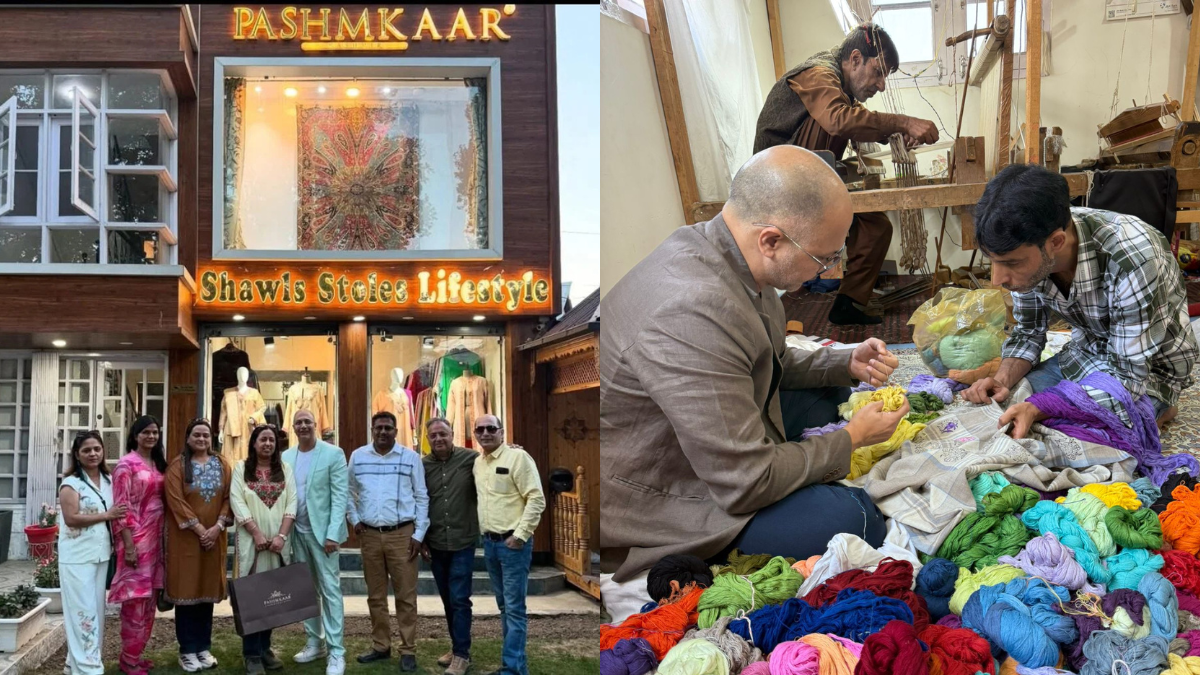
Pashmkaar now supports around 500 artisan families in Kashmir
Pashmina is much more than a piece of clothing it is a living testament to centuries of heritage, artistry, and cultural identity. Woven from the fine undercoat of the Himalayan Capra hircus goat, this fabric represents one of the most refined and delicate crafts in the world. Every strand tells the story of Kashmir’s artisans, whose unmatched skill has been honed through generations.
Throughout history, Pashmina has adorned royalty and nobility, gracing the shoulders of Mughal emperors, the courts of the Nizams of Hyderabad, and aristocrats across Europe.
In fact, by the 18th and 19th centuries, Pashmina shawls had become coveted heirlooms in royal households from Persia to France, valued not merely for warmth but as emblems of taste, status, and luxury. Napoleon famously bestowed them upon Josephine, and their presence in European salons cemented Kashmir’s global reputation as the home of textile excellence.
Today, Pashmina remains an enduring icon of Kashmir, embodying the delicate balance between nature, human craft, and cultural memory. Each shawl is not just fabric but also a piece of history expression of genteel luxury, artistic mastery, and a craft that has persevered through changing empires, economies, and eras.
In Kashmir, where centuries-old traditions blend seamlessly with modern aspirations, a remarkable story of entrepreneurship and cultural preservation unfolds.
However, as artisans always remain hidden behind the fabric and as Pashmina, itself fights imitations and industrially produced fake pashminas, Tariq Ahmad Dar, a Srinagar-based handicraft manufacturer, seller, and exporter, has embarked on a mission to elevate Kashmir’s handicrafts to global prominence, one intricate design at a time.
Dar’s story with Kashmiri shawls began when he was a child, growing up in a family of artisans. His father was also a shawl-making artist who at his time only earn 25 paise for his hand embroidery, later he managing a local workshop where the shawls were made. Pashmina was not only his father’s occupation, but also his mother, who is from Srinagar’s Eidgah area where Pashmina weaving is part of everyday family life. He says that his grandmother also used to do pashmina spinning and since his childhood, he has seen the aesthetic and spiritual beauty of handicrafts.
Being the eldest son of his family, Dar was always by his father’s side while he was conducting small business of shawl making, this early exposure to the world of Kashmiri handicrafts instilled in Dar a deep appreciation for the art form and the skilled artisans behind it. Little did he know that these childhood experiences would lay the foundation for a global brand that would one day carry the essence of Kashmir to the world. He always thought that artisans like his father and others worked hard for continuing this artwork but did not get the recognition by the dealers. This was the early thought of Dar while starting his business.
After completing his studies, Dar went into modelling field for some time in Mumbai. He participated in Wills Fashion Show, one of Asia’s largest fashion trade events, displaying collections from both established and emerging Indian designers. He gain insights into design and colour combination, this exposure to the world of fashion later proved to be invaluable in Dar’s mission to modernise and globalise Kashmiri handicraft. During these fashion shows, Dar noticed a disheartening trend.
“I used to see many celebrities wearing Kashmir pashmina shawls, but when it didn’t trace back to Kashmir, it was cause for frustration for me. Exporters here used to sell to companies who would put their own stamp on it and it annoyed me deeply,” Dar tells Media India Group.
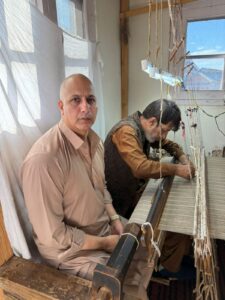
Tariq Ahmad Dar
“With the help of my father’s contacts, who were already connected with the artisans, I started working directly with them, I provided them raw material and other support on every step of the way and I also shared suggestions from the latest designers to keep the work fresh and appealing,” adds Dar.
This hands-on approach helped him to build strong relationships and made the brand well-known and respected. Through direct involvement and constant support, the business grew into a successful and trusted name.
“Over 90 pc of the handicraft items being made are old designs, what I add is the trend, and colour patterns which I have learned through my travels, We incorporate international fashion colours and styles into our shawls and other products, making them relevant in the global market while retaining their traditional essence,” says Dar.
Over the years, he opened stores outside India, notably in Hong Kong and Taiwan, and regularly participates in exhibitions across Europe, America and Asia.
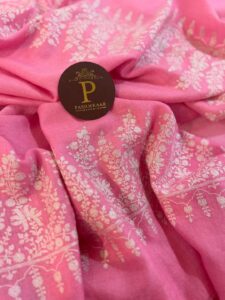
Ari work Pashmina Shawal
Unlike other manufacturers, Pashmkaar insists on pure, certified Ladakhi Pashmina with QR codes for authenticity and provenance, ensuring every shawl is handwoven and unique, promoting dignity and global recognition for artisans.
Pashmkaar now supports around 500 artisan families in Kashmir, where over 350 are women artists and Dar says that the company not only provides employment opportunities but also fair wages and annual salary hikes, a rarity in an industry where hardship has long been the norm. Beyond income, the brand offers dignity by acknowledging artisans as professionals who preserve a centuries-old artistry.
Educational centres established by Pashmkaar across Kashmiri villages further strengthen this mission, nurturing new talent and bringing women back into the craft, many of whom had left because spinning and weaving no longer sustained them financially.
“Through learn-to-earn schemes and collaborations such as the ONGC Kani shawl weaving project in Budgam district in Kashmir, dozens of young women have not only learned the trade but found dignified work we pay around 20 pc more to our artisans, and many work flexibly from their homes. It’s about restoring pride and independence,” he adds.
A particular source of pride for him is how Pashmkaar artisans now travel the world.
“We have taken our team to events overseas. For many, it is their first-ever trip abroad and when they return, the entire village greets them and they feel the honour their work brings. Also, our artisans are brought to the forefront not only at exhibitions but also on social media, giving the face behind the craft the credit and dignity long overdue,” says Dar.
He says that one of his key efforts has been to get a fair price for his artisans’ hard work and skills.
“A plain handwoven pashmina shawl takes 15–20 days just to weave and starts at INR 25,000– INR 27,000. Embroidered masterpieces can reach up to INR 1 million, depending on the intricacy and duration of the work sometimes as much as two years. Each piece is unique we never repeat designs, one shawl provides livelihood to 14 people,” says Dar.
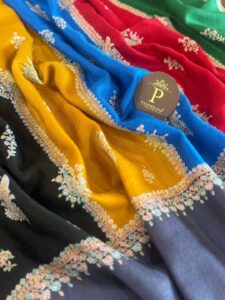
A Rangrez pashmina shawl
He has also fought the wave of fake pashminas by striving for Geographical Indicator tags.
“Real pashmina is like jewellery you need an educated eye. But now, with GI certification and QR codes in place, it is easier for anyone to check and ensure what they are buying is genuine,” says Dar.
The artisans do appreciate the attitude and the working conditions that Pashmkaar offers.
“Having dedicated 45 years to shawl-making, I have spent the last five and a half years with Pashmkaar, finding in the brand not just regular work but recognition. Pashmkaar gives us recognition not only on national levels in our country but also internationally. People see the faces behind the art that gives me inspiration to remain dedicated to this craft,” says Niyaz Ahmad Mir, a 55-year-old artisan from Srinagar, tells Media India Group.
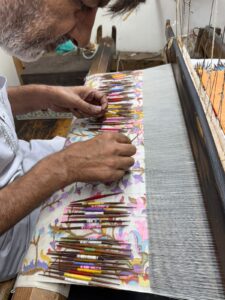
Shawl making process
“I went to Hong Kong with Dar, and together we represented the Pashmkaar brand. That moment motivated me even more, as Pashmkaar aims to restore an art whose precision and perseverance not only produces beauty but also carries Kashmir’s centuries-old story forward,” Mir adds.
Expanding a local heritage brand into international arenas has been a challenge, with obstacles ranging from export logistics to maintaining exacting standards.
Today, Pashmkaar is showcased on prominent national platforms in India and increasingly embraced abroad, occupying a unique niche where heritage artistry aligns with ethical luxury. For the future, Tariq’s vision is clear that he aims to make Pashmkaar a name synonymous with authentic Kashmiri handicrafts worldwide. Expansion into new international markets is underway, alongside collaborations with designers who can bring innovative expressions without straying from traditional foundations.
