
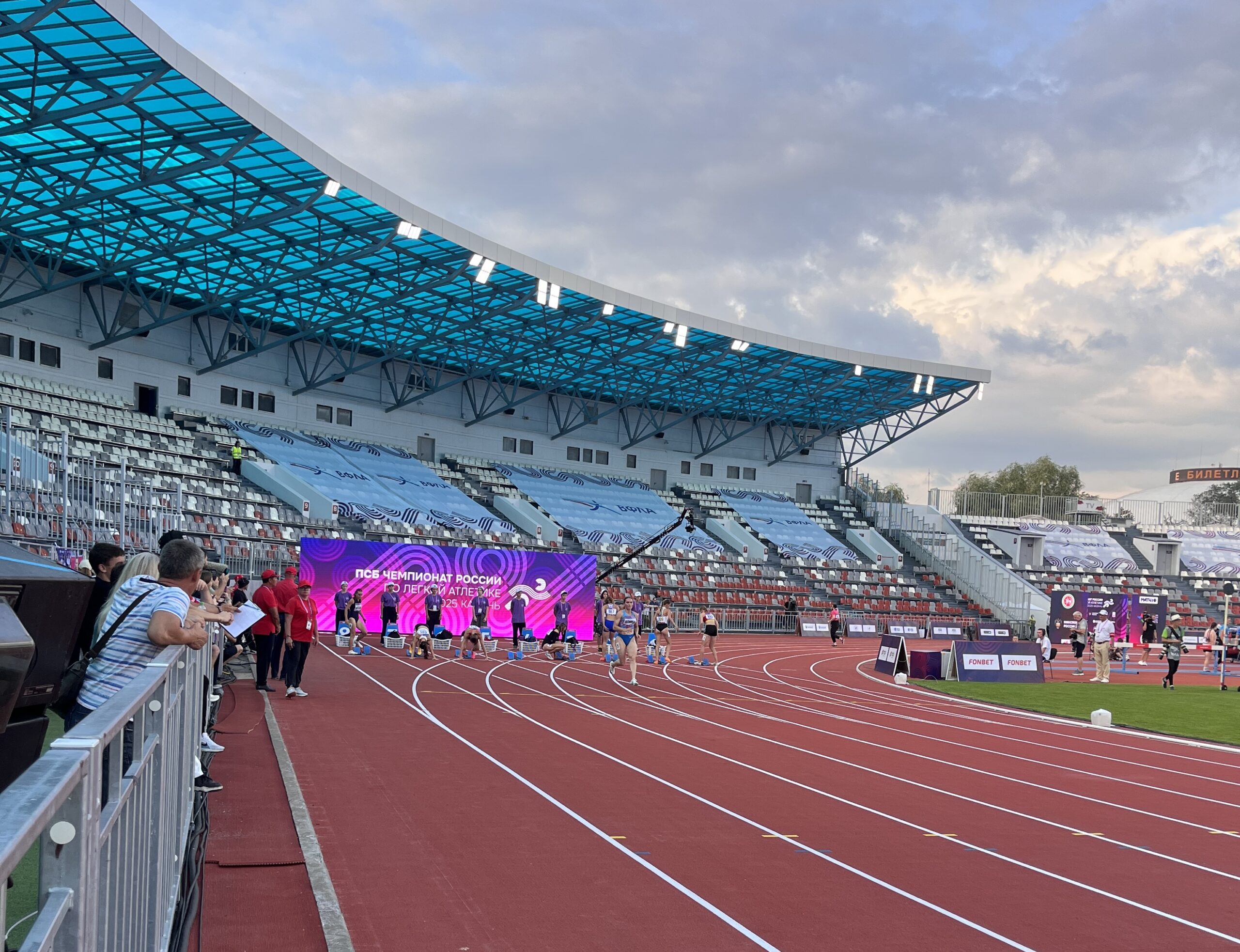
Russian athletes have to pass rigorous anti-doping tests, often more stringent than required for other nations (Photos: Media India Group/Garima Sharma)
Russia, which has been a major sporting power, has found itself sidelined and outcast from global sporting competitions for over a decade when repeated doping scandals led to investigations that exposed a vast state-sponsored doping programme in Russia, peaking after the 2014 Sochi Olympics.
Investigations by the World Anti-Doping Agency (WADA), global anti-doping regulatory body, demonstrated not only systemic use of banned substances among Russian athletes but also elaborate cover-ups, involving tampered samples and bribery. The fallout was swift and severe, and in November 2015, the Russian Athletics Federation was suspended by World Athletics, and the Russian Anti-Doping Agency (RUSADA) was declared non-compliant.
This was no ordinary sanction. Athletes, coaches and officials, both guilty and innocent, were caught in its wake. Between 2014 and 2024, Russia accounted for 44 pc of all doping sanctions in European athletics, with 452 individual cases, far surpassing any other nation.
Russia was banned from competing under its flag at major international events, including the 2019 Olympics, forcing its athletes to participate only as neutrals.
Now, 10 years later, Russian sporting organisations say that they have exterminated the widespread doping and are ready to participate in global competitions once again.
As part of its outreach to the international community, to convince the rest of the world, that Russian athletes had now overcome the doping scandals, a number of global media organisations, including Media India Group, were invited by the Russian Athletics Federation to observe the Russian Athletics Championship 2025, held in Kazan recently, and witness the historic moment of Russia’s potential reinstatement.
For athletes, fans and officials, it represents more than just a bureaucratic decision, it is the culmination of years of effort to overturn the devastating legacy of 452 documented doping violations and 51 stripped medals that defined Russia’s fall from grace.
The path toward reintegration into world sport has been arduous, scrutinised at every step by international governing bodies, fans and the athletes themselves, many of whom see their best years slipping away under the weight of decisions beyond their control.
Despite the damage, a rigorous effort to reform began. The Russian federation initiated comprehensive anti-doping measures.

Alexander Djordjadze
“We have around 3,000 tests annually and less than 10 anti-doping violations per year,” Alexander Djordjadze, Secretary General, Russian Athletics Federation, told Media India Group at Kazan.
“Our dialogue with World Athletics has been open, transparent and constructive. We share information, exchange views and jointly discuss how to bring our athletes back to international competition,” Petr Fradrov, President, Russian Athletics Federation, told Media India Group.

Petr Fradrov
Even after the original doping-specific ban was lifted by World Athletics in 2023, Russian athletes continued to be excluded from competing due to the ongoing conflict with Ukraine. This extended isolation has taken a profound toll on the athletes’ morale, livelihoods and sense of purpose.
For Polina Knoroz, a top pole vaulter who broke her own record at Russian Athletics Championships 2025 with a jump of 4.86 m to win the gold medal, the impact is personal and poignant.
“I do not have the opportunity to perform on the international stage but in Russia, I can produce a world-class result. Like many others, I am driven by the desire to prove that I can perform no worse than the global stars,” Knoroz told Media India Group.

Polina Knoroz
“I feel a bit disappointed that I am not having a chance to compete internationally. At the Diamond League, I would be among the winners, for sure,” Fyodor Ivanov, 400m hurdles champion who recently broke the Russian record at the recent Championship, told Media India Group.

Fyodor Ivanov
The consequences of exclusion are not just psychological but also material. “When the companies left Russia, a lot of sponsorships just ended. I lost most of my income, but am still doing fine. You can earn in Russia practising sports without foreign sponsorships, pretty much like any other occupation,” Sergey Shubhenkov, a former world champion hurdler, told Media India Group.
Yet, nothing, not even national championships or domestic acclaim, can fully substitute for the fulfilment and earning power that comes from competing and winning on the international stage.

Sergey Shubhenkov
The collective experience is perhaps best described as a tragedy by Elena Sokolova, an Olympic long jump silver medallist. “An entire generation of Russian athletes do not know what it is like to compete for the flag. It is a tragedy,” she added.
Yet, beneath this sense of loss and frustration lies a persistent hope, a continued drive to clear every anti-doping hurdle, to communicate more transparently, and to prove, both internally and externally, that Russian athletes can compete as equals in a clean, fair environment.

Elena Sokolova
“My vision as Chairman is that one day, Russian athletes will be allowed to return fully. When that day comes, our athletes must not only participate but also be competitive on the global stage. So, my responsibility is to prepare them for that moment through development, training support and infrastructure improvements,” Fradrov said.
The push for reform has extended beyond just compliance with testing. There have been systematic efforts to improve public communication, especially in English, and to keep international audiences regularly informed.
“Since early this year, we began analysing our social media channels like Instagram and Twitter, and it became clear that we need to post more frequently, in English, and with professional editing. We are taking steps in that direction,” says Fradrov.
The process is two-pronged like on the external level, there are negotiations and engagement with World Athletics to reduce tensions and work towards lifting sanctions. On the internal front, there is a focus on regional development, infrastructure, and motivating a new generation of athletes and coaches, key elements for any future in which Russian athletics returns to prominence.
“As for why Russian athletes are still not competing neutrally in track and field, that is a question for World Athletics, not us. It is their decision. What we can do within our control is continue to follow every requirement, engage constructively, and demonstrate progress in compliance and governance,” Djordjadze added.
The global athletics community remains cautious. World Athletics, under President Sebastian Coe, has maintained that the ban will only be reconsidered when a peace agreement is reached between Russia and Ukraine, and all guarantees about doping compliance are firmly in place. The Athletics Integrity Unit continues to include Russian athletes in its international testing pool, preparing for the possibility of an eventual return, but until the geopolitical landscape changes, the ban is set to remain.
Through every stage of this saga, Russian athletes have had to pass rigorous anti-doping tests, often more stringent than required for other nations. The country’s athletes now account for less than 10 anti-doping rule violations per year from some 3,000 annual tests, a tiny fraction when set against the past scandals. Yet, the shadow of those earlier years continues to loom, shaping both public perception and the day-to-day reality for the athletes themselves.
There is little doubt that the story of Russian athletics is in transition, marked by the enduring pains of the past and a sheer determination to carve a new, clean chapter in the sport’s history books. Whether, when and how Russian athletes will return to the world’s grandest stages depends not only on their vigilance and compliance but also on the decisions of international bodies and the evolving tides of global politics.
For now, their message is one of patience and hope: “Do not forget us,” as Knoroz said.
