
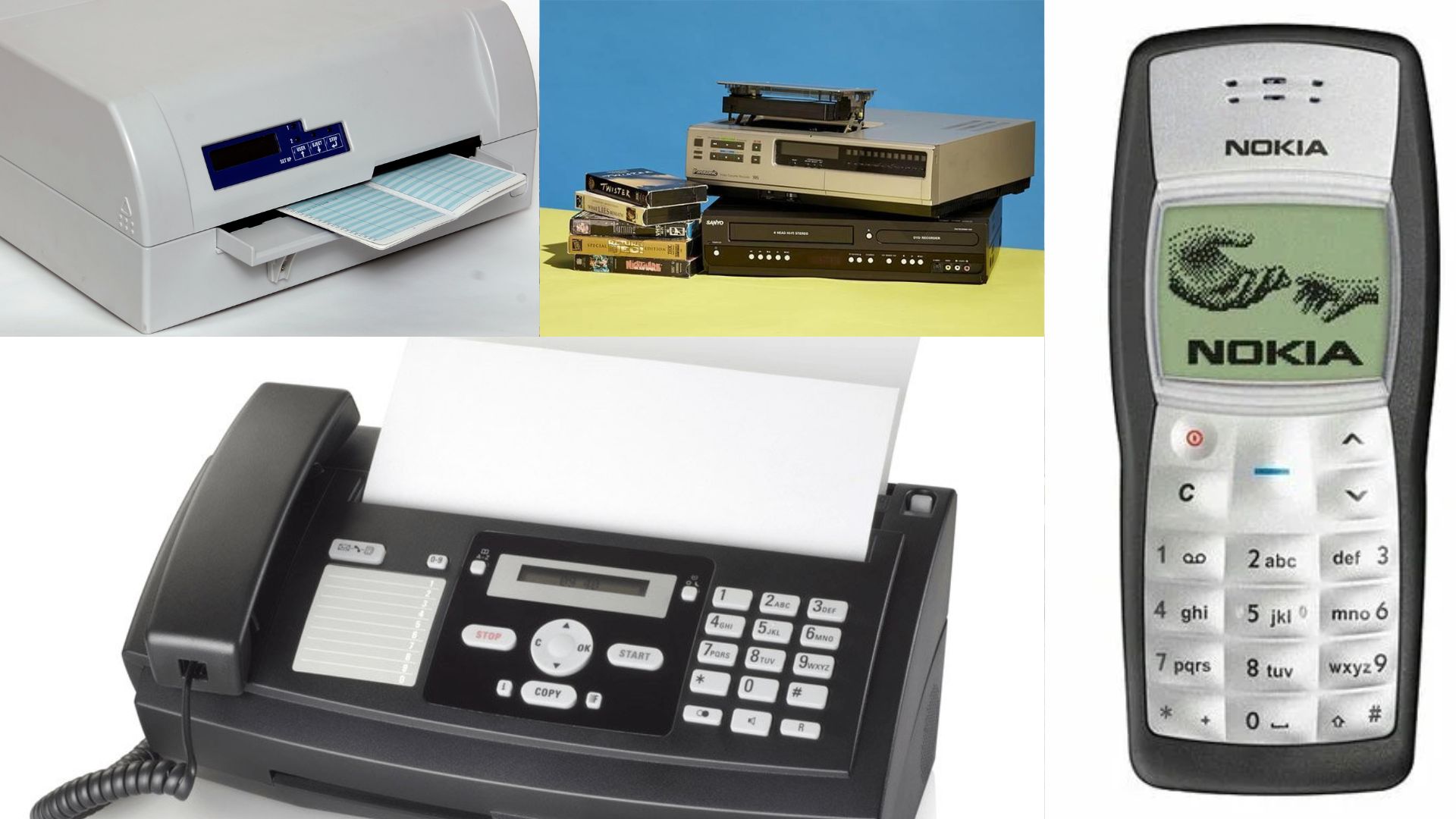
While the world races toward AI, 6G, and quantum computing, a surprising number of yesterday’s tools continue to survive
Whenever we talk about technology, it is usually in the context of the future, how artificial intelligence, quantum computing or space tech will reshape our world for better or worse. The focus is almost always forward-looking. But while we race toward tomorrow, we often overlook the fact that several older technologies still persist around us, not because they are the best options, but because they have simply refused to disappear.
Some of these were revolutionary in the 1990s but have since been pushed to the sidelines by newer, faster, and more efficient innovations. Once considered mainstream, they now survive in niche pockets, often out of nostalgia, habit, or very specific functionality. Here is a look at five such technologies from the 90s that are still in use today, despite being well past their prime.
Dot matrix printers
In 1970, dot matrix printers made their mark with the introduction of the DEC LA30, which could print 30 characters per second. While the basic concept existed earlier, the first commercially successful dot matrix impact printer was developed by Centronics the same year, setting the stage for a printing revolution.
These printers operate using a print head with pins that strike an ink ribbon to form characters and images through a series of dots. They rose to prominence in the 1980s and early 1990s, commonly used for printing multipart forms, invoices and basic text output on early personal computers.
Although inkjet and laser printers largely replaced them by the late 1990s, offering better print quality, quieter operation, and faster speeds, dot matrix printers didn’t vanish entirely. Thanks to their speed, ranging from 50 to 5,000 characters per second, low operating costs and ability to print on multi-copy forms, they remain relevant in select industries.
Sectors such as retail, logistics, banking and government agencies continue to use dot matrix printers, especially where large volumes of paperwork are involved. Even major airlines like Delta Air Lines and Lufthansa rely on them for tasks like printing boarding passes, baggage tags, and flight manifests, due to their dependability and suitability for diverse environmental conditions.
Nokia 1100
Way back in 2003, Finnish company Nokia introduced a compact mobile phone with small keypads, the Nokia 1100. Known for its simplicity, durability, and long battery life, it gained popularity for being affordable and focused solely on essential functions, making it ideal for basic communication, especially in emerging markets.
Nokia 1100 featured a small monochrome screen to display only text and numbers. Despite its limited functionality, it went on to become the best-selling mobile phone of all time, with over 250 million units sold. Its peak usage was around the mid-2000s when feature phones dominated the global market.
However, as the mobile phone industry rapidly shifted toward smartphones, the popularity of the 1100 declined. Nokia failed to adapt quickly to touchscreen technology and app ecosystems, areas where Apple and Samsung took the lead. As smartphones became the norm, basic models like the 1100 faded from the mainstream.
Yet the Nokia 1100 continues to find relevance today. In regions where electricity and access to modern tech remain limited, it is valued for its long-lasting battery and sturdy design. Some people still use it as a secondary phone or for its simplicity, especially in areas with weak network coverage or for basic calling and messaging needs.
In India, it remains popular in the second-hand and refurbished phone market. Though no longer available as a new device, the Nokia 1100 can still be found online through various retailers offering pre-owned models at low prices. Its continued demand reflects its legacy as one of the most practical and reliable mobile phones ever made.
Fax Machines
The modern fax machine, as we know it today, owes much to Xerox, which introduced a commercial version in 1964. However, the origins of fax technology trace back even further, to 1843, when Scottish inventor Alexander Bain patented the Electric Printing Telegraph, often considered the first fax machine.
It was not until the 1980s and 1990s that fax machines truly became mainstream, especially in the business world. During this period, they revolutionised communication by allowing the rapid transmission of documents, images, and even signatures, instantly bridging long distances and time zones.
With the rise of email and internet-based communication, fax use declined sharply. Still, it hasn’t vanished. In fact, fax machines continue to serve specific roles in industries where security, compliance, and legal validity are paramount.
In healthcare, for instance, faxing remains a trusted method for sharing documents containing Protected Health Information (PHI), due to its direct point-to-point nature. Similarly, law firms and courts still use fax machines to send contracts, legal filings and other sensitive materials. The ability to provide a timestamped, physical record of a transmission can be especially critical in legal settings.
Despite advances in digital communication, the fax machine endures, quietly but firmly, in places where reliability and security still take precedence over speed and convenience.
VHS Players
The VHS player, or Video Home System, emerged in the mid-1970s and became the dominant home video format, reaching peak popularity during the 1980s and 1990s.
Developed by JVC and launched in Japan in 1976 and in the United States a year later, VHS rose to fame thanks to the booming video rental market and the increasing availability of pre-recorded tapes.
Throughout the ’80s and ’90s, VHS became the go-to format for watching and recording movies at home.
But the arrival of DVDs in the late 1990s marked the beginning of VHS’s decline. With better picture and sound quality, along with more convenience, DVDs quickly overtook VHS in rentals and sales. By the mid-2000s, most studios had stopped releasing movies on VHS.
Though production ended in 2016, when Funai Electric made the last VCR/DVD comb, they are still used by some today. People continue to digitise old tapes, revisit rare VHS-only films, or simply enjoy the retro feel. Collectors, too, value VHS tapes and players, with certain editions now fetching high resale prices.
Pagers
Once a symbol of instant communication, pagers also known as beepers, might seem like a relic from the past, but they haven’t completely disappeared. Surprisingly, in certain sectors and regions, they still serve a purpose.
The origins of pagers can be traced back to 1921, when the Detroit Police Department implemented a radio-equipped police car system, the first of its kind. By the 1980s, pagers had evolved and gained popularity worldwide, with over 3.2 million users. However, their use was mostly limited to critical communication within specific locations, such as hospitals, due to their short range.
As mobile phones became more affordable and offered features like voice calling and SMS, the relevance of pagers began to decline in the late 1990s and early 2000s. For most people, pagers were quickly replaced by more versatile digital devices.
Still, pagers are far from extinct. In Japan, they are used in hospitals and remote areas with limited mobile network coverage. Their simplicity and reliability make them effective tools during emergencies, sometimes more dependable than smartphones.
In Germany, logistics companies and emergency services continue to rely on pagers to ensure quick and uninterrupted communication in zones with weak or no cellular signal, according to reports from Deutsche Welle.
In a world obsessed with constant upgrades and sleek, smart innovation, these lingering technologies serve as quiet reminders that not everything old must be discarded. Whether it is the rugged resilience of a Nokia 1100 or the dependable dot of a matrix printer, these relics reflect a time when tech was built to last, and sometimes, that is exactly what we still need.
