
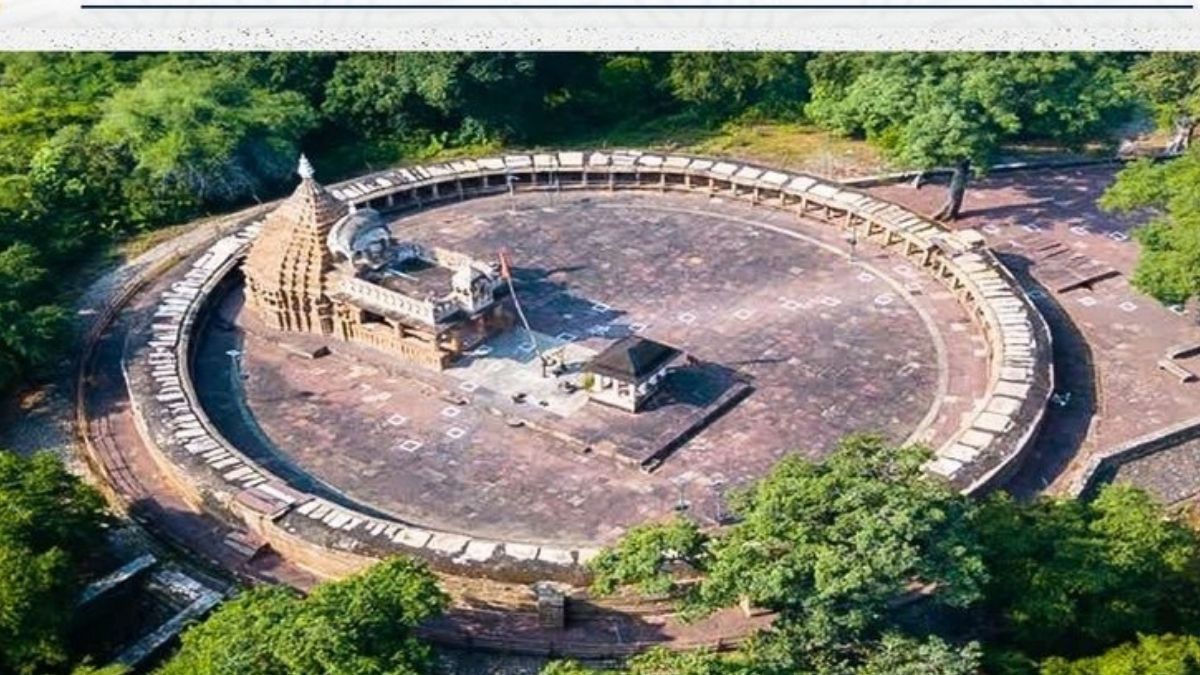
The resemblance has given rise to a long-standing story that the design of Parliament (Photo: Archeological Survey Of India)
Amid the historic landscape of Morena district in Madhya Pradesh, near the village of Mitawali, stands an ancient temple whose unusual circular design has drawn attention for its striking resemblance to the old Parliament House in New Delhi. Known as the Chausath Yogini Temple, the monument preserves a distinctive architectural form built around a circular courtyard, with rows of stone pillars and shrines arranged along its perimeter.
The resemblance has given rise to a long-standing story that the design of Parliament may have been inspired by the medieval temple. However, there is no established historical evidence confirming a direct connection between the two buildings.
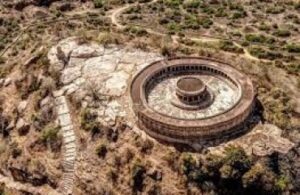
The Chausath Yogini Temple, also known as the Ekattarso Mahadeva Temple
Today, its distinctive architecture, secluded setting and unresolved connection with one of India’s most recognisable buildings make Mitawali an unusual heritage stop in Madhya Pradesh.
A temple built in a circle
The Chausath Yogini Temple, also known as the Ekattarso Mahadeva Temple, stands on a hill in Mitawali village. An inscription associated with the monument dates its construction to the reign of Kachchhapaghata ruler Devapala, with 1323 CE commonly cited for the temple.
Its design is radically different from the conventional temple layouts found across much of India. The structure is circular and open to the sky. Around its perimeter are 64 small chambers traditionally associated with the 64 Yoginis or female deities, while a central shrine is dedicated to Shiva. The circular arrangement and open courtyard create a geometric symmetry that becomes especially visible when viewed from above.
The word Chausath means 64, referring to the Yoginis, which are associated with the Shakti and Tantric traditions. The temple is therefore not simply an architectural experiment but a sacred space shaped around a distinctive religious tradition.
According to the Madhya Pradesh Tourism board, the temple was also associated with the study of astrology and mathematics based on the movement of the sun. Its circular form has consequently attracted interest not only from devotees and travellers but also from those interested in the relationship between architecture, astronomy and mathematics.
The architecture behind the Parliament resemblance
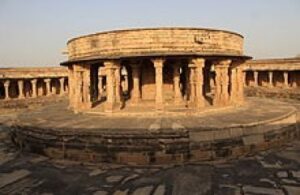
The temple’s circular perimeter, continuous rows of pillars and corridor-like arrangement
The temple’s circular perimeter, continuous rows of pillars and corridor-like arrangement bear a striking visual resemblance to the old Parliament House in New Delhi. The similarity in their circular layouts has contributed to the long-standing belief that the medieval temple may have influenced the design of Parliament.
The old Parliament House, designed by British architects Edwin Lutyens and Herbert Baker and constructed between 1921 and 1927, is also circular and surrounded by columns. The Mitawali temple, meanwhile, had existed for centuries before the building of Parliament.
The most famous version of the story often goes further, claiming that Parliament was directly copied from the temple. But that claim should be treated cautiously. No documented architectural record has been established showing that Lutyens or Baker used Mitawali as a design source. Madhya Pradesh Tourism itself notes that there is no proof supporting the inspiration theory.
The heritage beyond Mitawali
Beyond the Chausath Yogini Temple at Mitawali, Morena has several other notable monuments that add to its rich architectural heritage. Padavali, for instance, is known for its intricately carved medieval Shiva temple, later enclosed within fortifications. The combination of detailed temple sculpture and surrounding bastions gives the site a distinctive character.
Bateshwar is another major attraction, with a sprawling group of nearly 200 ancient temples that were painstakingly restored from ruins. Kakanmath Temple at Sihoniya offers a different story, combining striking medieval architecture with the local legend that the temple was built by ghosts in a single night. Together with Sabalgarh Fort, these sites show that Morena’s heritage extends well beyond Mitawali, encompassing temples, fortified monuments and stories that have survived across centuries.
