
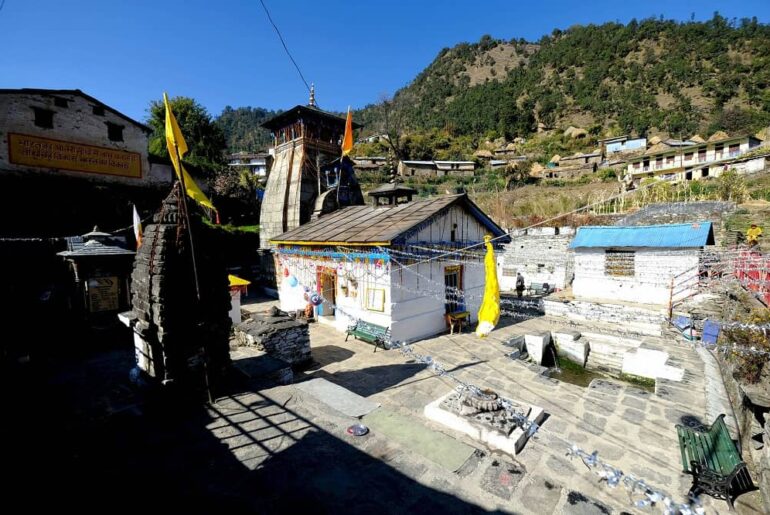
Rudrakund offers visitors a unique blend of tranquillity, devotion and raw mountain beauty
Nestled at an altitude of approximately 3,600 m in the Chamoli district of Uttarakhand, hidden away in the Garhwal Himalayas lies Rudrakund, one of the five revered Panch Kedar shrines dedicated to Shiva, a Hindu deity. The temple, accessible only by a 20 km trek from the village of Sagar near Gopeshwar, offers a profound spiritual experience amidst the serene beauty of the Himalayas.
Though not as widely known as some of Uttarakhand’s other more visited destinations, Rudrakund offers visitors a unique blend of tranquillity, devotion and raw mountain beauty.
It is a sacred water body believed to hold deep spiritual significance and according to local legends, the kund, a natural pond, is associated with the tears of the deity himself, shed in meditation and devotion and is thus considered a site of purification and introspection.
Journey to Rudrakund
The journey to Rudrakund is not a simple one. Like many of the spiritually potent sites in this region, it requires a fair amount of walking, patience and endurance. As one climbs through dense forests, breathing in the crisp air and taking in the views of the mist-covered valleys below, it becomes clear that the pilgrimage is not just to a place, but through an experience.
There are a number of significant sites in Uttarakhand’s sacred geography close to Rudrakund. The trek often intersects with routes to Rudranath, one of the Panch Kedar temples, where Lord Shiva is worshipped in the form of his face.
Legend says that the Pandavas, a group name referring to the five legendary brothers, Yudhishtira, Bhima, Arjuna, Nakula and Sahadeva, who are central figures of the Hindu epic Mahabharata, seeking forgiveness for the Kurukshetra war, embarked on a journey to find Shiva. To evade them, Shiva transformed into a bull and submerged himself in the earth. The Pandavas, in their pursuit, discovered his body parts at various locations, with Rudranath representing his face.
Also read: UCC in Uttarakhand: A step toward legal uniformity or threat to religious freedom?
It is not uncommon for pilgrims to combine their visit to Rudrakund with a stop at this revered temple, extending the spiritual journey.
Nearby, other destinations attract travellers and pilgrims with their own stories and scenery. The Tungnath Temple is acclaimed as the highest Shiva temple in the world and is accessible via a separate but equally scenic trek.
There is also the mystical Roopkund Lake, commonly known as the Skeleton Lake for the human remains that rest beneath its glacial waters adding a hint of archaeological and eerie curiosity to a landscape already rich with myth and magic.
A haven for nature and adventure enthusiasts
While spirituality remains a dominant attraction, the region also a haven for those who are simply in love with the mountains. The entire area is a trekker’s dream, offering alpine trails, dense woodland paths and meadows that bloom with wildflowers during the summer months. Wildlife enthusiasts may also catch glimpses of the region’s fauna which includes musk deer, Himalayan monals and even leopards.
Also read: Forts of Rajasthan: Symphony in sandstone
Rudrakund and the region around it stand out because there is hardly any mass tourism. Unlike many well-known hill stations filled with traffic and busy markets, this quiet part of Uttarakhand has stayed mostly untouched. It is more common to see a shepherd with his sheep than a tour guide and the food served is usually simple, home-cooked Garhwali meals instead of packaged snacks.
The best time to go is from late spring to early autumn, when the walking paths are clear and the meadows are full of flowers. In winter, the area becomes beautifully snowy, but heavy snow often makes it hard to reach.
