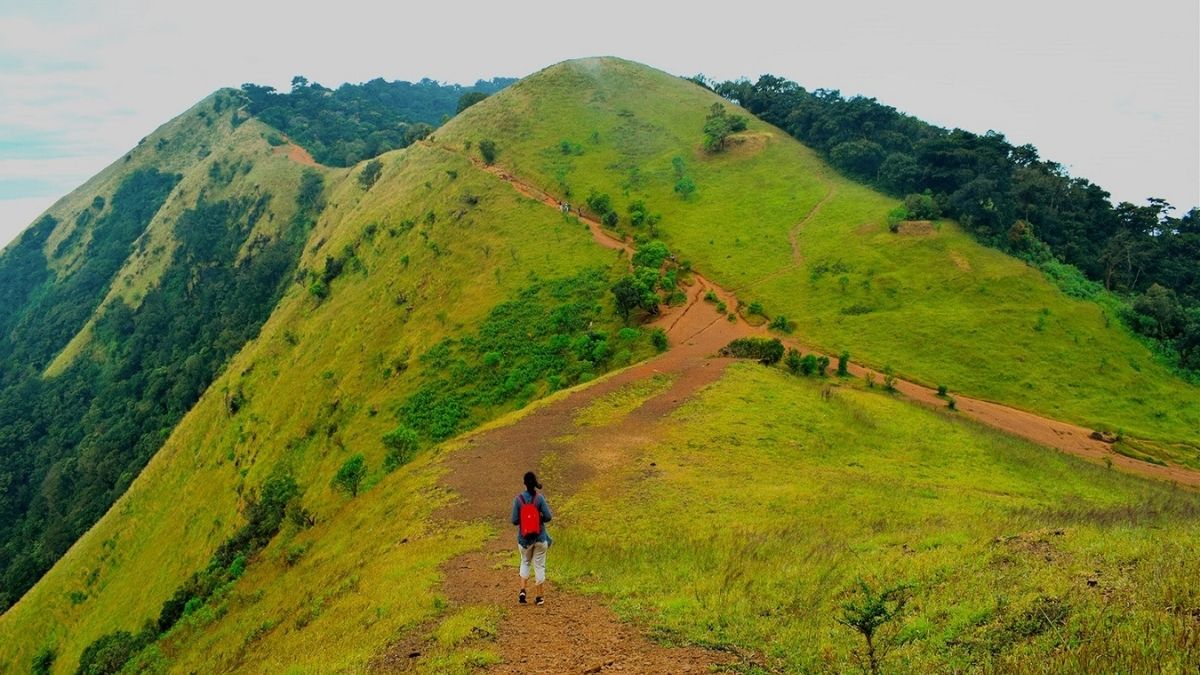
Karnataka Forest Department has introduced stringent new Standard Operating Procedures for trekking (Photo: Karnataka Tourism)
Days after a woman trekker died and another went missing for days, in different incidents, the Karnataka Forest Department has introduced stringent new Standard Operating Procedures (SOPs) for trekking, effective immediately, aimed at improving safety of trekkers.
The biggest change in the rules is the one making it mandatory for trekkers to be accompanied by licensed guides and trekkers cannot just head out in a large group anymore. There has to be a certified local guide for roughly every 10 trekkers. They have also capped batch sizes to keep groups manageable and making sure someone on the ground knows the terrain.
The new rules have come days after a girl from Kerala went missing near the Manikyadhara Waterfall in Chikkamagalur district. Police eventually found her dead on April 10 after using drones to search the area. Around the same time, there was another case in Kodagu as a woman from Kozhikode lost her way while trekking in Tadiandamol and ended up spending four days out there before she was finally found, alive.
Also Read: Gurez Valley: Trekkers’ untouched haven in Kashmir
According to the new SOPs that have been brought in by Forest Minister Eshwar Khandre, there must be a certified local guide for every 10 trekkers, with a maximum of 150 in one batch.
The government has also made it mandatory for guides accompanying trekkers to use GPS-enabled walkie-talkies. In addition, an application including maps of trekking paths must be installed on the phones of all the trekkers. It will facilitate the location of trekkers if they happen to get lost. As per the new rules, briefings regarding the distance, time required, and other aspects will be given to trekkers before their journey begins. The guide is also required to report every 30 minutes from the path to the base camp through walkie-talkie.
The rules state that minors must carry a consent letter from their parents and senior citizens must provide a fitness certificate to confirm their physical capability to undertake trek. To counter unexpected counter health issues, trekkers and guides must carry a first aid kit.
Karnataka has also made it mandatory for online bookings for trekking permissions and each trail has a daily limit of visitors between 100 and 300 depending on the trek. All forest trails are functional only during the season between September and February.
Different rules in different states
However, the method used by Karnataka State is not the same as that followed in the Himalayan States, which have an old permit system that is sometimes less structured.
Also Read: Trekking to Triund in Himachal Pradesh
For instance, the Uttarakhand government has made it mandatory for trekking parties to undergo rigorous physical examinations before undertaking a journey to high altitude areas, especially near Char Dham. Trekking parties, especially those with people above 55 years of age or having any pre-existing ailments, will be subject to a quick medical examination to determine whether they are fit to go on to such an altitude level.
In Uttarakhand, the High Court has imposed a ban on overnight camping at all high altitude meadows in order to conserve the fragile ecosystem of the meadows, and referred to the same as ‘God’s Grassland’. The ban includes restrictions such as overnight camping ban, removal of permanent structures within three months, restriction on the number of tourists and prohibition on commercial livestock grazing.
Similarly, in Himachal Pradesh, permits are required for some popular trails around the international borders. Foreigners need the Inner Line Permit (or Protected Area Permit) for areas like Tabo, Dhankar and Kaza in Lahaul-Spiti. For domestic tourists, permits are not required for normal tourist trails, however, special permits might be needed for treks near the Chinese border, especially in the Upper Kinnaur region. In January 2018, Himachal Pradesh imposed strict rules for trekking in high altitude areas, especially those in the Kangra district, whereby trekking over 3,000 metres is possible after getting approval from the local Superintendent of Police.
Also Read: Trekking in Sikkim
For foreign visitors, in Sikkim, two major permits are needed, the first being Restricted Area Permit (RAP) or Inner Line Permit for a group or individual travellers and the second, Protected Area Permit (PAP), also known as Trekking Permit for only a group comprising a minimum of two persons.
Foreigners need to travel with a guide and driver who have been previously approved by the concerned authorities. They are not allowed to travel individually in restricted regions like Tsomgo Lake and Yumthang Valley or Zero Point, furthermore, no access is granted beyond regions like Thangu Valley. There are daily restrictions on the number of tourists at high altitudes like Gurudongmar Lake. Online permits are a mandate, besides strict environmental regulations that include prohibition on use of single-use plastic in protected areas.
What travellers need to know?
The key aspect is that unplanned trips to any of these states will result in either rejection by the authorities or a penalty. In Karnataka, trekking registrations are mandatory, while in Sikkim, trekkers are required to show original passports or other government-issued ID such as Driving Licence or Voter ID. Photocopies of the passport, with minimum 2 sets, need to be produced for a valid Protected Area Permit in Sikkim. However, Aadhar card/PAN card cannot be used as proof of identity. Passport with a valid Indian Visa is mandatory for foreigners. For minors, it is mandatory to show a birth certificate or other relevant documents for proof of identity. For trekking areas like Nathula Pass, Tsomgo Lake and North Sikkim, permits are compulsory.