
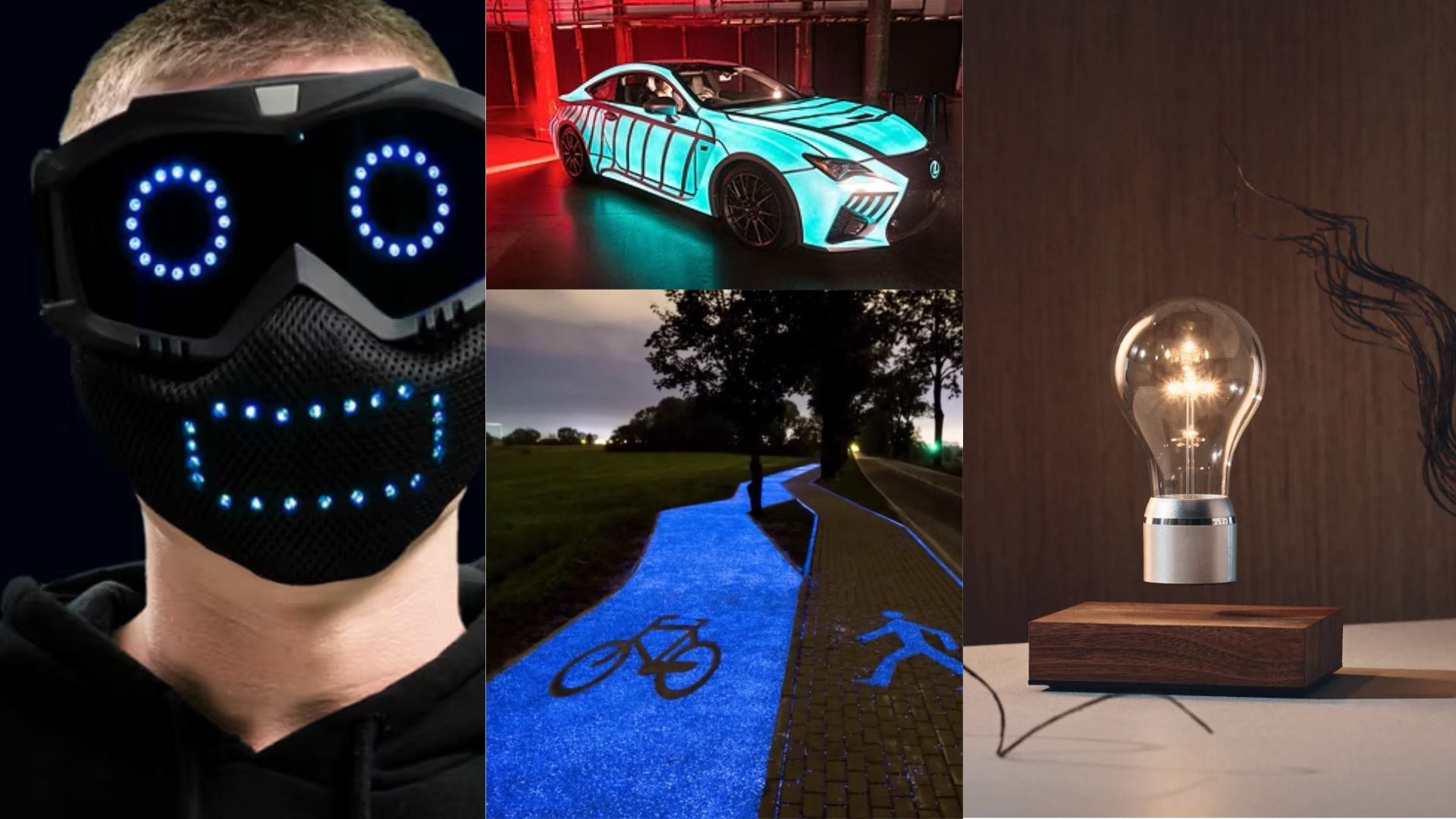
The blend of function and form has led to the creation of unique lighting designs that not only remove darkness but do so with artistic flair
In 1879, Thomas Alva Edison invented one of the most transformative technologies in human history, the electric light. But 150 years years later, beyond its practical role in illuminating homes, streets, and public spaces, light has come to serve a deeper aesthetic purpose. Over the years, lighting has been used creatively in museums, architecture, and even natural settings to shape mood, highlight beauty, and transform spaces.
This blend of function and form has led to the creation of unique lighting designs that not only remove darkness but do so with artistic flair.
Here are five distinctive lighting concepts that brighten spaces in their own visually striking ways.
Lumilor Electroluminescent Paint, USA
Imagine paint that does not just colour a surface, but lights it up. Lumilor, developed by US-based Darkside Scientific, is an electroluminescent coating system that transforms objects into functional light sources.
From helmets and motorcycles to clothing and industrial parts, it can be applied to a range of materials including metal, vinyl, wood, and plastic using a high-volume, low-pressure (HVLP) spray.
The technology supports various lighting effects, on/off, strobe, sequencing, and even motion or sound activation. Patented in over 30 countries, Lumilor has been adopted by companies like BMW, Ford, Lexus, and Airbus for both concept and OEM applications.
Its potential was first showcased when inventor Andy Zsinko painted a 1976 Kawasaki motorcycle with a glowing tribute to Pink Floyd’s Dark Side of the Moon, surface that did not just reflect the theme, but lit it up.
Levitating light bulb, Sweden
In a corner of Sweden, science meets design in the most whimsical way, a light bulb that floats mid-air. Meet Flyte, the levitating lamp that defies gravity using magnetic levitation and wireless power. No cords. No tricks. Just a bulb calmly spinning above its wooden base.
Invented by Simon Morris, an American in Stockholm, Flyte combines an electromagnet and power transmitter in the base with a magnet and receiver in the bulb, allowing it to hover and glow, completely untethered. With a Scandinavian-inspired design and sustainable materials like wood, it is a part light fixture, part conversation piece. The base even doubles as a wireless phone charger.
First launched on Kickstarter, Flyte struck a chord with dreamers and design lovers alike, raising over USD 600,000 and turning childhood wonder into real-world innovation.
Glow-in-the-dark bike paths, Europe
Across parts of Europe, bike paths are beginning to glow, quite literally. These glow-in-the-dark cycling lanes absorb sunlight during the day and emit a gentle, luminescent glow by night, creating a safer, more sustainable alternative to conventional streetlights.
At the heart of this innovation are luminophores—synthetic materials that soak up sunlight and release it gradually, glowing for up to 10 hours without using a single unit of electricity. The result is both eco-friendly and visually stunning, often drawing inspiration from iconic designs like Van Gogh’s Starry Night.
In 2016, a 100-meter test stretch of such a path was installed in Olsztyn, Poland, modelled after a similar concept in the Netherlands by designer Daan Roosegaarde. But unlike the Dutch version, which relies on LEDs, the Polish path is entirely solar-powered.
France, too, is lighting the way with LuminoKrom, a photoluminescent road paint that glows in the dark without consuming electricity or emitting CO₂. Designed for roads, cycle paths, and pedestrian zones, it’s a practical, planet-friendly solution for low-light areas and a glowing example of design meeting sustainability.
Emotion-detecting light mask, South Korea
Asia is not dimming out in the innovation game either, South Korea, in particular, is lighting up with tech that’s equal parts emotional and aesthetic. At the centre of this glow is the Qudi emotional LED mask, a futuristic facewear that lets users display over a hundred animated facial expressions through an LED screen. Think digital mood ring, but wearable.
Equipped with translucent eye-goggles for safety, the mask ensures users can express themselves while still seeing clearly, an essential feature for public use. While Qudi is not a skincare device per se, its LED technology taps into Korea’s booming beauty culture, where light therapy is already a staple in treating a variety of skin concerns.
The market is shining bright. According to news reports, Korean LED therapy devices accounted for 37 pc of the global skincare device market in 2023, riding a wave of popularity. Seoul-based brand LumiSkin, known for high-tech offerings like NanoWave thermal sensors and IonBoost galvanic tech, reported a staggering 215 pc year-over-year growth. In the world of wearable light, Korea is leading both in looks and lasers.
Mood‑sensing wristband lights, USA
The final innovation on this illuminating list is a game-changing wearable developed by scientists at MIT, a sleek, wristband-like device that does far more than tell time. Designed to recognise shifts in human emotions, the device can detect seizures in epileptic patients and monitor real-time stress and anxiety levels.
By combining data from electrical activity in the skin with wrist motion, the researchers developed an automated machine-learning method that identifies compulsive seizures with over 96 pc accuracy. But its applications go far beyond epilepsy. The same technology is being explored to monitor anxiety, mood fluctuations, responses to painkillers, and other clinical indicators.
At the microscopic level, MIT researchers have also crafted light-activated, battery-free devices that can wrap around individual neurons, restoring disrupted electrical signals caused by neurodegenerative diseases. Together, these innovations mark a leap forward in emotional intelligence and neurological health monitoring, right from the wrist.
In a world increasingly defined by smart tech and sustainability, light is no longer just about visibility, it is about possibility. From bike paths that charge by day and glow by night to wristbands that read emotions and neural impulses, lighting has become a language of innovation. These breakthroughs prove that illumination can be immersive, expressive, and even therapeutic.
