
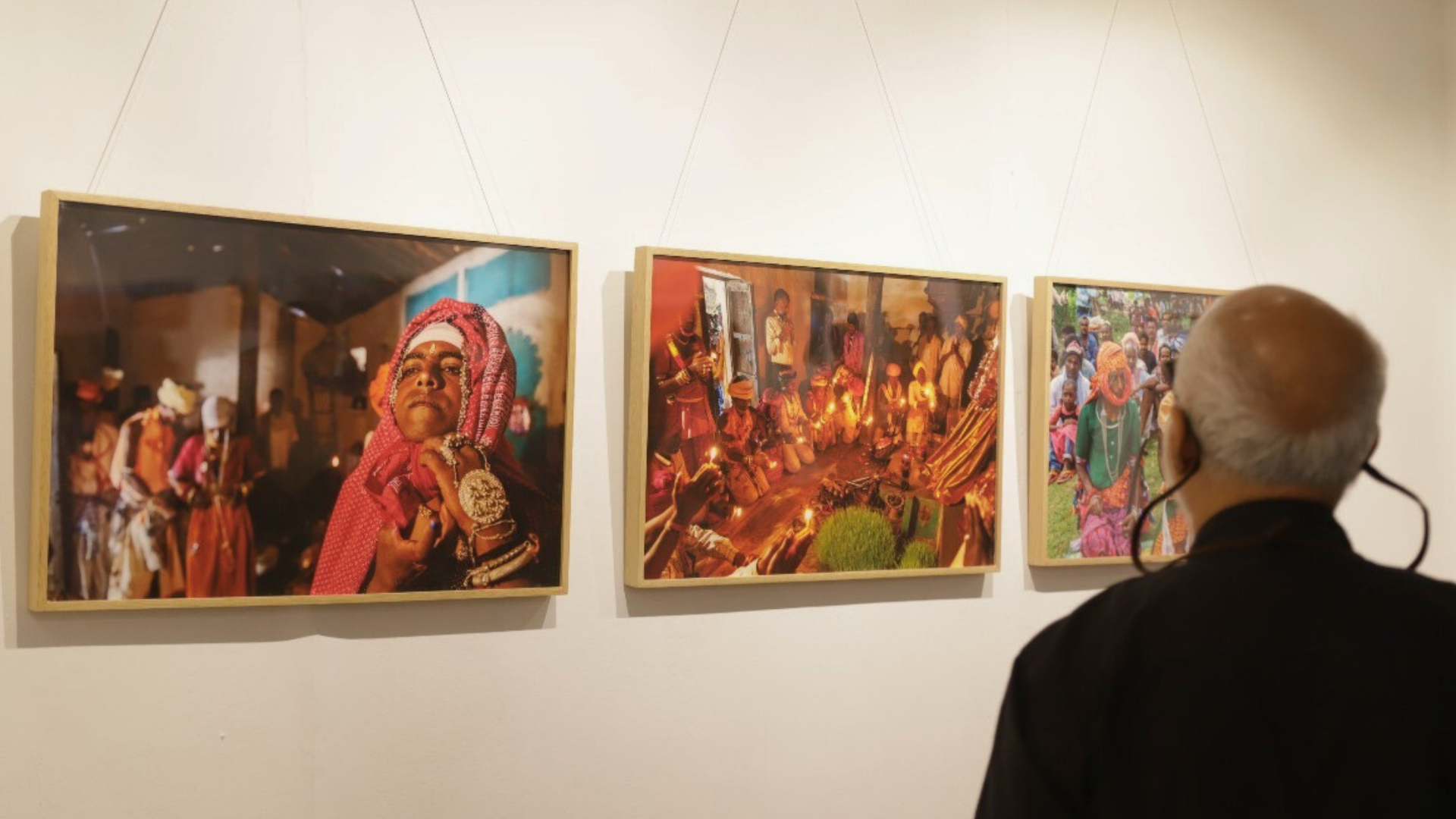
Over the span of the 14 days, the exhibition attracted over 500 attendees (Photo: Media India Group)
A gathering of Mewar Bhil women during Rajasthan’s Gavri festival, dressed in vivid pinks, reds and oranges, the women sit closely together, their colourful attire and jewellery reflecting Bhil cultural identity. The communal scene illustrates both devotion and vibrant unity, as these women participate as supporters and spectators in a ritual that embodies the spiritual and social essence of the Gavri festival.
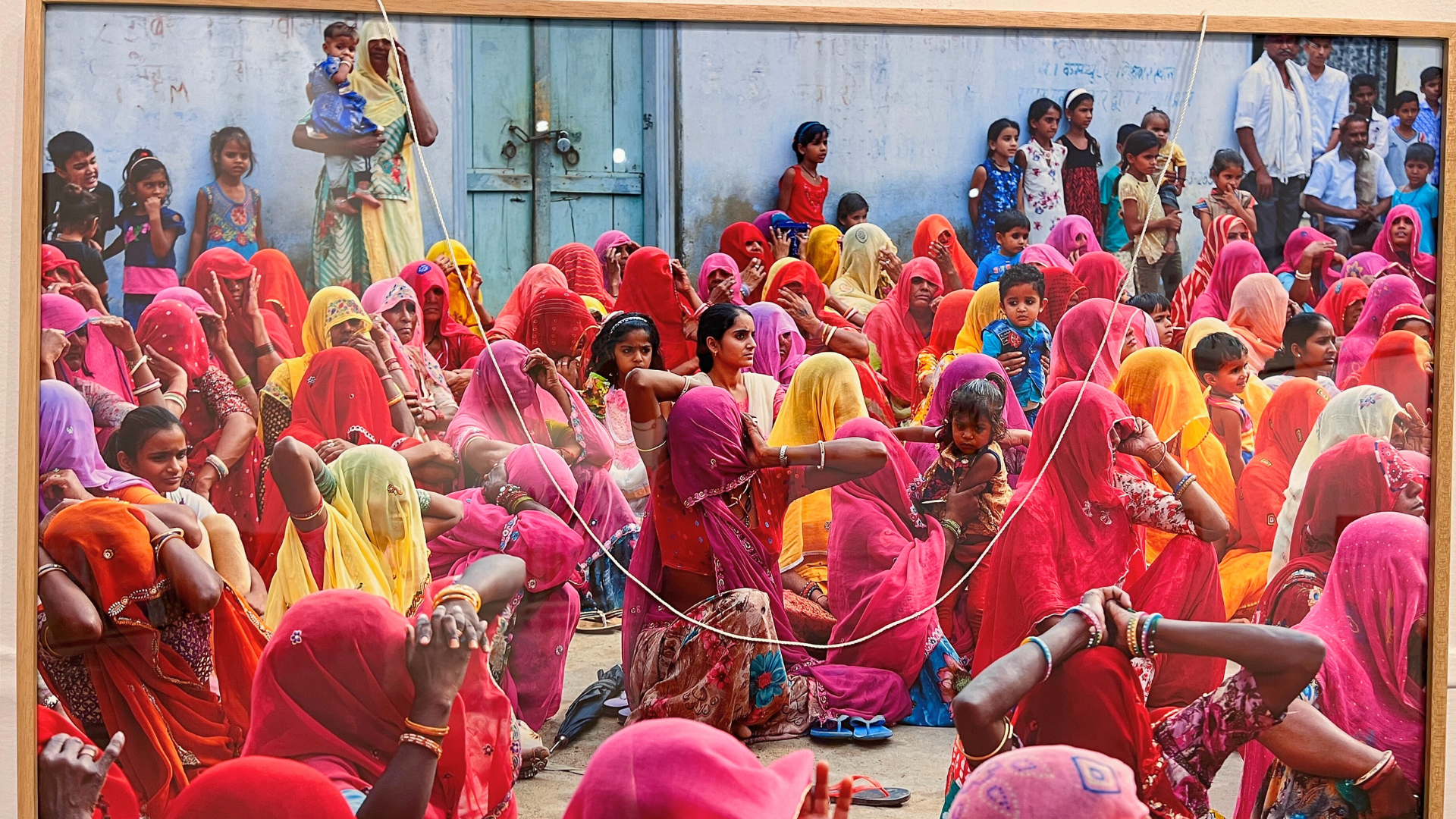
The communal scene illustrates both devotion and vibrant unity
The photograph cited above was one of the 90 showcased in an exhibition titled Playing with the Goddess: Gavri of the Mewar Bhils that concluded on Friday, after a fortnight-long successful run in New Delhi.
Each entry in the exhibition was part of a carefully stitched visual tapestry. Curated by Aditi Ghosh Mehta, an author and a retired Indian Administrative Service (IAS) officer, and captured through the discerning lens of acclaimed photographer Sudharak Olwe, the exhibition offered not merely a display of photographs but more of an immersive journey into the lives and spiritual endurance of the Mewar Bhils, one of Rajasthan’s most marginalised tribal communities based in Udaipur.
“I was posted in Udaipur as an IAS officer. And I had a little office, maybe six, seven staff. One day going on tour, I saw a troupe of Gavli dancers. I loved it. After I finished my work, I was returning and they were still dancing. It was unbelievable to me. So that spoke to me. That, it is just not a dance and I have something to learn. And that is how the journey started,” Mehta, tells Media India Group.
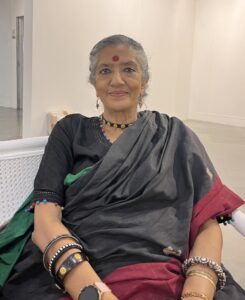
Aditi Ghosh Mehta
“Now the Gavli dancers have succeeded, without even a concerted effort, in creating a criss-cross web of obligations and mutual entitlements. They go as a troupe of dancing gods to villages, creating a web of relationships across Mewar, a real cultural commons,” she adds
The exhibition was inaugurated on July 18, attended by distinguished personalities including Justice of Supreme Court Dipankar Datta, as well as noted photographers Raghu Rai, Pablo Bartholomew, Jhumpa Datta, Ajay S Mehta, and Ravindra Singh.
Over the span of the 14 days, the exhibition attracted over 500 attendees, reflecting a strong public interest in the subject. The visitors were taken through a carefully curated display of 90 powerful photographs, bringing to life the vibrancy and depth of the Gavri festival. Complementing the exhibition was the availability of a comprehensive book authored by Mehta, consisting of three volumes. This monumental work took her 30 years to complete, underscoring her dedication and scholarship in documenting the culture and traditions of the Mewar Bhils.
“I started 30 years ago. As you have to research, you have to talk to the people. I did not know the language of ritual. I did not know anything about the Bhil community,” says Mehta.
At the core of the exhibition was the Gavri, a 40-day ritual theatre festival unique to the Mewar Bhils, which explores myth, gender, divinity and survival in the face of adversity.
Olwe’s photographs did more than document this festival; they brought to light the intricate interplay of devotion and marginalisation that define the Bhil experience. Olwe, who is known for chronicling lives often overlooked by mainstream narratives, articulated his motivation in deeply personal terms.
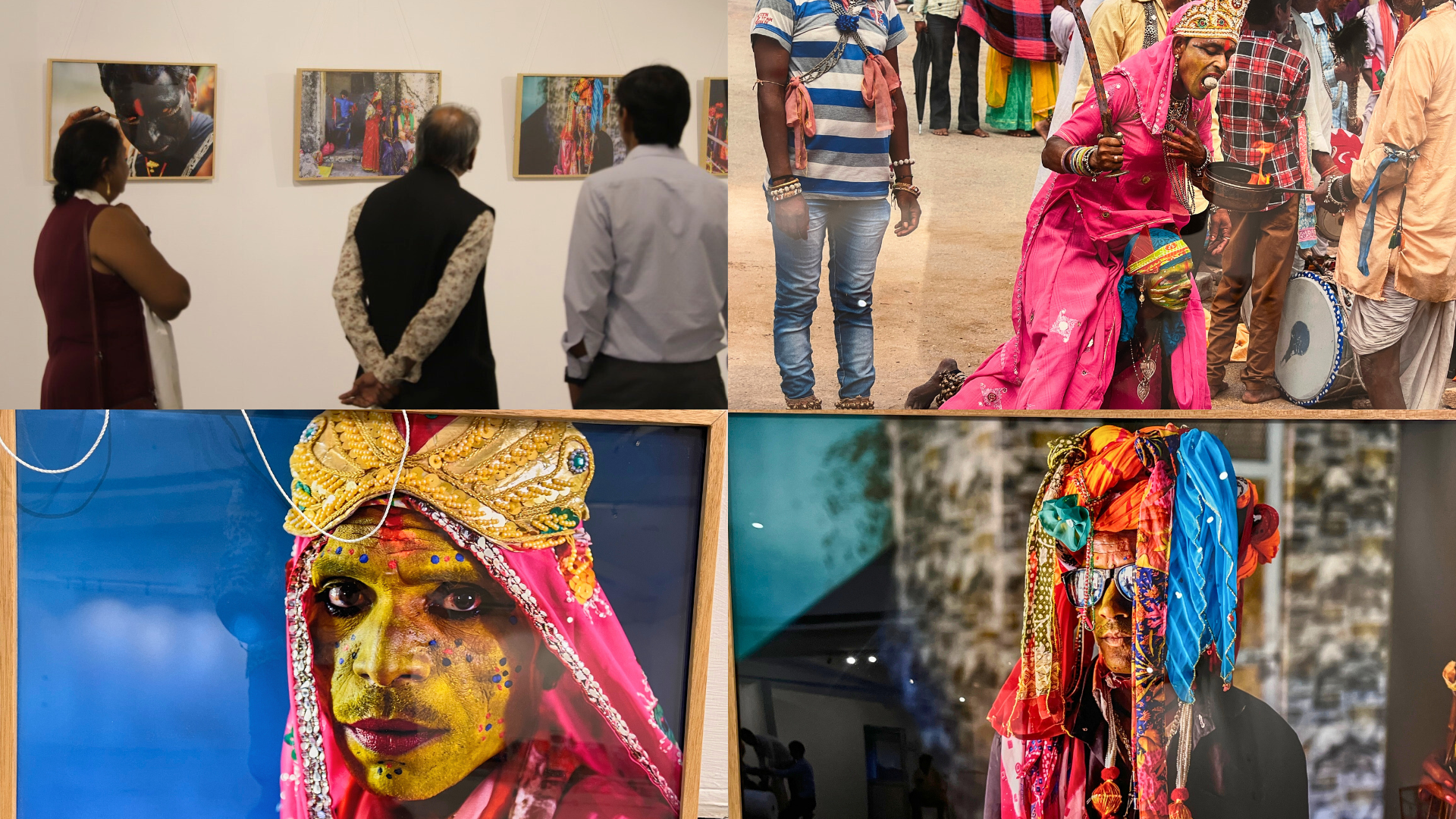
The vibrant visual array, photographs pulsing with the colours of masked processions brought the intangible alive
“I photograph people around the country and mostly marginalised. Mostly Dalit and tribals. The Bhils are tribal and they are very marginalised in Rajasthan. I was photographing them when I met Mehta, who was researching on this subject, and she asked me to photograph this festival. That is how I started this because I mostly do not photograph the festivals. I photograph the condition of the people,” Olwe tells Media India Group.
“The Bhil was my prime point to get up to, turn towards, start photographing them. Which we followed like every day for 40 days of the festival,” says Olwe.
Meanwhile, Mehta’s vision shaped the narrative flow of the exhibit, and was instrumental in connecting Olwe’s lens to the thematic undercurrents of Gavri. Her research on the subject helped anchor the images in a context that was both respectful and revealing.
Olwe was candid about the challenge of editing his work. “Actually, it was very difficult,” he says. Over the intense 40-day Gavri festival, a cascade of striking moments and characters unfurled before his camera. From the boisterous personifications of goddesses to everyday faces etched with resilience, he had to make choices that would both represent the spectacle and remain faithful to the community’s lived reality.
“On the basis of photographic quality of the images I and my team tried to do a story with the photograph. There were over 7,000 pictures that we clicked over the span of 40 days. Out of which we selected those 90 pictures for the collection,” he adds.
For visitors, the exhibition was a revelation. The vibrant visual array, photographs pulsing with the colours of masked processions, sacred enactments, and the daily rhythms of Gavri participants, brought the intangible alive. But beyond the visual spectacle, the exhibition’s depth lay in its ability to provoke inquiry.
Complementing Olwe’s photographs were images by his team Pradeep Paliwal, Mamata Mehta, and Chetan Laxkar, each contributing to the exhibition’s multi-perspective approach.
