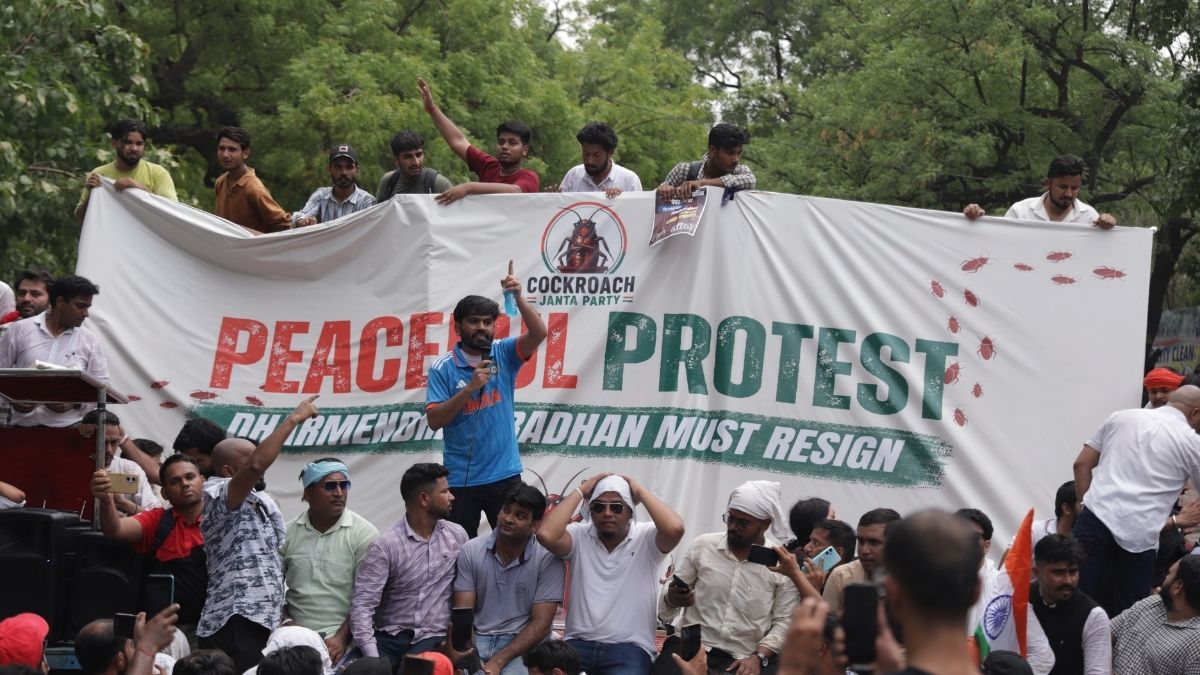
Abhijeet Dipke joined the Delhi protest to demand Education Minister Dharmendra Pradhan's resignation (Photos: Aman Kanojiya)
Hundreds of students, teachers and professionals, from all over India, gathered at Jantar Mantar in New Delhi on Saturday under the banner of the Cockroach Janta Party (CJP), demanding the resignation of Union Education Minister Dharmendra Pradhan over the National Eligibility cum Entrance Test (NEET) paper leak and CBSE marking failures. Abhijeet Dipke, the founder of the movement, led the protest in person after flying back to India for it. Social activist Sonam Wangchuk from Ladakh also joined the demonstration in support.
Delhi Police that had permitted the first-ever public demonstration by CJP watched from the sidelines. The debut protest by CJP was also the first time that Gen Z in India had descended on the streets and support for the gathering was built not through party networks or union registers but through Instagram reels and posts on X, a social media app.
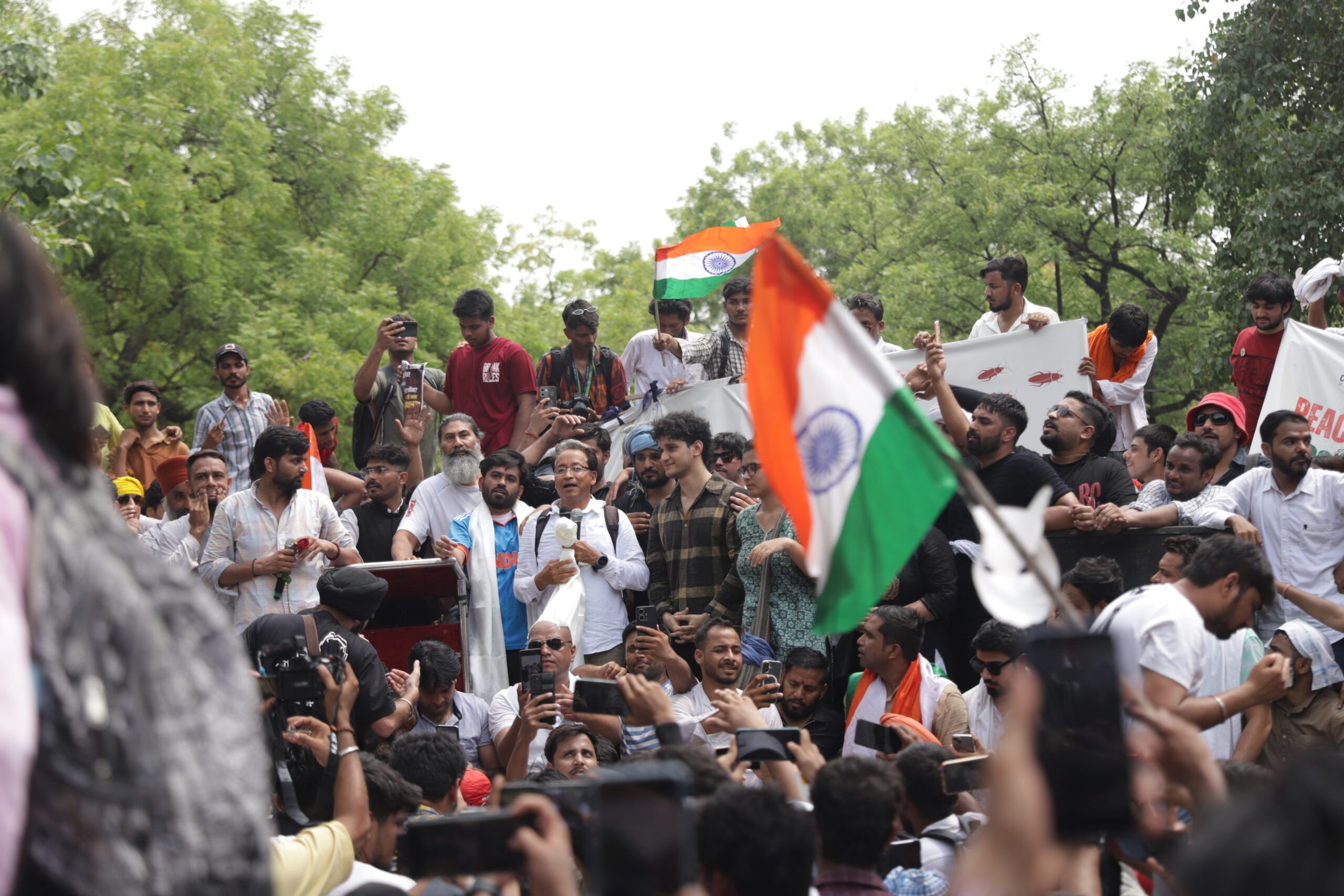
Social activist Sonam Wangchuk from Ladakh also joined the demonstration in support
The protest site filled steadily through the afternoon, with people who had travelled from across the country to participate in the demonstration. Amongst the protestors were students who had appeared for this year’s NEET exam and there were those who were preparing for next year’s. Also in the gathering were teachers, working professionals and people who had taken time off work to be there. The crowd was young in a way that Jantar Mantar protests rarely are. There were no party flags. No one had been bused in.
Also Read: Class 12 On-Screen Marking (OSM) rollout exposes cracks in India’s evaluation systems
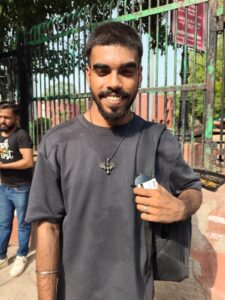
Manash Kalika
Manash Kalika had flown in specially from Assam for the protest. He had just started a job as a chemical engineer in Panipat and had come on his own, without any organisation behind him. He had appeared for his Joint Engineering Entrance (JEE) exam in 2021 and remembers that year, students in his hometown of Guwahati were accused of irregularities during the examination. It did not get the attention it deserved. The following year, something similar happened. The year after, again.
“Every year, every examination, there is something uncommon happening. This year it became completely visible,” Kalika told Media India Group.
He said the CJP protest was the first time he felt that the anger had somewhere to go. “Everyone has anger towards the system. Some initiation was needed. And this was it,” says Kalika.
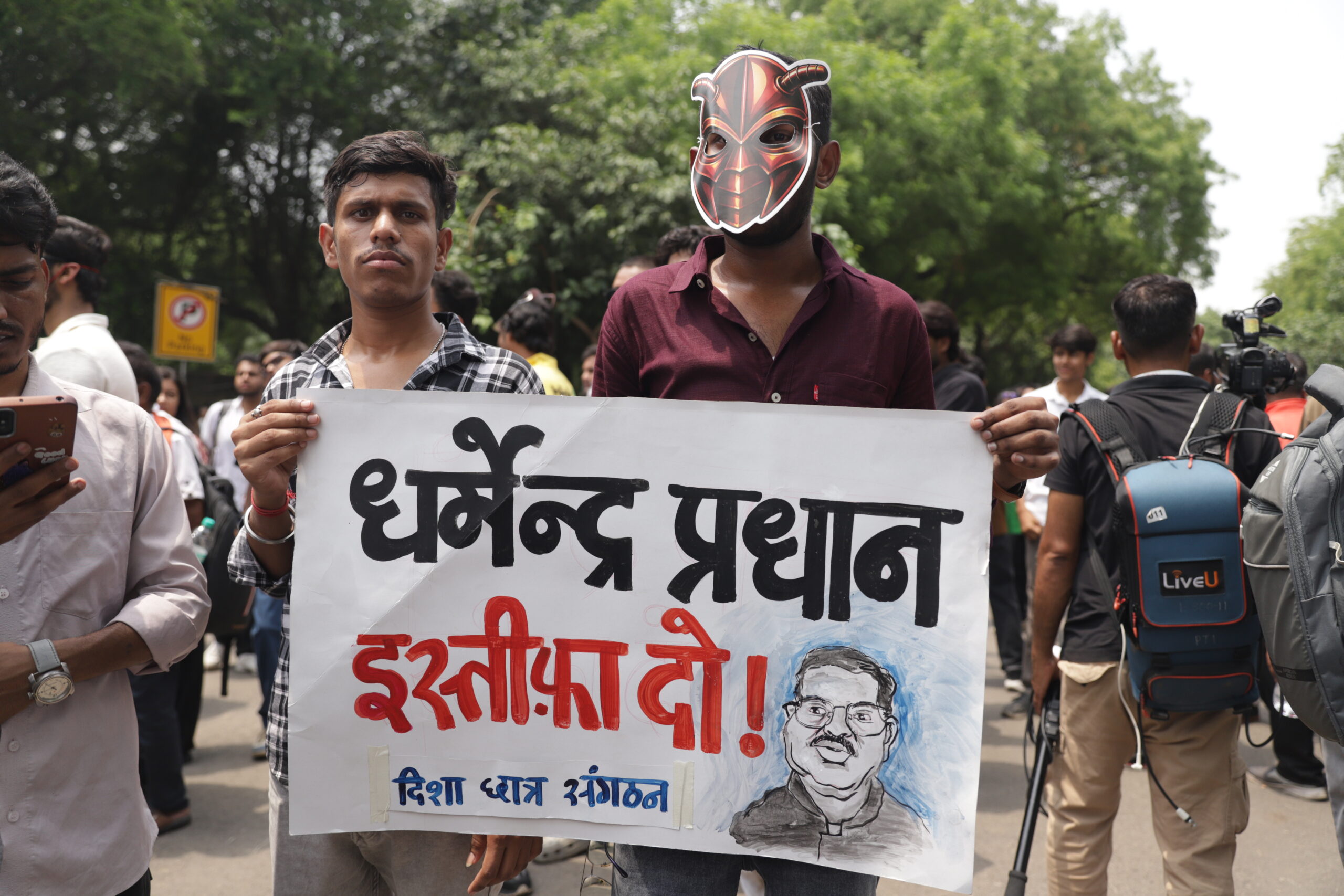
Students demand resignation of Education Minister
“I don’t blame the system. I blame the people. Why don’t you raise your voice? You have education. You have political awareness,’’ he asked.
The immediate cause of the protest was the NEET-UG 2026 examination, held on May 3 for over 2.27 million aspirants, which was cancelled on May 12 after investigations revealed overlaps between a pre-circulated guess paper and the actual question paper. But that was not the only crisis. Days later, the CBSE which had introduced a new On-Screen Marking system this year to evaluate answer sheets, was forced to admit that its OSM system was far from perfect and agreed to re-evaluate all those students who felt that they had not received the right results. The OSM system also faced criticism for blurry scans, technical glitches and delayed resolution, pushing millions of students into uncertainty over their results. Students began publicly documenting incorrect markings and vulnerabilities in the system and their disclosures spread quickly. Finally, over 1 million students filed for re-evaluation of their answer sheets, a number that had never been seen before in the country.
Also Read: Education hampered by lack of investment in health & nutrition, warns UNESCO
But these were not the only blunders by the government in conducting examinations this year. Within about a month, four different examinations, conducted by four different bodies, all fell flat due to improper organisation or unqualified companies conducting these exams.
Besides NEET and CBSE, the Common University Entrance Test (CUET), which determines the allocation of universities to students across the country for undergraduate and graduate studies, was severely disrupted by technical problems, forcing roughly 3,700 candidates to take the exam all over again.
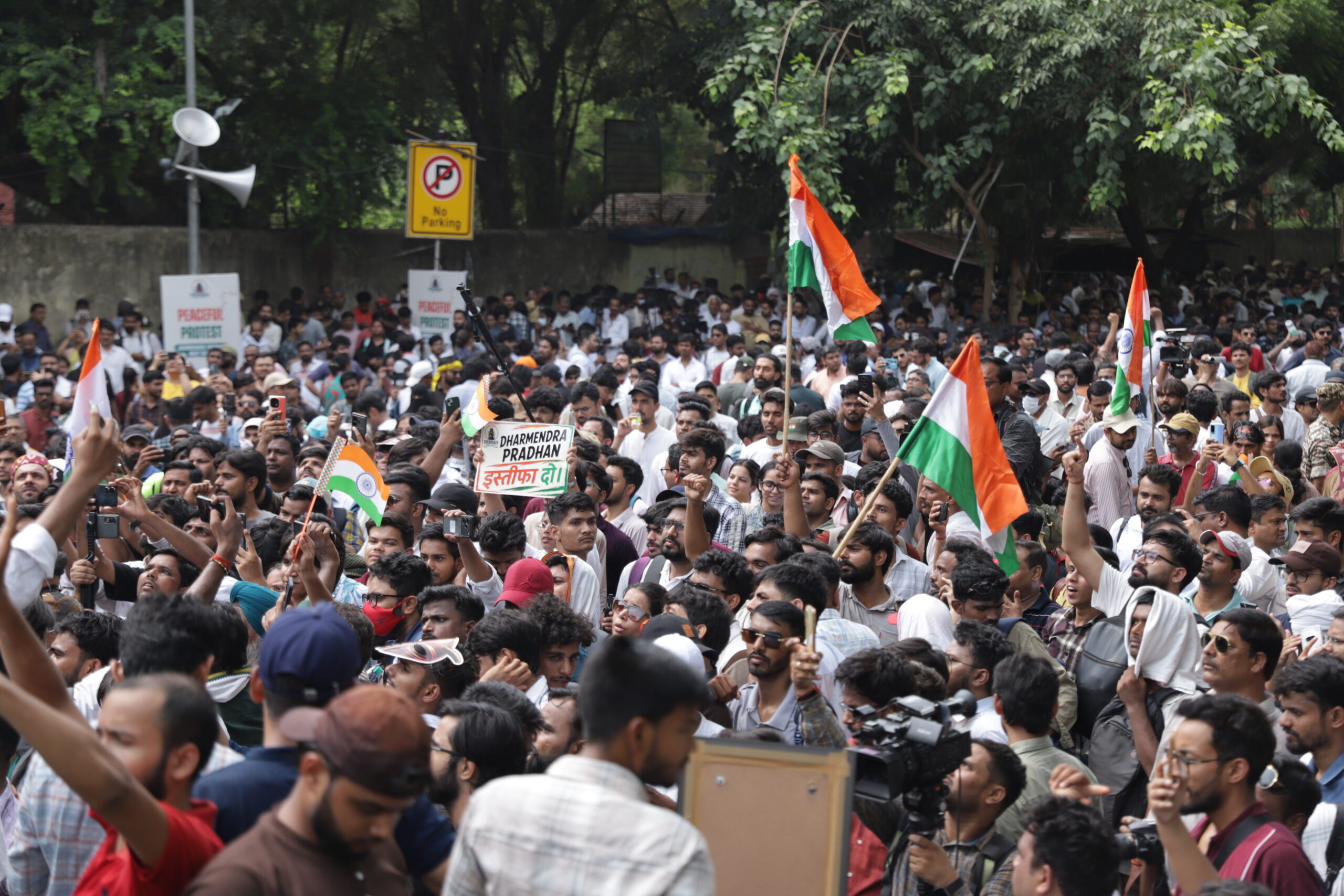
The protest was attended by hundreds of students
In another incident, the Staff Selection Commission (SSC GD) experienced mass centre overbooking, where centres with a 300-student capacity were assigned over 600 candidates, leading to chaos and vandalism in cities across Uttar Pradesh and Bihar.
Despite the repeated crises, the government failed to take any corrective measures and the Education Minister Dharmendra Pradhan refused to take responsibility for the blunders and resign, despite several calls by the opposition parties as well as impacted students and their parents that Pradhan should go.
The government tried to appease the public anger by suspending some officials of the organisations implicated in the repeated failures, but refused any action against Pradhan under whose supervision the failures occurred. Pradhan’s resignation was one of the loudest demands by the protestors on Saturday.
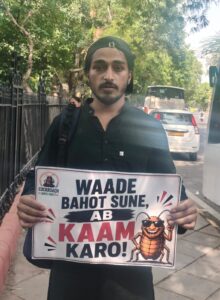
Mohammad Kashif,
“I joined this protest to ask for the resignation of the education minister. The NEET paper got leaked. He is accountable and responsible. It has always been like this if a minister cannot do his job, he resigns. That is how it is supposed to work. But he is still not going,” Mohammad Kashif, a graphic designer based in Okhla, who had joined the protest, told Media India Group.
He also noted, with some surprise, that the Delhi Police had been cooperative the entire day. For a protest that had grown out of social media satire, the significance of an absence of confrontation between the police and the protestors, was not lost on the gathering.
Shyam Kumar, a teacher from Ballia in Uttar Pradesh, says he had been watching paper leaks happen for years and that he had seen it long before it became a national conversation. He said that whenever people raise their voices online about something good, get their accounts blocked, and the pattern of leaks has continued year after year without anyone being held responsible at the top.
“I know my career is over, but I want to fight for my students who work hard for these exams, and then this happens to them,” Kumar told Media India Group.
He also added something that several people at the protest echoed that the demand was not just about one exit. “We don’t only want a resignation. We also want to know who will sit in that chair next. That is equally important. The current party does not have the respect to resign even when they cannot handle things the way they should be handled,” said Kumar .
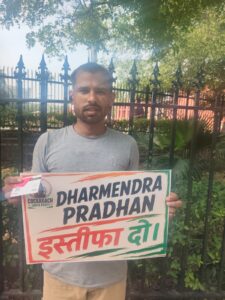
Shyam Kumar
Also Read: Doctors’ stir over NEET PG courses picks pace after police clash
At least four students who appeared for this year’s NEET exam have died by suicide after the examination was cancelled. Among them was Akansha Chaturvedi, a 20-year-old aspirant from Madhya Pradesh’s Mauganj district, living in Nagpur where her father, Krishna Kumar Chaturvedi, worked as a cook. The family found a note in her book after she died. Her father said she had come out of the examination confident and happy.
The moment the news of the paper leak and cancellation broke, he said, she was shattered. On Saturday, Chaturvedi told reporters at Jantar Mantar that he was pulling his younger son out of school entirely.
“It is better to put him into farming than traumatise him with the failure of the system,” he said.
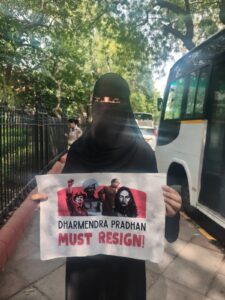
Sheeba Khatoon
DMK, which had ruled Tamil Nadu for the last five years until it lost recent elections, has stated that 119 students have died by suicide over the last eight years linked to NEET-related stress. Activist organisations tracking the current crisis put the number of suicides directly linked to the Education Ministry’s failures this year at 17.
These numbers had faces at Jantar Mantar. Rohan Malick has been preparing for NEET in Delhi for the past two years. He was among the students who had sat for this year’s exam. “Even I got suicidal thoughts sometimes. I have given two years for this exam and the government is not even able to see. If things remain the same, many students will end their lives. Many already have,” Malick, another student, tells Media India Group.
Malick had also sat for the exam. He was not carrying a placard. He was just there, standing in the crowd, which was its own kind of statement.
Shreya Singh, from Jangpura in Delhi, said that she was planning to appear for NEET next year. She said she was no longer certain that it was the right decision. “Right now I am at a stage where I am so confused about what I should do. Should I change my field? Because this has become a pattern now. Papers are getting leaked and nobody is accountable,” Singh told Media India Group.
Singh said she had genuine doubt about whether putting in a year of hard work would lead anywhere at all. “If I work day and night, the same thing will happen. That thought is always there now,” she added.
Sheeba Khatoon, also from Okhla, had come as a student in support of the cause. She said very little but stood through the entire protest. “If students stay silent now, nothing will ever change. We are here because this affects all of us,” Khatoon told Media India Group.
The Cockroach Janta Party was founded on May 16, the morning after Chief Justice of India Surya Kant compared unemployed young people to ‘cockroaches’ and ‘parasites of society’ during a Supreme Court hearing. Abhijeet Dipke announced a platform for all the ‘cockroaches’ out there the following day, listing the eligibility criteria as being unemployed, lazy, chronically online, and able to rant professionally. What started as a sharp response to a judicial remark became, within three weeks, a movement with millions of followers and a physical presence at one of Delhi’s most recognised protest sites.
The broader CJP movement, which includes a students’ union, has organised around demands for transparency in recruitment examinations, mental health awareness among students, and youth representation in governance. Saturday’s protest was its first major gathering on the ground and it drew people who had never attended a protest before alongside people who had been trying to be heard for years. Whether Pradhan resigns immediately or not, the people who had come to Jantar Mantar on Saturday made one thing clear, they were not going to stop asking for his resignation.