

Indian temple architecture spans several millennia, paralleling the nation's complex religious, cultural and political history
In the recent years, Indian temple architecture has witnessed a fascinating blend of tradition and modernity. One striking example from 2025 is the contemporary interpretation of temple designs that celebrate India’s rich cultural heritage while embracing minimalist aesthetics and innovative materials. These modern temples, spread across various regions, reflect deep respect for ancient styles but respond to present-day sensibilities, illustrating how temple architecture continues to evolve dynamically.
The historical evolution of Indian temple architecture spans several millennia, paralleling the nation’s complex religious, cultural and political history. Indian temples are not just religious centres but embodiments of artistic, social, and technological achievement, reflecting distinct regional styles and philosophies. Understanding this evolution requires exploring the major architectural styles developed across India’s diverse regions and historical periods.
Broadly, Indian temple architecture is divided into three classical styles, namely Nagara which is essentially North Indian, Dravidian that is popular in South India and Vesara or a hybrid of the two found in the Deccan plateau. Each style has defining features in layout, vertical elevation and ornamentation, often influenced by local culture, climate, and available materials.
Nagara style (North Indian temples)

Temples exhibit a clustered arrangement of spires that ascend upwards, symbolising the mythical Mount Meru
The Nagara style prominently features curvilinear towers called shikharas, typically constructed using sandstone or marble. Temples exhibit a clustered arrangement of spires that ascend upwards, symbolising the mythical Mount Meru, the abode of Lord Indra, considered the king of gods in Hindu cosmology. The interiors house a sanctum sanctorum or garbhagriha, where the main deity resides, with surrounding halls or mandapas for devotees.
An iconic illustration is the Birla Mandir in Jaipur, completed in 1988 but embodying Nagara characteristics with its towering spire or shikhara and intricate carvings of mythological narratives. The temple combines red sandstone and white marble, creating a visually striking contrast that is both spiritual and artistic. Craftsmen designed arched entrances and domes influenced by Mughal architecture, showcasing a syncretism rare in temple construction.
The temples at Khajuraho in Madhya Pradesh, built between the 10th and 12th centuries by the Chandela dynasty, serve as masterpieces of the Nagara style. These temples are renowned not only for their soaring spires but also for delicate sandstone carvings that include extraordinary depictions of human figures and mythology, including famously complex erotic sculptures.
Dravidian style (South Indian temples)
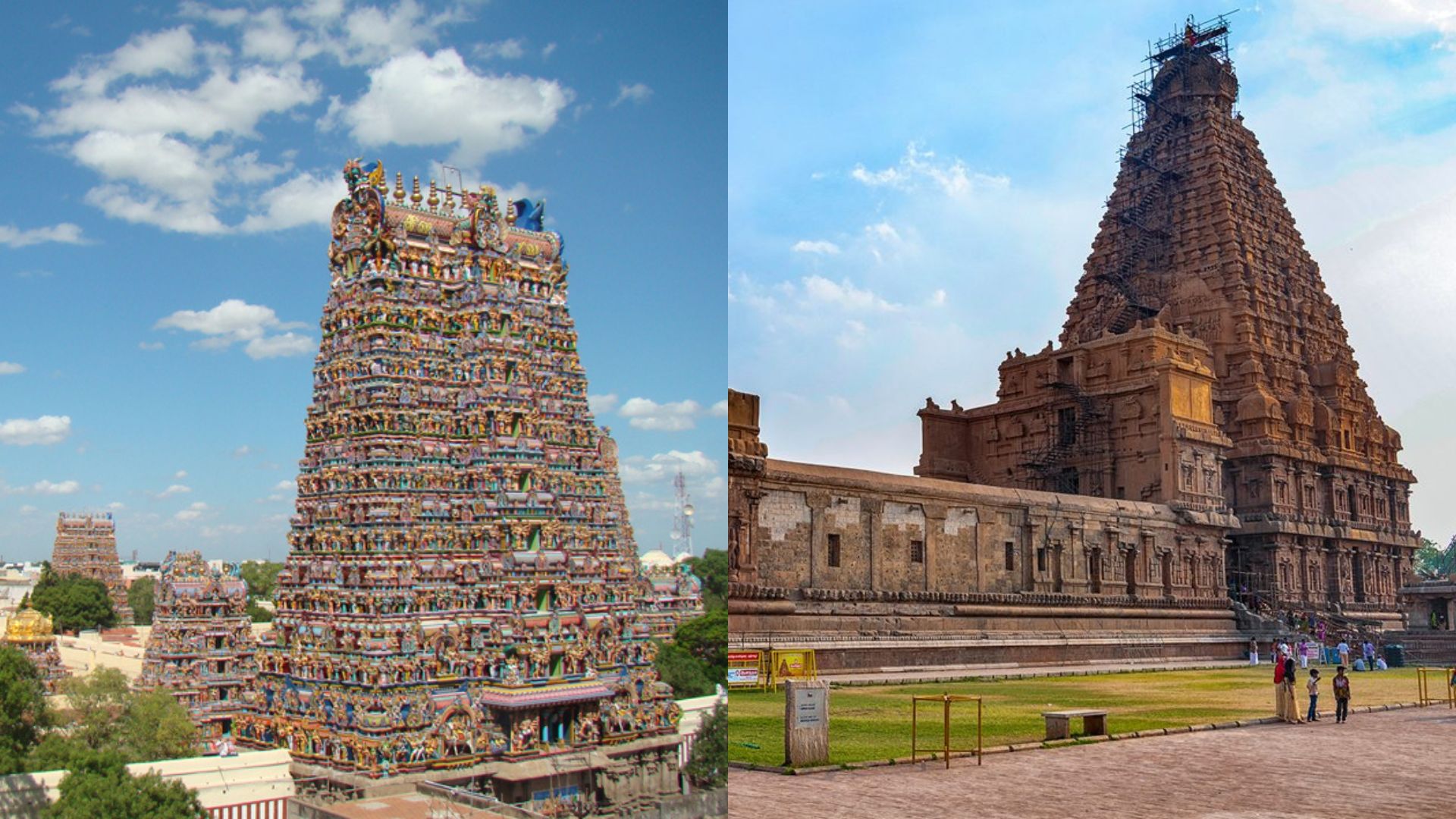
South Indian temples use granite and sandstone extensively, highlighting durability and grandeur
South India’s Dravidian temple style is distinguished by pyramid-shaped towers called vimanas over the sanctum and massive, elaborately sculpted gateway towers known as gopurams. These structures use granite and sandstone extensively, highlighting durability and grandeur. The temples serve as cultural hubs where religious rituals, music, and dance thrive.
One of the most renowned Dravidian temples is the Meenakshi Temple in Madurai, Tamil Nadu, featuring sculpted gopurams adorned with thousands of colourful figures that depict gods, demons and mythical stories. The temple complex also includes vast pillared halls and water tanks, demonstrating advanced urban planning. Its architecture is a harmonious blend of functionality and ornate symbolism, attracting millions of pilgrims and tourists.
The Chola dynasty further enhanced the Dravidian style through monumental temple constructions like the Brihadeeswarar Temple in Thanjavur, built in the 11th century. This temple’s vimana reaches over 70 m, and its massive monolithic shikhara is capped by an enormous granite kalasha (finial). The precision and scale demonstrate highly advanced engineering techniques. Stucco figures and intricate sculptures detail the epic narratives and religious themes central to Shaivism.
Vesara / Deccan style (Central-southern Indian temples)
The Deccan region developed temples blending northern Nagara and southern Dravidian features, often called Vesara style. The Kailasa Temple at Ellora, a UNESCO World Heritage Site, in Maharashtra exemplifies this tradition. Carved from a single basalt rock in the 8th century, this monolithic structure represents both architectural ingenuity and spiritual vision. It emulates a freestanding temple with a richly decorated vimana and courtyard sculptures of mythical animals and deities, serving as a model of combined influences.
Regional and cultural variations
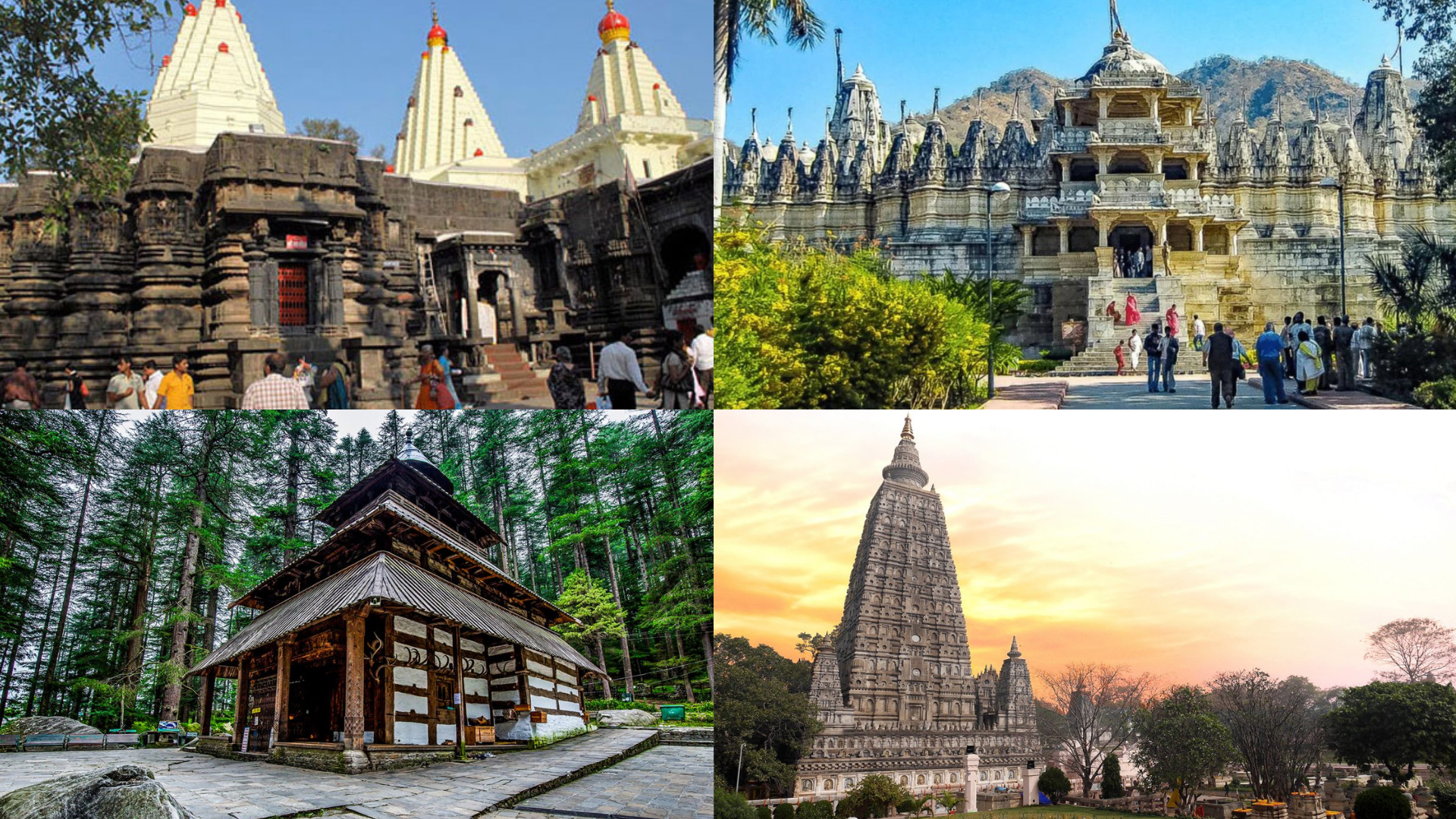
These structures highlight a unique fusion of nature and spirituality
Beyond these primary styles, Indian temple architecture reflects considerable regional diversity. Temples in West India, such as the Mahalakshmi Temple at Kolhapur in Maharashtra, showcase intricate carving work on black stone and spacious mandapas adorned with sculptures epitomising local traditions.
In the Northeast, temples like Hadimba Temple in Manali incorporate indigenous materials such as wood and feature designs integrating with the forested environment.
These structures highlight a unique fusion of nature and spirituality, differing significantly from the stone-dominated forms elsewhere.
Jain temples, such as the Dilwara Temples on Mount Abu, emphasise marble craftsmanship and symmetry. These temples display detailed floral and geometric carvings, highlighting Jain philosophical ideals through architectural design. Buddhist architecture also contributed uniquely, with stupas and monasteries like the Mahabodhi Temple in Bodh Gaya embodying spiritual milestones through brick and stone construction.
Evolution over time and technological advances
Indian temple architecture has evolved through dynastic changes, religious developments and regional influences. The earlier cave temples gradually gave way to structural temples with grand elevations. Construction techniques advanced with improved stone quarrying, carving, and engineering knowledge, enabling larger and more complex temples.
In modern times, architectural computation and digital tools assist in recreating intricate patterns and features with precision, preserving traditional aesthetics while optimising construction. Contemporary temples incorporate minimalist design elements yet maintain symbolic proportions and motifs that link them to their historical roots.
FAQs
What are the main styles of Indian temple architecture?
The three classical styles are Nagara (North Indian), Dravidian (South Indian), and Vesara (Deccan or mixed style).
What is a garbhagriha in a Hindu temple?
It is the sanctum sanctorum, the innermost chamber where the main deity is housed.
What is the difference between a shikhara and a vimana?
A shikhara is a curvilinear tower above North Indian temples, while a vimana is a pyramidal tower over South Indian temples.
What are gopurams and where are they found?
Gopurams are large, elaborately carved gateway towers, characteristic of South Indian Dravidian temples.
