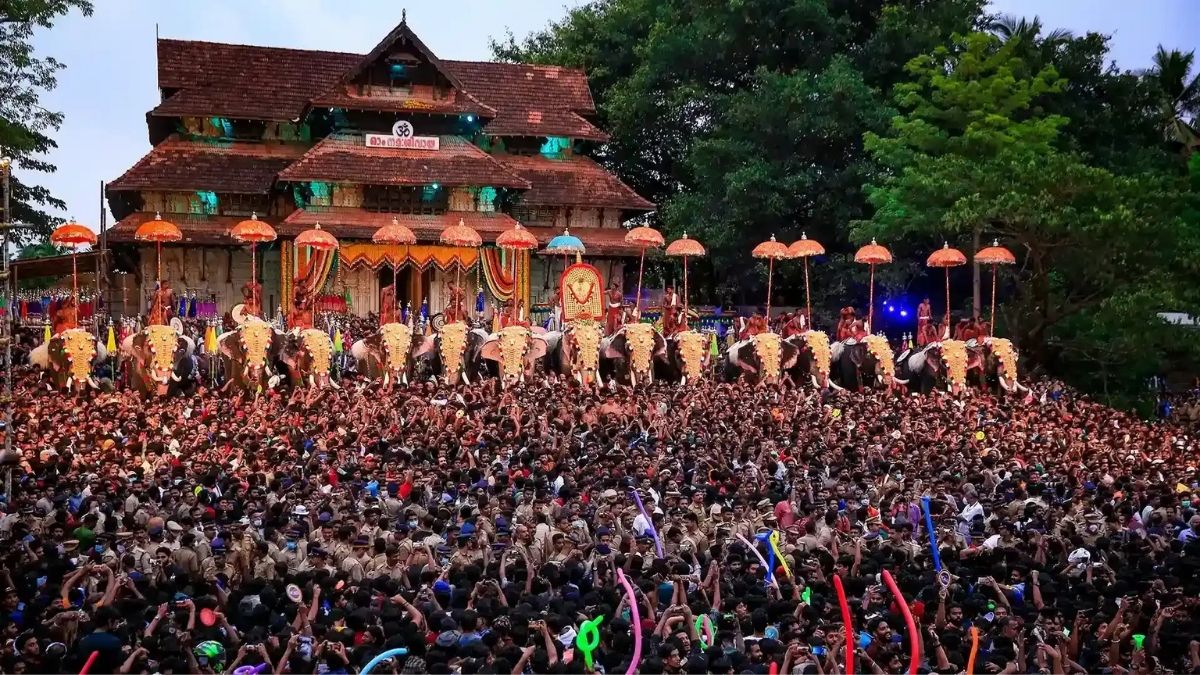
Thrissur Pooram brings together devotion, rhythm and spectacle through elephants, percussion and ritual display (Photos: Kerala Tourism)
Bringing together temple groups such as Paramekkavu Bhagavathy temple and Thiruvambady Krishna temple along with thousands of devotees and artists, Thrissur Pooram is a grand celebration held each year in late April or early May at the Vadakkunnathan temple in Thrissur, Kerala.
Initiated in the 18th century by Sakthan Thampuran, Thrissur Pooram is marked by decorated elephants, chenda melam percussion, umbrella exchanges and coordinated temple rituals that blend devotion, structured rivalry and Kerala’s rich cultural performance traditions.
Today, it stands as a defining expression of Kerala’s culture, where religious worship blends with artistic quality, structured competition and communal participation. What makes it different is not only its scale but also its precision, where every ritual performance is timed, coordinated and executed with remarkable discipline.
Though primarily centred in Thrissur, Kerala, Thrissur Pooram’s influence is spread across the state through participation of artists, temple committees and devotees from multiple districts. This collective involvement transforms the festival into a shared cultural cultural event instead of isolated religious practice.
Rooted deeply in Hindu temple traditions of Kerala, especially those associated with Shiva and Bhagavathy worships. The festival also draws participation from a wide range of social groups including artisans, percussionists, elephant caretakers, traders and residents. While similar temple festivals exist across Kerala, Thrissur Pooram remains the most widely recognised due to its scale and visual intensity.
Also Read: Theemithi: Walking through fire in devotion and faith
Origin and historical foundation
Thrissur Pooram origin can trace back to late 18th century under Maharaja Sakthan Thampuran of the Kingdom of Cochin, who reorganised temple festivals in the region.
Before this, temples conducted smaller, separate celebrations that often lacked coordination. Sakthan Thampuran brought these together into a single structured event, ensuring equal participation while managing rivalry between temple groups.
This reorganisation established Thrissur Pooram as a unified temple festival that balances cultural harmony with symbolic competition, laying the foundation for its present form.
Mythology, ritual structure and symbolism
While not tied to a single mythological narrative, Thrissur Pooram is deeply embedded in Hindu devotional traditions centred on Lord Shiva and goddess Bhagavathy.
The festival symbolises devotion to Shiva at the Vadakkunnathan temple, collective worship through coordinated temple participation and ritualised competition as a form of devotion.
The structured rivalry between temple groups is symbolic, expressing artistic excellence and spiritual commitment. This controlled competition is central to the festival’s identity and meaning.
Thrissur Pooram serves multiple spiritual and cultural purposes. It honours Lord Shiva while bringing together temple communities. It also preserves Kerala’s traditional art forms and ritual performance practices, while strengthening community identity through collective participation. The festival reflects how spirituality in Kerala is closely intertwined with music, visual expression and disciplined performance.
Also Read: Capturing unique rituals & myths of Mewar Bhils through lens
Key elements of the festival
Thrissur Pooram is defined by a series of highly structured and visually striking rituals. Elephants adorned with gold-plated ornaments form a central visual element, while chenda melam creates powerful rhythmic soundscapes through large percussion ensembles.
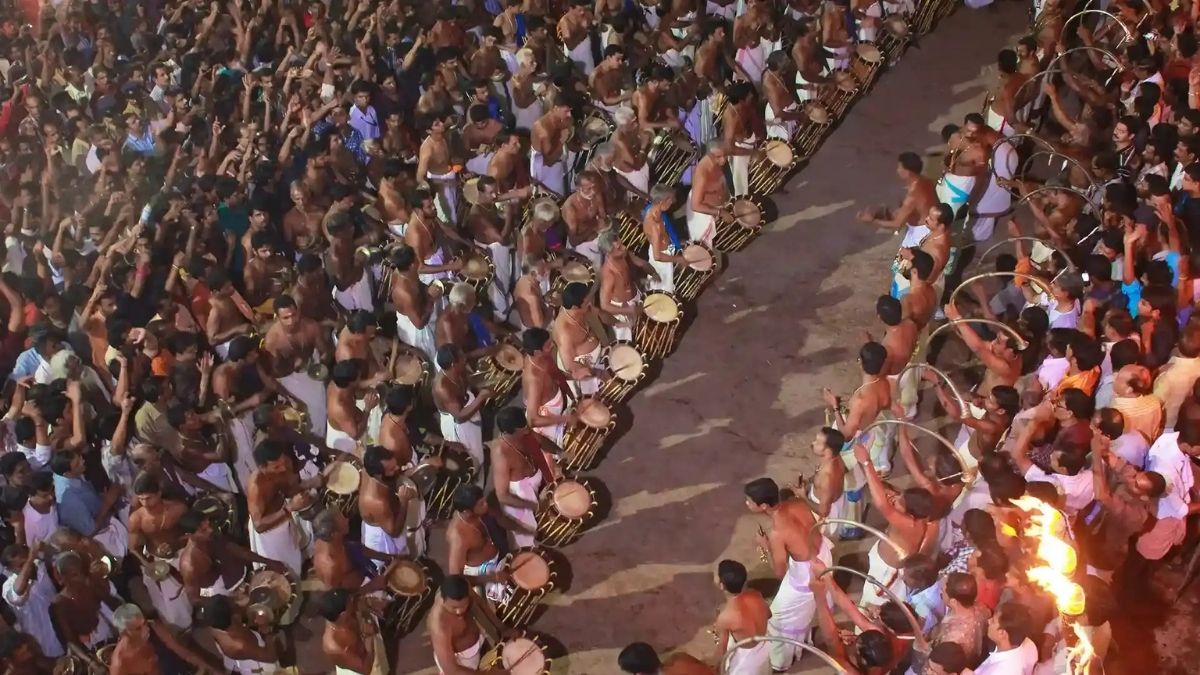
Powerful rhythmic waves rise as percussion ensembles perform in perfect synchrony
The Kudamattam, or umbrella exchange ritual, features synchronised and rapid exchanges of brightly coloured umbrellas atop elephants, creating a dramatic visual display.
Another defining feature is the Ilanjithara Melam, a massive percussion performance held under the Ilanji tree within the temple grounds. Hundreds of percussionists perform in harmony, building rhythm and intensity in a structured progression that is considered one of the finest examples of traditional Kerala percussion.
The Elanjithara Melam is complemented by Panchavadyam, a classical ensemble of five instruments that adds layered musical depth to the festival atmosphere.
The procession of decorated elephants, each adorned with gold-plated headgear called nettipattam, ceremonial fans and ornaments, forms a central visual identity of the festival.
Another key ritual is the grand fireworks display, often held in the early hours, which is not merely celebratory but also competitive, with different temple groups.
Each element is precisely timed, contributing to a festival that blends devotion with spectacle.
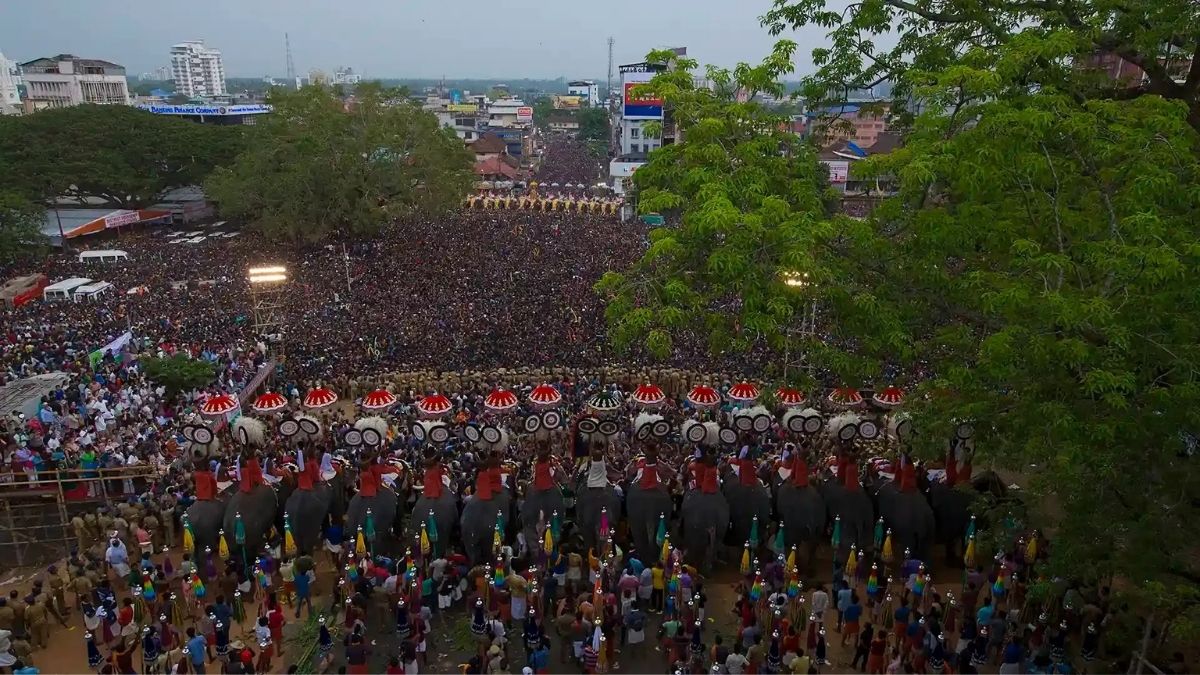
Kudamattam showcases rapid umbrella exchanges atop decorated elephants in a synchronised display
Preparation and performance
Preparation for Thrissur Pooram begins well in advance and involves extensive coordination among temple committees, artists and local communities.
Percussionists undergo rigorous rehearsals, caretakers prepare elephant for ceremonial roles and organisers manage complex schedules and ritual sequences. Devotees and volunteers contribute to decoration, logistics and ceremonial arrangements.
During the festival, the atmosphere is shaped by continuous drumming, chants, fireworks and dense crowds, creating an intense and immersive environment of devotion and celebration.
Also Read: Kerala & Kadammanitta Padayani festival and its many colours
Community, identity and shared culture
Thrissur Pooram is deeply embedded in Kerala’s social fabric. It reflects strong connections to temple traditions, local identity and generational transmission of artistic skills such as percussion and ritual performance.
Communities participate collectively in both preparation and celebration, sharing an understanding of rivalry as symbolic and unifying rather than divisive. Respect for discipline, timing and coordination underpins the entire event.
The festival acts as a cultural bridge, reinforcing social unity through shared experience and participation.
Relevance in the present day
Today, Thrissur Pooram has grown beyond a purely religious event into a major cultural landmark of Kerala. It attracts visitors from across India and abroad, contributing to tourism and local economies.
Despite evolving in a contemporary context, the festival retains its core identity as a temple-centred celebration rooted in devotion, discipline and collective expression.
Thrissur Pooram is a carefully arranged cultural symphony where devotion becomes performance and ritual transforms into show. It represents a unique system in which temples, communities and artists come together to express faith through sound, colour and movement, sustaining centuries-old traditions while continuing to evolve within modern Kerala.