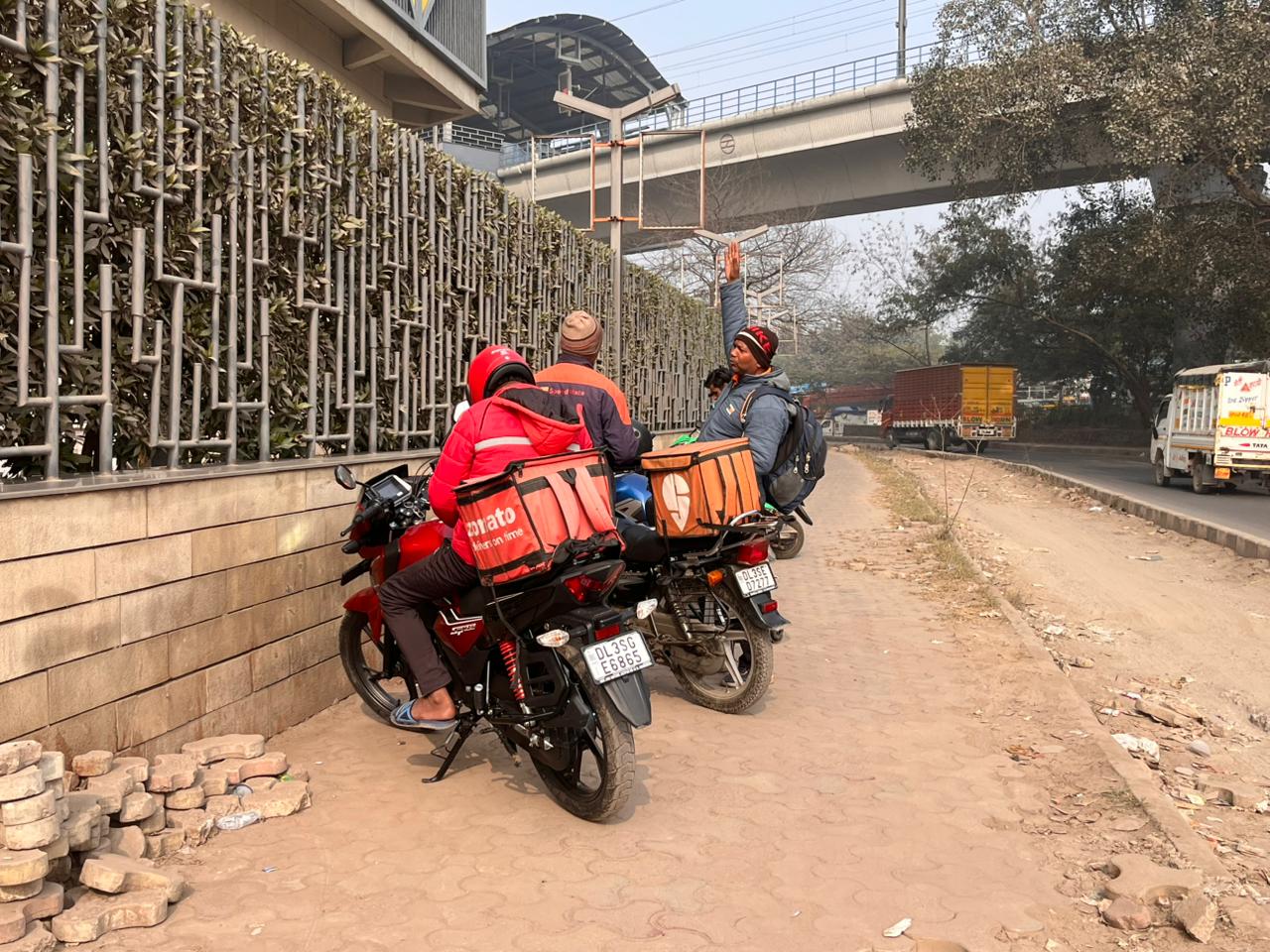
Quick Commerce companies including Blinkit and Zepto have dropped the 10-minute delivery promise (Photo: MIG)
About a fortnight after quick commerce workers staged a day-long strike in protest against their working conditions, notably a 10-minute delivery window and unstable earnings, leading Quick Commerce companies including Blinkit and Zepto have dropped the 10-minute delivery promise.
On Tuesday, after a statement by the Union Labour Ministry, that said the 10‑minute promise forced riders into risky road behaviour and gruelling shifts, the ultra-fast delivery has disappeared from these platforms.
While the gig workers have welcomed the move to end the unreasonably short delivery windows, they say that their other issues still remain unaddressed.
Also Read: Nationwide strike by gig workers on Dec 31, against Q-commerce, falling pay
At Jasola Vihar in South Delhi, Surrender Kumar, a delivery boy for a quick‑commerce platform, welcomed the end of the 10‑minute promise but immediately focussed on the deeper issues he faces.
“I am very happy they dropped the 10-minute delivery. We were always rushing, running between settlements and risking our lives. But we earn so little now that I want them to also raise our pay, because what we get hardly covers petrol and food,” Kumar tells Media India Group.
Kumar’s sentiments reflect long-standing complaints among gig workers nationwide, about low pay, unpredictable hours and little to no job security. Delivery partners often work 10–14 hours a day to make ends meet, with take‑home pay that varies widely depending on incentives and order volumes. Another rider, Mohammad Salman, admitted he hadn’t even heard about the policy reversal.
“I heard people talking that something changed, but I didn’t know exactly what. For us, nothing will really change until we see more money right now, people work so much and still struggle to buy things for their own families,” Salman tells Media India Group.
Also Read: No instant gratification for Q-com workers
He adds that there were many instances when even slight delays resulted in fines and in several cases, workers were blocked by the app for failing to reach within the given time.
Not all customers are celebrating the change. While some feel relieved that riders aren’t under extreme pressure, others question the value of ordering online if deliveries slow down.
“I am happy the 10‑minute delivery is gone. Riders were under too much pressure and honestly, slower deliveries don’t bother me as long as they are safe,” Reenu Shah, a working professional in Delhi, tells Media India Group.
In contrast, Jeet Singh, another Delhi resident, tells Media India Group, “If it takes 20 minutes now, why would I order online? I can go to the shop and get it in 5–10 minutes myself. The convenience is lost if delivery is not really faster than doing it myself.”
For government officials and labour activists, the removal of ultra‑fast deadlines is only the first step. They says that it must be paired with minimum earnings safeguards, insurance cover and clearer working standards if the gig economy is to be sustainable and humane. For delivery boys like Kumar and Salman, the next protest if it comes won’t be about marketing claims. It will be about earning enough to live on.
“Speed was not the real problem, it was that we never saw a fair share of what the company makes from our work,” Kumar said.
The Gig Workers Association (GigWa), an association based in Delhi, that has been at the forefront of recent protests against ultra-fast delivery timelines, welcomed the removal of the 10-minute delivery promise but cautioned that the move addresses only one part of a much deeper crisis facing delivery workers. The association said the rollback validates long-standing concerns that extreme timelines endanger workers, while stressing that structural issues around pay, working hours and algorithmic control remain unresolved.
Also Read: Customers discover pitfalls of quick commerce
“We welcome the rollback of the 10-minute delivery promise because it finally acknowledges what workers have been saying for months that these extreme timelines put our lives at risk. But we want to emphasise very clearly that this is only the beginning. Removing a marketing claim does not automatically remove the pressure on workers. Long working hours, unstable earnings, unpaid multi-order deliveries and constant algorithmic surveillance are still very much part of our daily reality. What platforms call ‘flexibility’ is, in practice, forced availability, where workers stay logged in for 10 to 14 hours out of fear of losing incentives or future work. Even a single delayed order can wipe out an entire day’s earnings. Speed was never the core issue the real problem is that workers carry all the risk while companies keep the profits,” Nitesh Kumar Das, Organising Secretary, Gig Workers Association tells Media India Group.
He emphasised the need for a permanent institutional mechanism for collective dialogue between workers, platforms and the government, warning that in the absence of such a system, workers are repeatedly pushed towards strikes and protests simply to be heard. He stressed that convenience cannot come at the cost of workers’ safety and dignity, adding that they are not asking for charity but for fair pay, transparency and recognition of their labour.