
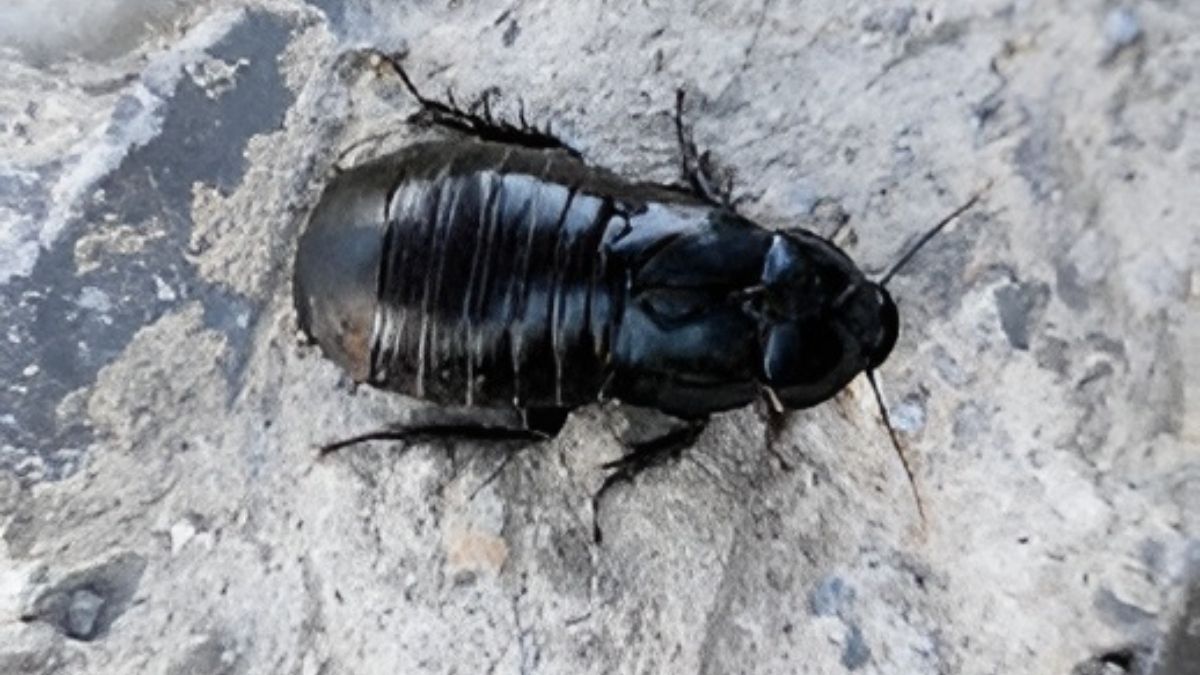
ZSI scientists unveil genetic barcode library of cockroaches, revealing hidden native diversity beyond their reputation as pests
But away from all this political drama about cockroaches, just 10 days after the comments by CJI, on May 25, a research team comprising scientists from the Zoological Survey of India (ZSI) released the genetic bar-code library of cockroaches to uncover hidden native diversity. A press release by the Press Information Bureau of India included a term, ‘Beyond Pests’! The findings of the ZSI scientists were published in the prestigious international taxonomy journal, Zootaxa.
The finding is an important milestone in understanding these insects that we have all seen and most of us detest, trying to eliminate them by spraying pesticides or just stomp on them. But the ZSI team showed that cockroaches are much more than mere pests. And they are no ordinary mortals! They offer a masterclass in resilience, adaptation and systems thinking. The finding invites humanity to reconsider how it defines value in the biosphere and how often civilisation mistakes ecological necessity for inconvenience.
The United Nations Convention on Biological Diversity (CBD) , established in 1992 during the Rio’s Earth summit, has its primary objective of preserving the planet’s life support systems through three main pillars, namely conserving biodiversity, utilising resources sustainably, and equitably sharing genetic benefits. The CBD promotes living in harmony with nature and understanding the vital functions that living creatures perform and as many as 196 countries are signatories to CBD, making it one of the most universally-accepted global pacts.
The CBD Treaty requires each nation to study and protect their native wildlife and here is the key role played by these pesky pests who never seem to disappear, irrespective of the number of pest controls one may get. Scientific studies show that countries like India are home to nearly 200 species of cockroaches. And contrary to our popular misplaced notion, a vast majority of these are native and live harmlessly in forests or caves. UN CBD, views cockroaches as an important part of natural ecosystems. While a few species are urban pests, ‘Global CBD Reports’ highlight their vital ecological roles in breaking down organic matter and recycling soil nutrients and it says that all species of cockroaches, have an evolutionary place in biodiversity.
Nature does not create and does not support redundancy. Every surviving species carries a lesson written millions of years back. Nature, the greatest teacher, classroom and observatory with 4.5 billion years of experiential learning, tells this story vividly. The tragedy is that human-species are the only students in nature’s class that have not paid attention to the teacher. The tragedy is not that the cockroach exists. The tragedy is that humanity has yet to understand why it exists.
Crucial role of cockroaches
For generations, humanity has looked at the cockroach with disgust. It has become the universal symbol of dirt, nuisance and unwanted survival. We crush it without hesitation, ridicule it in popular culture and associate its presence with poor hygiene and urban decay.
While cockroaches are widely misunderstood and stereotyped purely as household pests, most of the wild species are harmless, in fact they paly critical role of supporting and regenerating the vital parts of nature including soil. As one of the oldest and most diverse insect groups on earth, they play a vital role in maintaining natural ecosystems by decomposing organic matter, recycling nutrients, and supporting forest food webs. As these wild species are highly sensitive to environmental disturbances, they serve as crucial indicators of ecosystem health.
These findings shift the focus away from household pests to celebrate the country’s hidden, wild insect wealth. India’s official biodiversity assessments, updated by the Zoological Survey of India (ZSI), show that India is home to 191 distinct cockroach species, and more than 60 pc of them (119 species) are endemic, meaning they are found nowhere else on Earth!
The wisdom of Nature’s Supreme Court
Long before humans built cities, before mammals dominated the land and even before dinosaurs appeared, the ancestors of today’s cockroaches had already found their place in Earth’s evolving systems. For more than 300 million years they survived continental drift, volcanic winters, ice ages and mass extinctions. Entire branches of life disappeared, while the cockroach lineage continued to adapt.
Nature rewards not arrogance, but adaptability. This lesson is increasingly relevant in an era of climate disruption, where resilience rather than dominance will determine the future of both ecosystems and civilisations.
We should not judge an entire civilisation by a few individuals . Worldwide, science recognises thousands of cockroach species. Only a tiny fraction have adapted to human settlements and become what we call household pests. The overwhelming majority spend their lives unnoticed in forests, wetlands, grasslands and natural ecosystems, participating quietly in the grand cycles that sustain life. Humanity has condemned an entire evolutionary family because a few members learned to exploit our own wasteful habits.
Ironically, this mirrors one of the most common, recurring mistakes by humans, judging entire communities, cultures or systems by isolated examples, instead of understanding the whole. Nature teaches integration, not prejudice.
Nature perfected circular economy billions of years ago. Every fallen leaf, dead branch, discarded fruit and decomposing organism becomes raw material for cockroaches . Cockroaches are among the silent workers that keep this circular economy functioning. By consuming decaying organic matter, they accelerate nutrient recycling, enrich soils and support the productivity of forests upon which biodiversity and ultimately human well-being depend. The Sustainable Development Goals call for responsible consumption and production. The cockroach has been practicing circular resource management since long before humanity invented economics. They are the examples of how SDGs can be implemented! Perhaps our universities should study Nature’s waste managers, the hundreds of species of non-domestic urban cockroaches with the same seriousness that they study industrial engineering and AI.
Cockroaches do not protest against the pesticides or inhumane treatment meted out to them, they just adapt. They are humble servants of Nature busy in developing their own algorithm and understanding the models and patterns of nature .
Also Read: Hundreds from across India gather at Cockroach Janta Party protest in Delhi
The silent infrastructure of biodiversity
Before tagging the name of cockroach to any proverb, phrase and borrow that name for any sarcasm to get the support of crowds and masses, it should be understood that every ecosystem depends on visible and invisible infrastructure. Trees capture carbon, rivers transport nutrients, pollinators sustain agriculture and decomposers return life to the soil. Cockroaches occupy an essential position within this living infrastructure. They feed birds, reptiles, amphibians and mammals, while their digestive systems host microbial communities that contribute to decomposition and nutrient cycling.
Like the ozone layer protecting life without demanding a security charge from human civilisation, recognition, many ecological services are free and remain invisible until they begin to disappear. Human civilisation often notices Nature only after it has been degraded. The wiser course is to understand before we lose. Fundamentally, the battle against cockroaches is not only a battle against nature, it is also the consequence of a collision between natural adaptation and human-designed environments.
A handful of species of cockroaches discovered that cities provide permanent warmth, food and shelter. They became extraordinarily successful urban opportunists. Public health demands that these species be managed in homes, hospitals and food systems. Scientific pest control is both necessary and responsible. But management should never become a philosophy of eradication.
For centuries, rural communities have lived closer to ecological realities than modern urban societies. Farmers understand that organisms considered pests in one context often perform indispensable functions in another. Traditional knowledge rarely divides nature into categories of absolute good and evil. Instead, it recognises relationships, seasons and balance. Nature remains humanity’s oldest university, and rural societies remain among its most experienced graduates. The cockroach demonstrates that ecosystems operate through cooperation, recycling and interconnectedness rather than isolated competition.
Development has too often been framed as a choice between economic growth and environmental protection. Nature rejects this false choice. Nothing becomes waste. Everything becomes a resource for another process. This offers a powerful metaphor for the “third way” of sustainable development, one where economic prosperity, ecological integrity and social well-being reinforce each other instead of competing.
The future belongs not to linear economies but to circular civilisations inspired by Nature’s own design principles.
Understanding Nature before passing judgements
Scientists believe cockroaches will continue adapting to changing climates because flexibility is embedded in their evolutionary success. The question is whether humanity will demonstrate similar wisdom. Our technological achievements have advanced rapidly, yet our relationship with Nature often remains rooted in domination rather than partnership. The climate crisis, biodiversity loss and resource depletion all point toward the same conclusion, that humanity has failed to understand and follow ecological laws. And humanity cannot have its own laws and interpretation without understanding and learning from Nature .
The cockroach will never become a beloved creature, nor should public health concerns be ignored. But reducing one of Earth’s oldest survivors to a symbol of disgust reveals more about human perception than ecological reality. Every surviving species represents an experiment that has passed the ultimate test of time.
Ozone Layer Protection diplomacy has taught the world that global problems require balanced solutions rather than simplistic extremes. The same principle applies to climate change and more importantly to biodiversity. The answer lies in intelligent coexistence and ecosystem management, not ecological intolerance.
The lesson from a cockroach
The greatest lesson of the cockroach is not biological but civilisational. It reminds us that resilience matters more than appearance, contribution more than popularity and systems more than individual components. The cockroach, unnoticed beneath our feet, is one of countless silent Sherpas who is carrying the weight of planetary systems that sustain life itself , to reach the summit of sustainability.
“DNA barcode studies on the cockroaches of Peninsular India have opened new avenues for understanding the evolutionary diversification of endemic lineages, revealing possible Gondwanan biogeographic affinities and highlighting how long-term geographic isolation and continental history shaped the fauna of the Indian subcontinent,” said ZSI last month, while releasing its research report.
As humanity searches for pathways toward climate stability, biodiversity conservation and sustainable development, we would do well to remember that Nature has already spent 4.5 billion years perfecting solutions. Our responsibility is not merely to protect Nature. It is to first understand something, before passing a judgement!
(Rajendra Shende is a former Director UNEP, Founder Director Green TERRE Foundation, coordinating lead author, IPCC that won Nobel peace prize, Prime Mover SCCN, IIT Alumnus. The views expressed here do not necessarily reflect those of Media India Group.)
