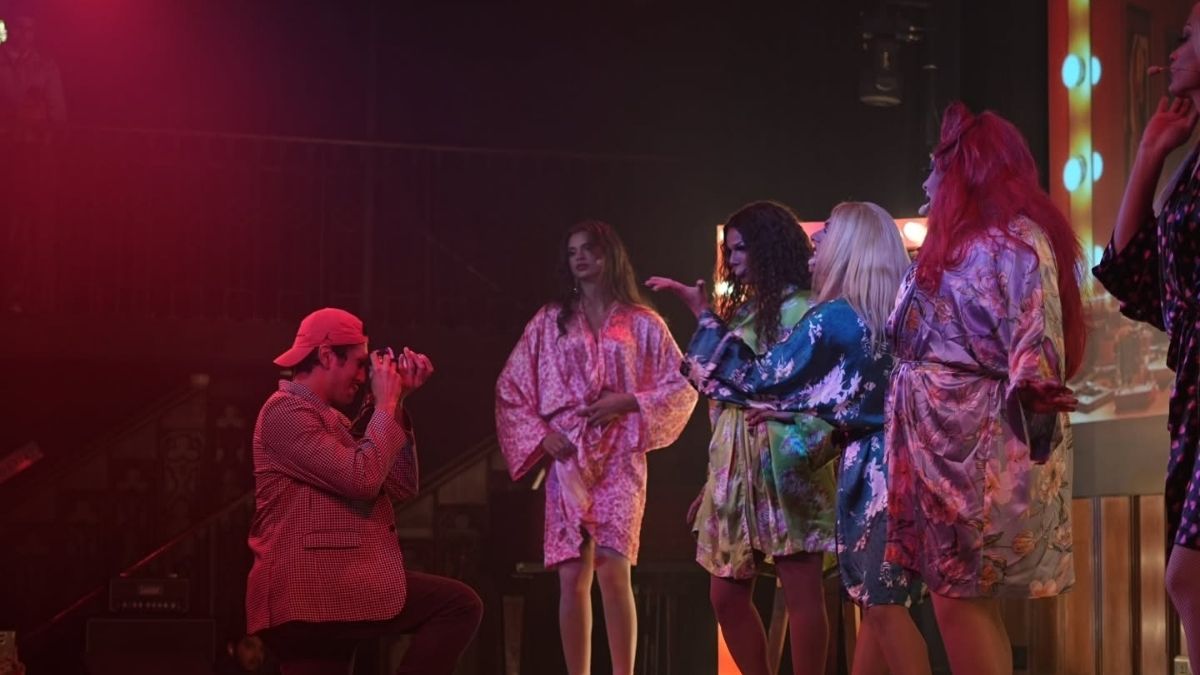
Superqueens is being watched as a marker of how far drag has travelled in India, from private club nights to a scripted stage production carrying a ticket price and a formal script
Superqueens, billed as India’s first full-scale drag musical, will be staged on July 30. The 90-minute production is written and directed by Vivek Mansukhani, with additional writing by Aishwarya Ayushmaan, Teya and Prateek Sachdeva, and choreography by Shohini Dutta and Udisha Uniyal.
Set in Delhi, the show follows five drag performers as they work to keep the art form alive in the city while dealing with questions of identity, money and the day-to-day realities of performing in India.
The production moves between scripted scenes and dance numbers, set to a mix of Bollywood songs, club music and pop tracks. It is built in a cabaret format rather than a conventional stage play, allowing the performers to shift between storytelling and live performance within the same sequence.

The five performers at the centre of the show are Hash Brownie, Betta Naan Stop, Sickk, Whacker Cracker and Lush Monsoon
What sets Superqueens apart from earlier drag shows in India is its format. Most drag performances in the country have been built around short sets, usually a single act or a series of numbers strung together for an evening. Superqueens, instead, runs as a full-length musical with a continuous narrative, giving the performers room to develop their characters and address subjects that a short-form set rarely has time for, including restricted access to venues and the lack of stable platforms for drag artists to perform on regularly.
The five performers at the centre of the show are Hash Brownie, Betta Naan Stop, Sickk, Whacker Cracker and Lush Monsoon. Each plays their own drag persona rather than a fictional character, a choice the makers say ties the show directly to their real experiences rather than an invented plot. Mansukhani says the idea for the musical came directly from the performers themselves.
Drag performance in India has existed on the margins of mainstream entertainment for years, largely confined to nightlife circuits, private events and, more recently, reality television appearances by performers such as Sushant Divgikar, who competes under the drag persona Rani Ko-HE-Nur.
Community platforms built around drag, including groups formed in cities such as Hyderabad, Chennai and Bengaluru over the past several years, have worked to give the art form more visibility outside these circuits. Superqueens extends that visibility into a scripted, ticketed theatre production, a format the art form has not occupied in India before.
The show does not treat drag only as spectacle. Alongside the music and costume changes, it spends time on the financial strain many performers describe, the difficulty of finding venues willing to host drag nights on a regular basis, and the personal cost of building a public identity around a persona that is not always accepted outside performance spaces.
The writers have described the show as an attempt to place these details next to the more familiar image of drag as glamour and comedy, so that audiences see both sides of what performers describe as their working lives.
For a mainstream Indian audience, Superqueens also functions as an entry point into LGBTQIA+ storytelling that is not filtered through a single character in a larger plot, as queer characters in Indian film and television have often been. Here, the five leads are the entire story, and the show does not step back from their day-to-day circumstances to make the subject easier to sit through.
Theatre in India has been slower than film or streaming to feature drag and queer performers as central figures rather than supporting ones, which is part of why the production is being described as the first of its kind rather than simply another addition to an existing genre.
The musical had an earlier run last year at Piano Man in Delhi’s Malviya Nagar, where it opened to a full house and was extended with a repeat show. Since then, it has been staged multiple times across the city, drawing repeat interest from audiences and steady coverage from entertainment publications tracking its run.
Beyond a single evening of theatre, Superqueens is being watched as a marker of how far drag has travelled in India, from private club nights to a scripted stage production carrying a ticket price and a formal script.