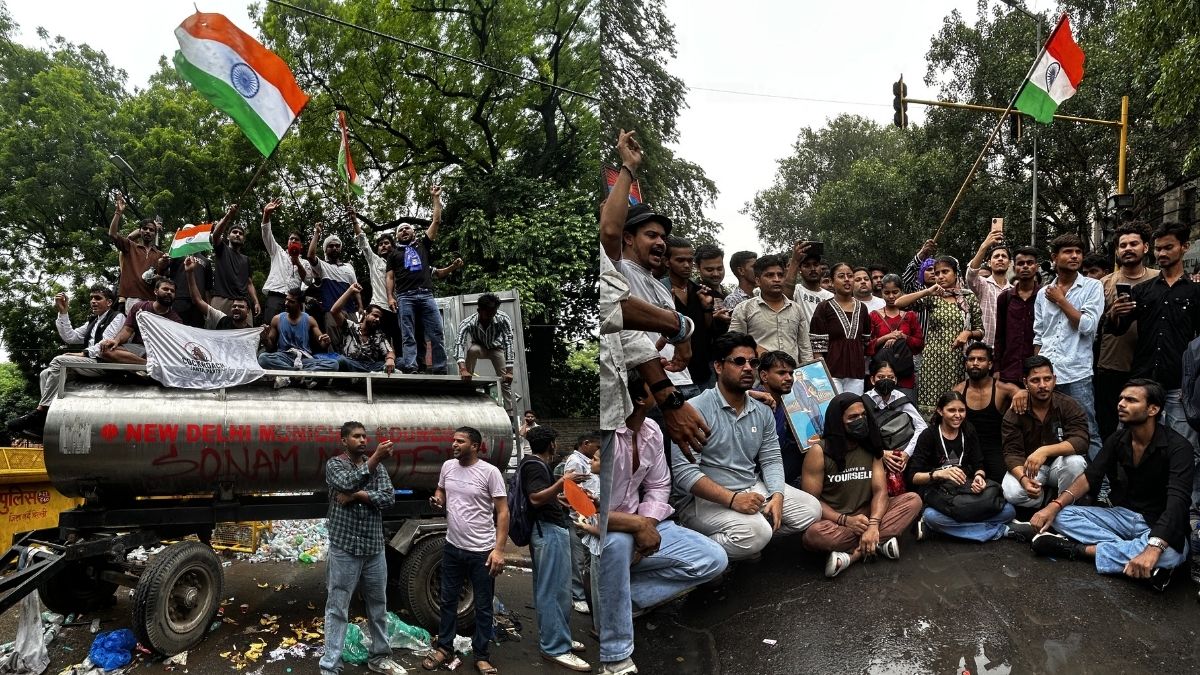
Students and supporters gather at Jantar Mantar during a protest over alleged exam irregularities (Photo: Media India Group/Sanvi Choudhary)
Until yesterday, protests were stories I had written from press releases, television footage or speeches delivered from a podium. I had never covered one on the ground, from right in the midst of action. I had never experienced what it feels like when thousands of people occupy a public space to demand accountability from those in power, or how quickly that space can transform from one of democratic expression into one of fear.
As the youngest reporter in the team of Media India Group, I was excited and anxious when my senior asked me to accompany her to cover the Chalo Sansad march organised by the Cockroach Janata Party on July 20.
Excited, because this was the first time ever that I would be stepping on the field to cover a political issue and that too one which had turned into a national issue that had begun attracting global headlines. But also anxious, as I had read about the heavy police presence and I had heard a lot about how some protests escalate into violence.
But nonetheless, I was very enthusiastic about the opportunity and was glad that I was part of the team to report on it from the Ground Zero, so to say.
As a trainee journalist, my first protest assignment was supposed to be a day in the field. Instead, it became a lesson on the realities of dissent, policing and the fragile line between order and chaos.
Along with two senior colleagues, I reached Jantar Mantar in early afternoon. As we stepped out and began walking towards the protest site, the roads were already filled with students arriving in groups. Some carried flags while others held placards with slogans demanding justice.
Also Read: 30-day NEET protest erupts in violence after police use tear gas and batons
They marched shoulder to shoulder, raising slogans that echoed through the streets leading to Jantar Mantar. Despite the large numbers, the atmosphere remained disciplined. Volunteers moved through the crowd asking people to stay together, while police personnel watched from the sides.
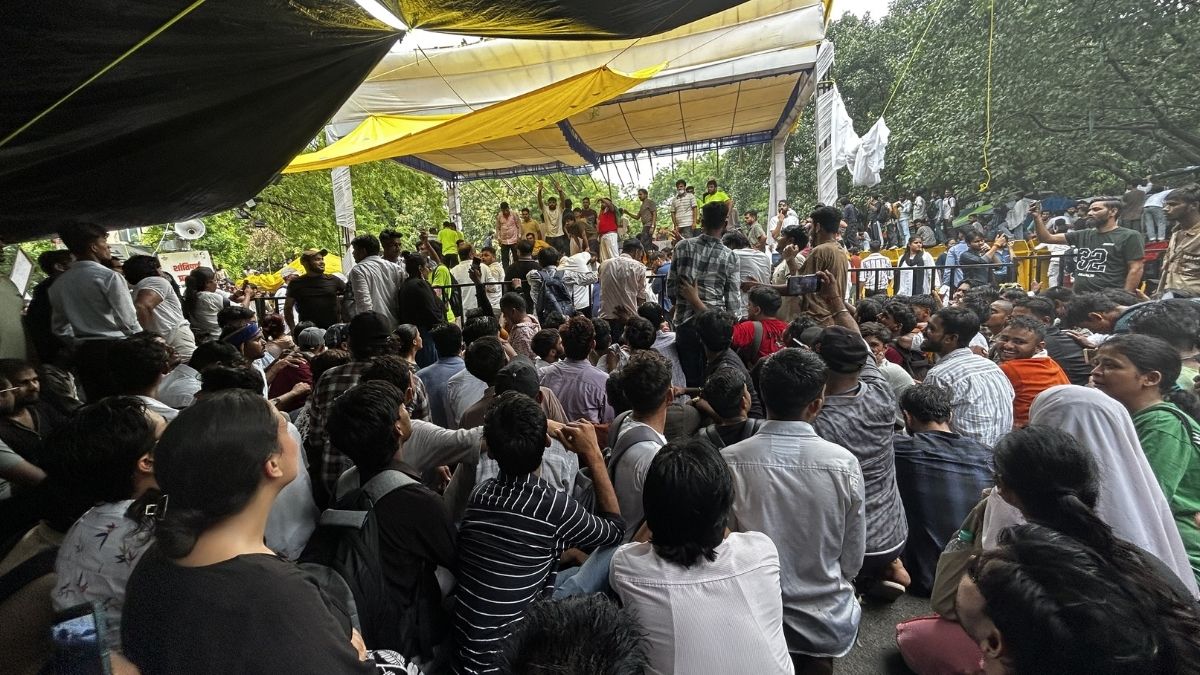
Organisers address the gathering, repeatedly urging protesters to maintain peace and avoid confrontation (Photo: Media India Group/Sanvi Choudhary)
The closer we moved towards the main venue, the denser the gathering became. Hundreds of students had already assembled before the stage, while many more continued to pour in. Parents stood beside their children, office-goers had arrived after taking leave from work. There were startup founders, social activists, teachers and ordinary citizens who had travelled from different states. It was immediately clear that it was no longer just a student protest, instead, it had evolved into a broader public demonstration over issues that many believed reflected deeper concerns about governance and accountability.
From the stage, organisers repeatedly appealed for calm. They urged everyone to remain seated, insisting that the movement had to remain peaceful regardless of the circumstances. Every few minutes, another speaker reminded the crowd not to provoke the police and to continue protesting peacefully. Looking around, there was little to suggest that the gathering would soon be converted into complete disorder. Students were listening to speeches, raising slogans between addresses and holding their placards high. It was noisy, but controlled.
Then, in a matter of seconds, everything changed.
My colleague suddenly walked towards me and said only one thing, ‘Hold on to yourself.’
Before I could understand why, I saw people running towards the stage. Within moments it became evident that they were trying to escape. Someone shouted that the police had begun a baton charge. The crowd that had been sitting peacefully only seconds earlier was now pushing desperately in every direction. Fear spreads faster than information.
Within moments, thousands of people were trying to move through spaces that simply did not exist. The pressure of the crowd became overwhelming. Bodies pushed against one another as everyone attempted to avoid being caught in the advancing police action. My colleague kept repeating, “Don’t fall. Whatever happens, don’t fall. Because the gathering was converted into a stampede and if you fall, there is no way back up,” my colleague kept warning me repeatedly and those words became the only thing I could focus on.
But despite trying to maintain my balance and remain standing in the midst of pressing crowds, I lost my footing and fell. The force of the crowd pushed me directly onto the metal barricades placed in front of the stage. For a few seconds, I found myself trapped between the barricades and the people trying to escape behind me. The sound of people screaming, got mixed with slogans, whistles and the noise of police advancing towards the gathering. It no longer felt like a protest. It felt like survival.
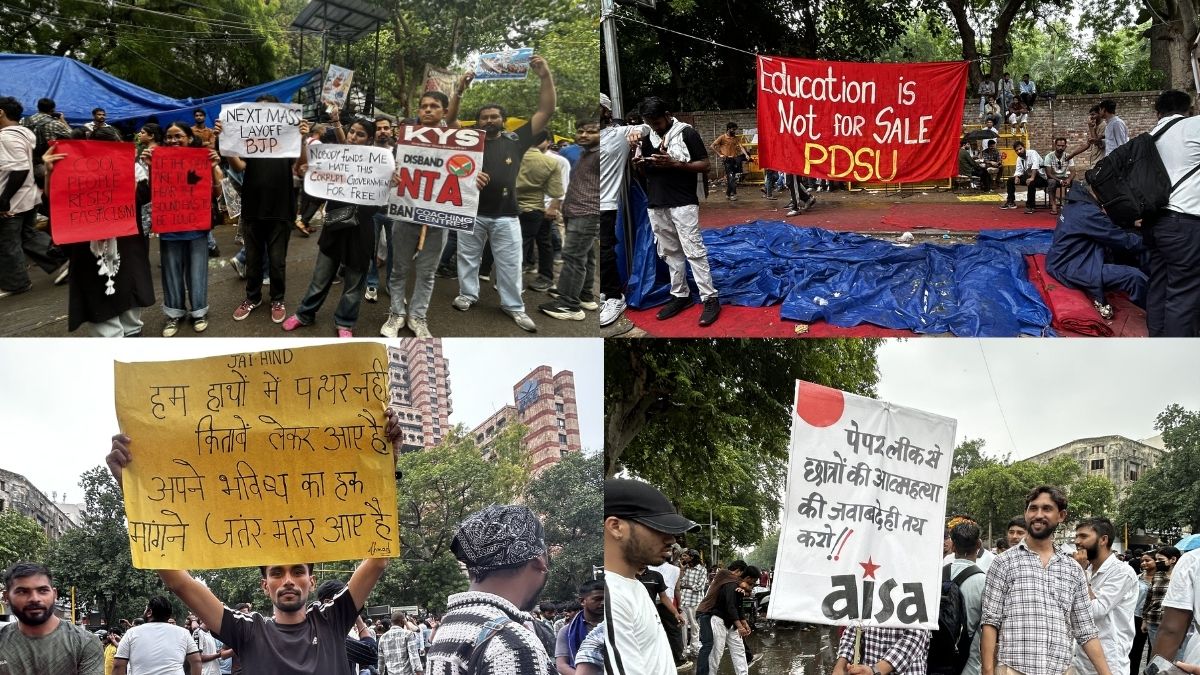
Placards and banners carried by protesters reflect demands for transparency and accountability (Photo: Media India Group/Sanvi Choudhary)
As I struggled to regain my balance, police personnel moved closer. At that moment, I feared I would be struck by their batons, while I struggled to get back on my feet. Fortunately, that did not happen. Instead, they allowed me and my colleague to move away from the barricade and leave the immediate area. We managed to get out, but many others remained caught inside the confusion.
What disturbed me most was not merely the fear of being trapped in a crowd. It was the speed with which a peaceful demonstration had transformed into a scene of panic.
Only minutes earlier, organisers had been asking protesters to remain seated precisely to avoid confrontation. There had been no visible violence. Yet the response escalated rapidly into a lathi charge, followed by the firing of tear gas.
As we tried to move away, the effects of the tear gas became impossible to ignore. Thick smoke spread across the roads surrounding Jantar Mantar. My eyes started burning almost instantly. Breathing became difficult and visibility dropped sharply. People covered their faces with scarves, handkerchiefs and even pieces of clothing while trying to find a way out. Some were coughing uncontrollably while others helped strangers who could barely see. Even walking a few metres became difficult because the air itself had become hostile.
Eventually, we managed to move out of the immediate area and reached a place where protesters had regrouped. Some had bruises on their arms and legs, while others sat silently, trying to process what had just happened.
One of them was Niwas, a second-year BA student from Sultanpuri, Delhi, who had attended the protest for the first time after watching environmental activist Sonam Wangchuk’s appeal urging citizens to join the demonstration.
Also Read: Hundreds from across India gather at Cockroach Janta Party protest in Delhi
“This was my first protest. My friend and I came together after watching Sonam Wangchuk’s video asking people to gather on the 20th,” Niwas told Media India Group.
Niwas recalled sitting inside the barricaded area along with hundreds of others before the situation escalated.
“Many of us were sitting inside the barricades. Some people were even sitting on top of them. Suddenly, tear gas shells were fired. The smoke was so low that it came straight into our faces. Our eyes and faces started burning. We were crying and ran because we could not breathe,” he said.
According to him, there was a brief moment when the situation appeared to calm down, but it did not last.
“After a while everything became quiet. We thought it was over and started moving ahead again. That is when the police started beating people. Some of us were hit. We changed lanes to get away, but there were police standing there as well. Suddenly everyone started running again. We did not even know what had happened. We just saw people running and got scared ourselves,” he recalled.
In the confusion, Niwas said rumours spread rapidly through the crowd, adding to the panic.
“At one point we saw people throwing stones. We thought they were coming towards us, so we ran back again. There was tear gas everywhere. It burns your face badly. People were running in every direction just to get away,” he said.
As the immediate panic subsided, another detail caught my attention.
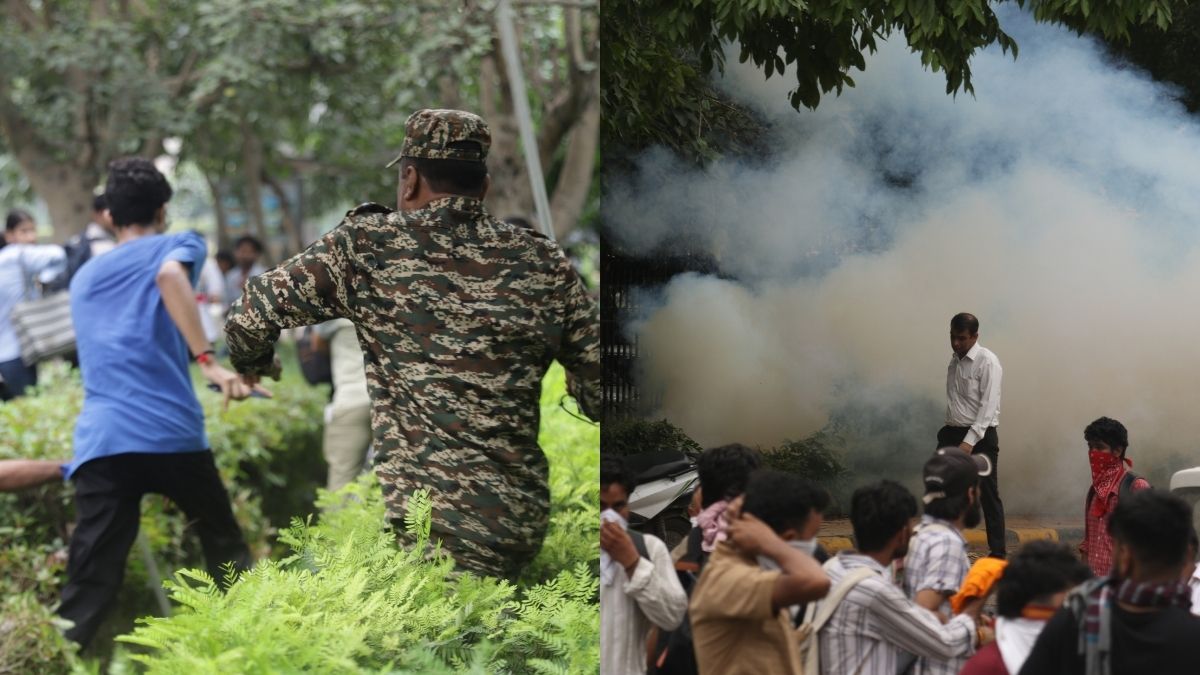
Police use batons and tear gas to disperse protesters (Photo: Aman Kanojiya)
Many police personnel were wearing their name badges as required. However, I also noticed several officials participating in the operation who were not displaying any visible identification. In any law enforcement operation involving the use of force, identification serves as an important element of accountability. Watching officials carrying out crowd control without clearly visible identification left me questioning how responsibility is established if allegations of excessive force later arise.
The assignment, however, was far from over. We resumed reporting as soon as it became safe enough to do so. We began speaking with those who had managed to leave the protest site. What surprised me most was the composition of the crowd. This was not simply a gathering of students preparing for examinations.
Parents had travelled with their children because they believed the issue affected their family’s future. Young professionals said they had taken leave from work to stand with the protesters. Startup founders, teachers and retired citizens also joined the demonstration, arguing that concerns over transparency and accountability ultimately affected the country’s institutions as a whole.
While each had their own story, many shared the same frustration that the system had repeatedly failed them.
Among them were two young women from Delhi, Nidhi and Neha, both government job aspirants who had completed college and were preparing for competitive examinations. This was the second day they had joined the protest.
For Nidhi, the demonstration was about much more than examinations. She described it as a fight for transparency and the right to raise questions without fear.
Also Read: Students unhappy with Supreme Court ruling on NEET
“We have so many problems, but we do not even have the freedom to express them. If we speak up, even online, our posts disappear. We are not asking for anything unreasonable. We just want transparency. We want the government to do its job honestly,” Nidhi told Media India Group.
Recalling the police action, she insisted that the gathering had remained peaceful until force was used.
“We were sitting peacefully and listening. Suddenly everything changed. So many people were injured. I saw boys being beaten and I also saw girls getting hit. The police personnels bluntly said that we will beat boys, only boys were being targetted, but I saw girls being lathi-charged too,” she said.
According to her, the authorities had enough time to engage with the protesters before the situation escalated.
“The protest has been going on for days. If they wanted to talk to us, they could have done it earlier. Instead, nobody acknowledged the issue. They probably thought people would return home after a few days, but now that more people are joining, they are worried,” Nidhi added.
Standing beside her was Neha, who had also travelled from Delhi. Like many others at the protest, she was preparing for government recruitment examinations. For her, repeated examination irregularities had become more than an administrative issue. They had consumed nearly a decade of her life.
“We completed our degrees years ago and have spent almost years preparing for government exams. We study day and night, sacrificing our personal lives, only to see examinations postponed, cancelled or leaked,” Neha told Media India Group.
She pointed specifically to recruitment examinations in Bihar, including BPSC, TRE and other competitive tests, arguing that repeated paper leaks had shattered the confidence of thousands of aspirants.
“People spend an entire year preparing. Some even reach their thirties waiting for recruitment. Their families continue supporting them financially because they cannot move on with their lives. Then the paper gets leaked. Who takes responsibility for that? Who is accountable for wasting years of our lives?” Neha asked.
Listening to them, it became clear that everyone had come with a different personal story but shared a common belief that they needed to be heard.
The protest was not limited to students or government job aspirants. Among those I met was Rakesh Yadav, a businessman from Mukherjee Nagar who said he had been attending the protest since July 17. The founder and CEO of a private security services company, he made it clear that he had no personal stake in any competitive examination.
“I am not a student. I am a businessman. I run my own company and more than 250 people work with me. I have no personal interest in any examination. I came because I wanted to stand with Sonam Wangchuk and against what I see as injustice,” Yadav told Media India Group.
Yadav said he was injured during the police action and pointed to a wound on his head while recounting the events.
“There was complete chaos. People started falling over each other. It was a stampede. I was injured in the rush and my head was hurt,” he said.
Also Read: Student suicides on the rise in India
What disturbed him most, however, was not his own injury but what he claimed he had witnessed around him.
“I have videos from the protest. I saw women being injured. Some suffered serious injuries while trying to escape. People were simply trying to protect themselves,” he alleged.
According to Yadav, the events at Jantar Mantar also had a wider impact on India’s image.
“Connaught Place is visited by dozens of foreign tourists every day. Many of them were recording what was happening. What image of India will they take back after seeing people being beaten and running in panic,” he asked.
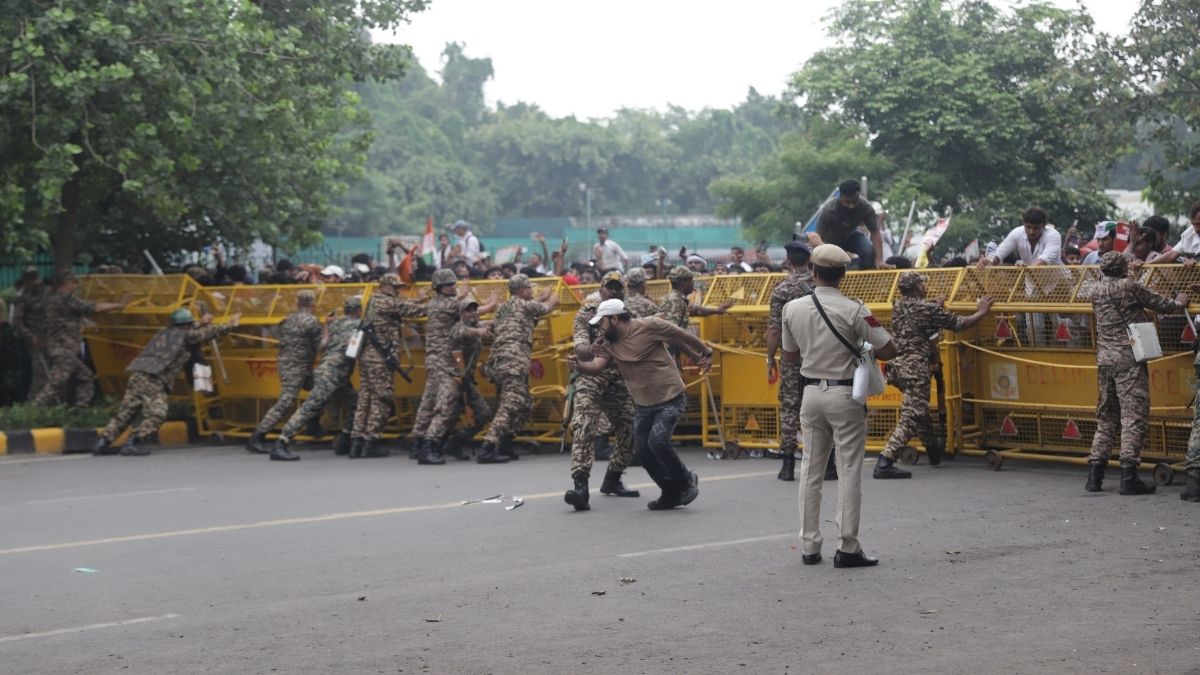
Police block the route with barricades as protesters attempt to march towards Parliament (Photo: Aman Kanojiya)
His presence at the protest reflected something I had begun noticing after speaking to several participants. The demonstration had grown beyond a movement led solely by students. It had become a gathering of citizens from different professions and backgrounds, united not necessarily by the same personal grievance, but by a shared concern over accountability, transparency and the right to peaceful protest.
While the situation at Jantar Mantar was tense, reports from around Parliament suggested an even heavier security response. Although we could not reach Parliament because of the situation unfolding where we were, police had deployed additional personnel, barricades and water cannons to stop protesters attempting to march towards the area. Much of central Delhi remained under heavy security throughout the day.
As I travelled back home, I kept replaying the events in my mind. My first protest had taught me far more than how to cover a demonstration. It revealed how public spaces become arenas where citizens and the State negotiate power, dissent and authority.
It showed me how quickly democratic expression can give way to fear when confrontation replaces dialogue. Above all, it reminded me that behind every image of protesters running, every headline about a lathi charge and every statistic about crowd control are ordinary people who leave home believing they will simply make their voices heard.
Yesterday, I went to Jantar Mantar to report a protest. I returned with a deeper understanding of what it means to witness democracy not from a newsroom or a television screen, but from the middle of the crowd itself.