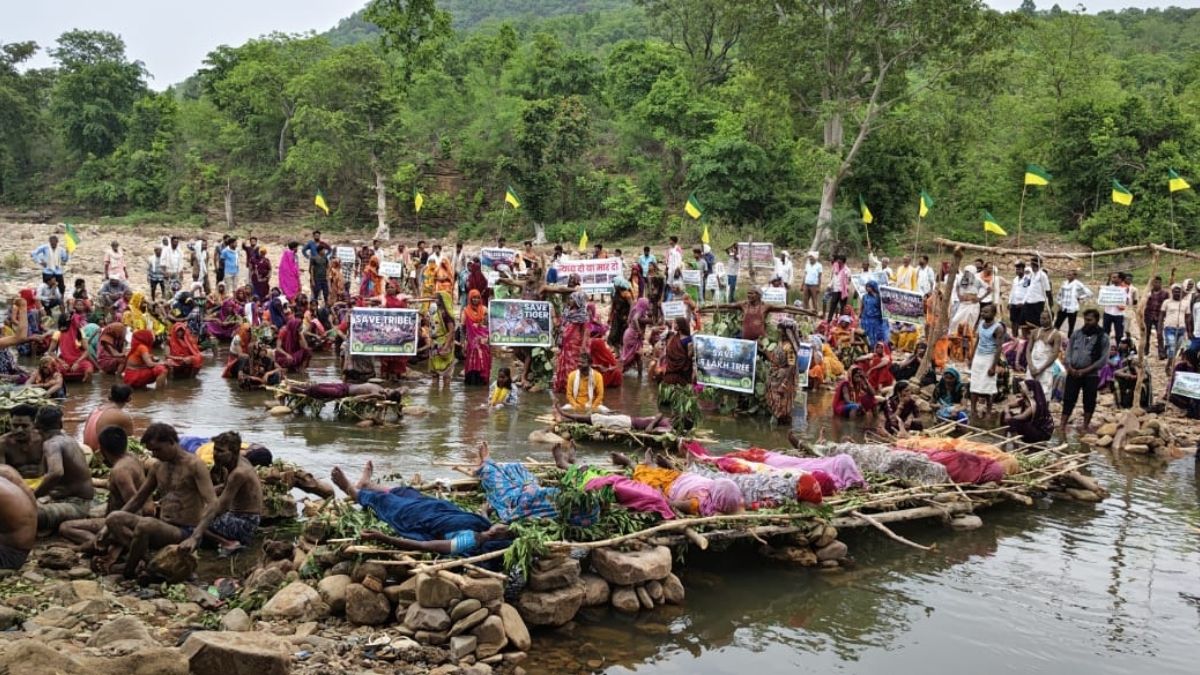
Villagers stage the Chita Andolan against displacement from the Ken-Betwa project in Madhya Pradesh (Photos: Amit Bhatnagar, Anmol Adiwasi and Hisabi Rajpoot)
As the Ken-Betwa River Link Project advances in Madhya Pradesh, thousands of villagers facing displacement have transformed their resistance into the ongoing Chita Andolan, lying on mock funeral pyres to symbolise that losing their homes, farmland and forests is equivalent to losing their lives.
While the government projects the INR 446.05 billion project as a landmark initiative for irrigation, drinking water, hydropower and regional development, the protests have once again exposed a long-standing reality, India’s biggest failure in large river and dam projects does not lie in flawed engineering, but failed rehabilitation.
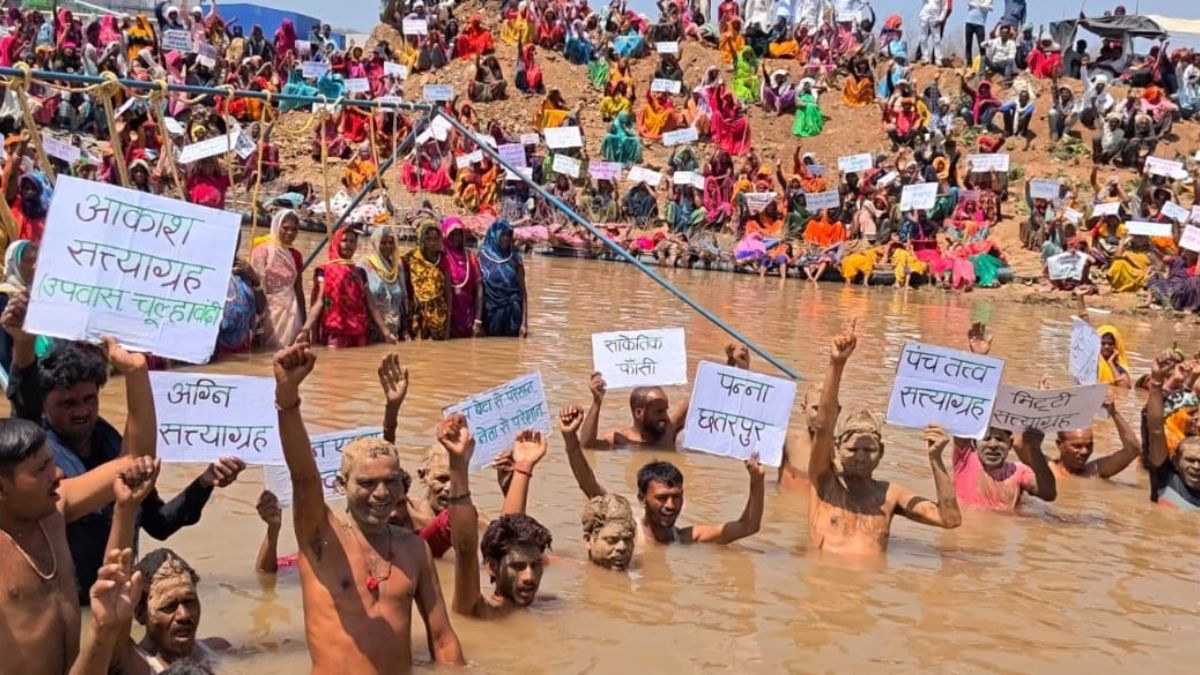
Villagers protest in the river as part of the Jal Andolan
The demonstrations unfolding in Panna and Chhatarpur districts of Madhya Pradesh are not an isolated incident. They are the latest chapter in a pattern that has followed almost every major river valley project since Independence. From the Narmada Valley in 1980s to Polavaram in Andhra Pradesh and now Ken-Betwa, governments have celebrated engineering milestones while displaced communities have spent decades, waiting for land, compensation, housing and livelihood restoration promised under rehabilitation policies.
Across projects, relief and rehabilitation have repeatedly lagged behind construction, leaving generations of displaced families trapped in prolonged uncertainty. India today has over 4,900 large dams, making it one of the world’s largest dam-building nations. Most were built after Independence, with hundreds more still under construction. These projects have expanded irrigation, generated electricity and supplied drinking water to millions.
Also Read: World Water Day: Pollution aggravates water scarcity in India
India has never maintained a comprehensive official record of how many people have been displaced by dams and river projects or how many have been successfully rehabilitated. Researchers studying development-induced displacement argue that this absence of official data itself reflects the low priority accorded to rehabilitation within India’s development planning.
The scale of displacement varies across studies, but all point to an enormous human cost. According to the Indian Social Institute, nearly 21.3 million people have been internally displaced due to development projects, including 16.4 million by dams, 2.55 million by mining, 1.25 million by industrial projects and around 600,000 by wildlife sanctuaries and national parks.
Other estimates are considerably higher. Academic studies published in Nature and other research suggest that between 50 million and 60 million people were displaced by development projects between 1947 and 2000, with large dams alone accounting for nearly 16 million displaced people.
A PubMed-indexed study examining 1,589 large dams found that approximately 11 million people were displaced. Of these, only 2.75 million were formally rehabilitated, leaving nearly 8.25 million people to rebuild their lives largely without institutional support.
The Indian Institute of Public Administration estimates that every large dam in India displaces an average of 44,182 people, making rehabilitation one of the country’s largest yet least discussed social challenges.
Also Read: Sacred Origins: Sources of 5 holy rivers of India
An unequal burden
The other major challenge of these projects is that while their benefits almost always go to the urban centres and farms and industries, the biggest brunt of displacement falls almost exclusively on the tribal population as these projects are normally undertaken in or around forests or mountains.
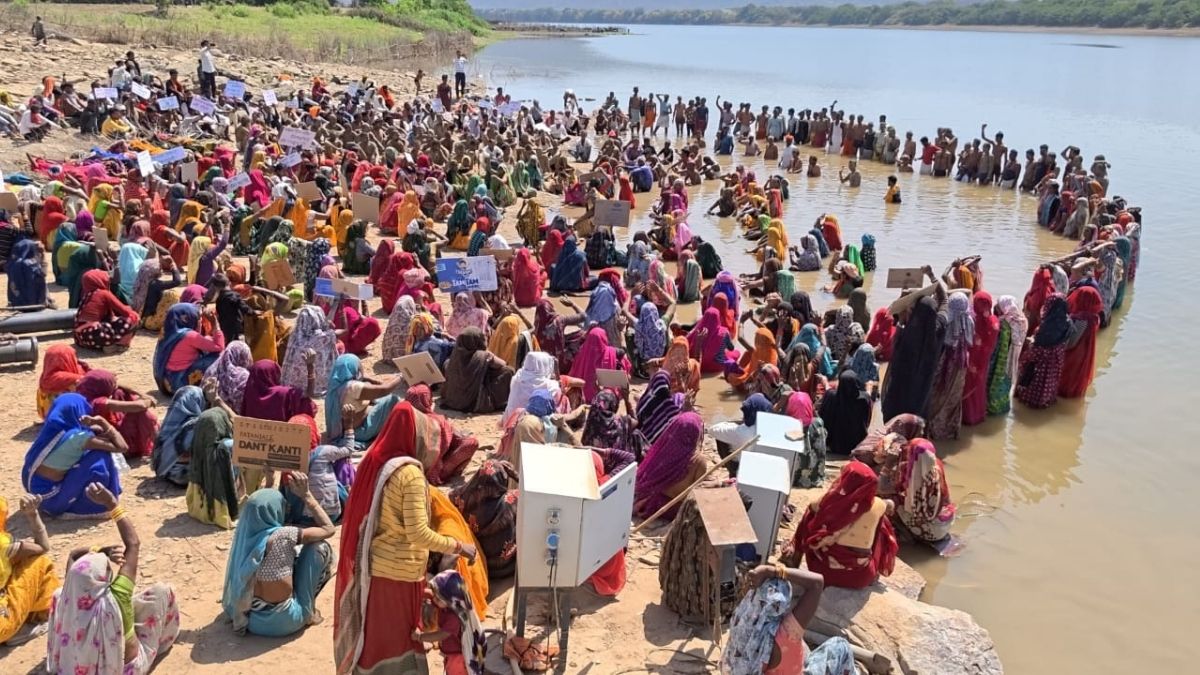
Hundreds of villagers gather along the riverbank, holding placards and raising their hands in protest
Although Adivasis or tribals constitute around 8 pc of India’s population, government working groups and independent studies estimate that they account for nearly 40-50 pc of all people displaced by development projects. For tribal communities, displacement is not merely the loss of land. It often means losing forests, traditional livelihoods, sacred sites, cultural identity and centuries-old community networks that cannot be replaced through financial compensation.
Ken-Betwa: Development meets resistance
The Ken-Betwa River Link Project, India’s first river interlinking project under the National Perspective Plan, has become the latest example of this long-running conflict between infrastructure development and rehabilitation.
The project, with an estimated cost of INR 446.05 billion, promises irrigation benefits to 908,000 hectares, drinking water for 620,000 people, generation of 103 MW of hydropower and 27 MW of solar energy.
Its first phase directly affects 22 villages spanning Panna and Chhatarpur districts and impacts nearly 7,200 families.
The Madhya Pradesh government recently informed the Assembly that 1,321 families from seven villages in Panna have already been displaced, while 3,718 families in Chhatarpur are affected by land acquisition and submergence. Authorities also stated that after fresh surveys, an additional 638 families were included among rehabilitation beneficiaries.
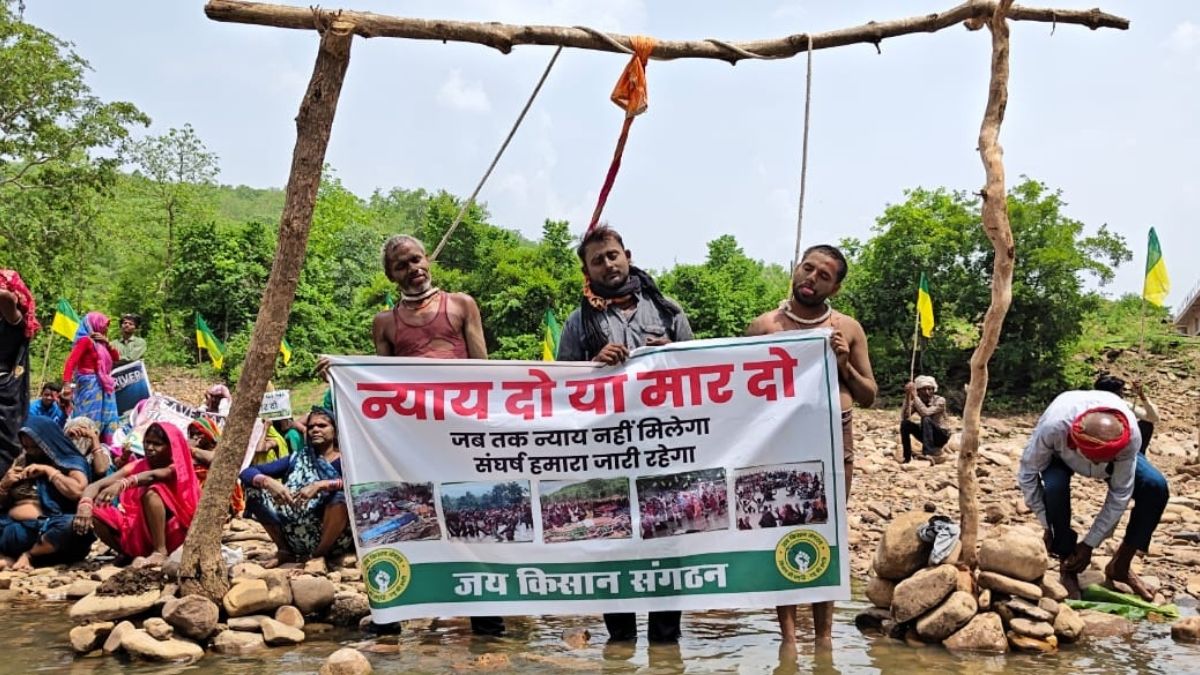
Residents were demanding justice and rehabilitation
However, official assurances have done little to calm affected communities.
Many villagers have rejected the rehabilitation package, alleging non-transparent land surveys, discrepancies in beneficiary lists and inadequate compensation. Reports have also highlighted cases where households facing complete displacement allegedly received lower compensation than families only partially affected by the canal network. The protests have grown increasingly symbolic.
Also Read: Tribals to continue to oppose Mali Parbat mining project in Odisha
Recently, under the Chita Andolan, around 7,000 women reportedly lay on mock funeral pyres, describing displacement as equivalent to social death. Protesters also organised Jal Andolan, standing inside rivers with ropes around their necks and Mitti Andolan, burying themselves in mud to demand land-for-land rehabilitation, village-level resettlement, prior informed consent and investigations into alleged irregularities in compensation.
The issue also reached the Supreme Court, which observed that environmental governance must remain eco-centric and emphasised that the rights of forest-dwelling communities must be protected before major infrastructure projects move ahead.
However, Medha Patkar, social activist and founder of Narmada Bachao Andolan (NBA), says the issues unfolding in Ken-Betwa are not unique but reflect a larger pattern across India’s river-linking projects.
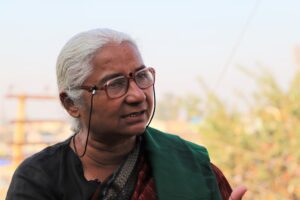
Medha Patkar
She notes that Ken-Betwa itself comprises of six dams and says such projects have long faced questions over their social and environmental consequences.
“All the river-linking projects are somewhere questioned. These concerns were raised even when former President A P J Abdul Kalam supported river-linking. Every project has to be looked at within its own ecological and social context,” Patkar tells Media India Group.
Referring to the ongoing distress, she says it is encouraging that the government has now agreed to conduct a joint survey with affected villagers, but adds that this exercise should have been carried out much earlier.
“It is good that a joint survey is now planned and discussions are taking place, but this should have happened much before,” she says.
Sardar Sarovar: Four decades of unfinished rehabilitation
Long before Ken-Betwa, the Sardar Sarovar Project on the Narmada River had become India’s most prominent example of the rehabilitation crisis surrounding large dams.
Official estimates placed displacement at around 42,000 families, while the Narmada Bachao Andolan (NBA) estimates that nearly 85,000 families, or around 500,000 people, were affected, more than half of them Adivasi, according to reports by SabrangIndia and documentation by the Narmada Bachao Andolan.
Even decades after the dam’s construction, rehabilitation remained incomplete.
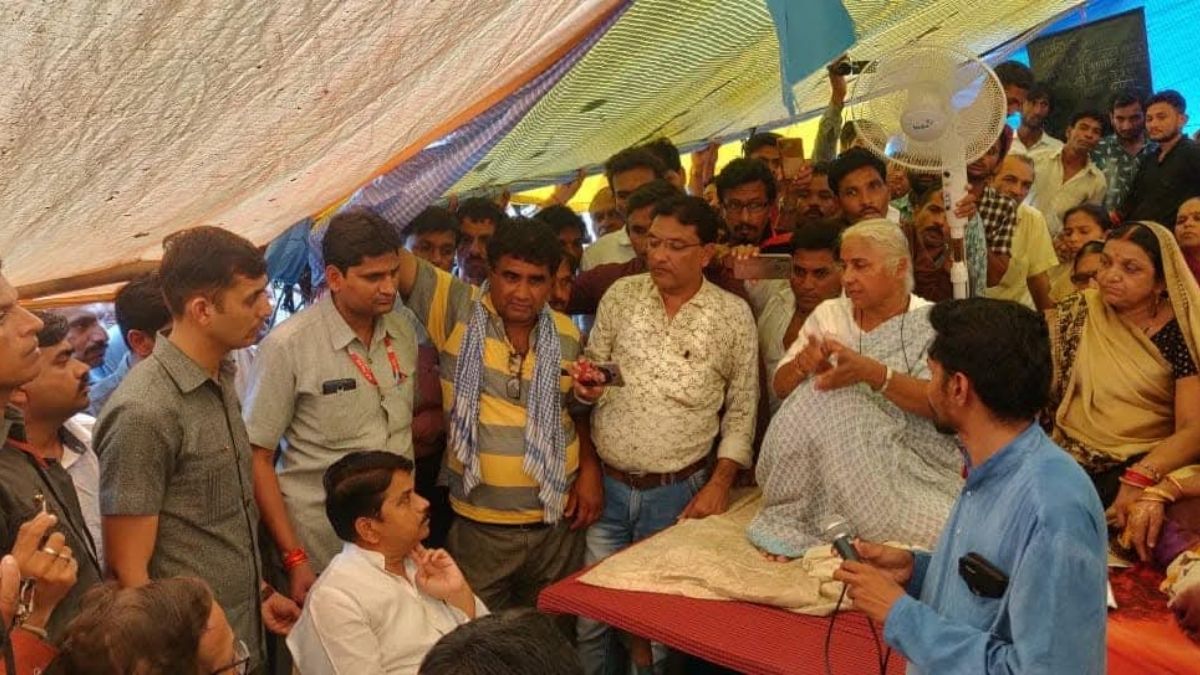
Narmada Bachao Andolan activists protest against displacement, demanding land, compensation and rehabilitation (Photo: Narmada Bachao Andolan)
In 2019, the Madhya Pradesh government acknowledged that 17,452 families were still living in submergence zones awaiting rehabilitation, while activists estimated the figure to be over 32,000 families.
Many affected households alleged that they were evacuated before receiving promised housing compensation of INR 580,000, forcing families to rent accommodation or live in temporary settlements.
One of the most significant failures lay in community rehabilitation.
The Narmada Water Disputes Tribunal had envisaged relocating villages together so that social structures could be preserved. Instead, displaced families were scattered across multiple resettlement sites, separating extended families, fragmenting tribal settlements and weakening traditional institutions that had sustained these communities for generations.
More than three decades after the project began, rehabilitation remains disputed. According to Patkar of NBA, thousands of families continue to negotiate for land rights, compensation and proper resettlement, illustrating how displacement often extends far beyond the completion of infrastructure.
Financial oversight has also highlighted implementation failures. A Comptroller and Auditor General (CAG) report flagged delays linked to land acquisition and rehabilitation, while project costs escalated significantly over time.
Also Read: Assam’s tribal communities lose home to mining
Polavaram: Construction outpaces rehabilitation
A similar story has unfolded in Andhra Pradesh’s Polavaram Project, another flagship irrigation initiative frequently described as vital for the state’s agricultural future.
The project is expected to submerge more than 276 tribal villages across nine mandals and displace over 250,000 people, of whom more than 53 pc belong to tribal communities, while around 13 pc are Dalits.
Despite spending exceeding INR 210 billion by early 2024, rehabilitation has continued to lag behind physical construction.
Government data showed construction progress significantly ahead of overall project completion because land acquisition and rehabilitation remained incomplete. Tribal organisations continue to claim that nearly 93,000 displaced families are still awaiting rehabilitation.
Ground reports have documented instances of forced evictions, including allegations that authorities disconnected water supply, electricity and village borewells while using heavy machinery to relocate families to rehabilitation colonies located several km away.
Although the government later announced that nearly INR 20 billion had been disbursed to displaced families within a year, civil society organisations argue that financial compensation alone cannot replace land, forests, livelihoods and community life.
Weakest link in India’s development model
Across India’s major river and dam projects, the pattern remains remarkably similar.
Communities repeatedly report delayed land surveys, exclusion from beneficiary lists, disputed compensation, inadequate livelihood restoration, fragmented resettlement and years of legal battles before receiving rehabilitation benefits.
According to Patkar, one of the biggest structural flaws in India’s rehabilitation framework is that resettlement is often mistaken for rehabilitation.
“Resettlement is different. The government may provide land for an alternative house, but rehabilitation means people should receive an adequate and sustainable source of livelihood. Mere cash compensation does not fulfil the requirement,” she says.
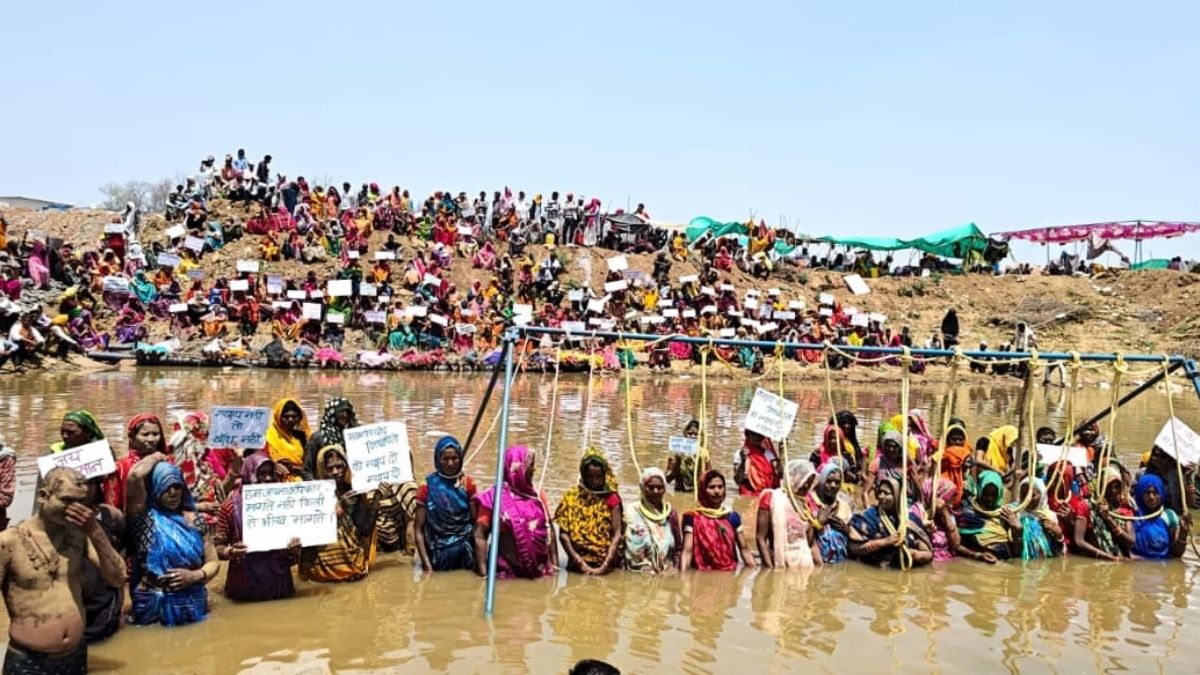
Women take part in the river protest, some using ropes around their necks to symbolise their demand
She argues that compensation-based rehabilitation frequently creates new problems.
“Corruption comes in, cash is misused by some family members, conflicts arise within families, and the compensation is always inadequate because the market value of land keeps increasing. People cannot secure an alternative livelihood and they continue to suffer,” says Patkar.
The country has progressively strengthened its legal safeguards.
The Right to Fair Compensation and Transparency in Land Acquisition, Rehabilitation and Resettlement Act, 2013, requires social impact assessments, compensation and rehabilitation before land acquisition. Similarly, the Forest Rights Act, 2006, recognises the rights of forest-dwelling communities and mandates safeguards before diversion of forest land.
However, activists, researchers and rehabilitation experts argue that implementation has consistently failed to match the intent of these laws.
Large infrastructure projects continue to be evaluated primarily through engineering achievements, irrigation potential, electricity generation and investment figures, while rehabilitation remains treated as an administrative process rather than the central pillar of development planning.
Patkar argues that rehabilitation cannot improve without fundamentally changing the way development projects are planned. “The main thing is decentralised democratic planning of development. Every project should be finalised only after a proper social and environmental impact assessment with the full and fair participation of local communities through Gram Sabhas,” she says.
She warns that when projects are driven primarily by political and corporate interests without community participation, displacement becomes inevitable.
“If projects are imposed on the basis of the influence of money and capital, those who have lived with natural resources for generations face destruction and displacement. The disparity in society only increases,” says Patkar.
She also stresses that compensation rarely replaces what communities lose. Families dependent on rivers lose fishing livelihoods, while those living in forests lose access to fuel, fodder, forest produce and other resources that sustained them for generations.
“They cannot simply purchase everything they once produced themselves. Their entire way of life is disrupted,” she adds.