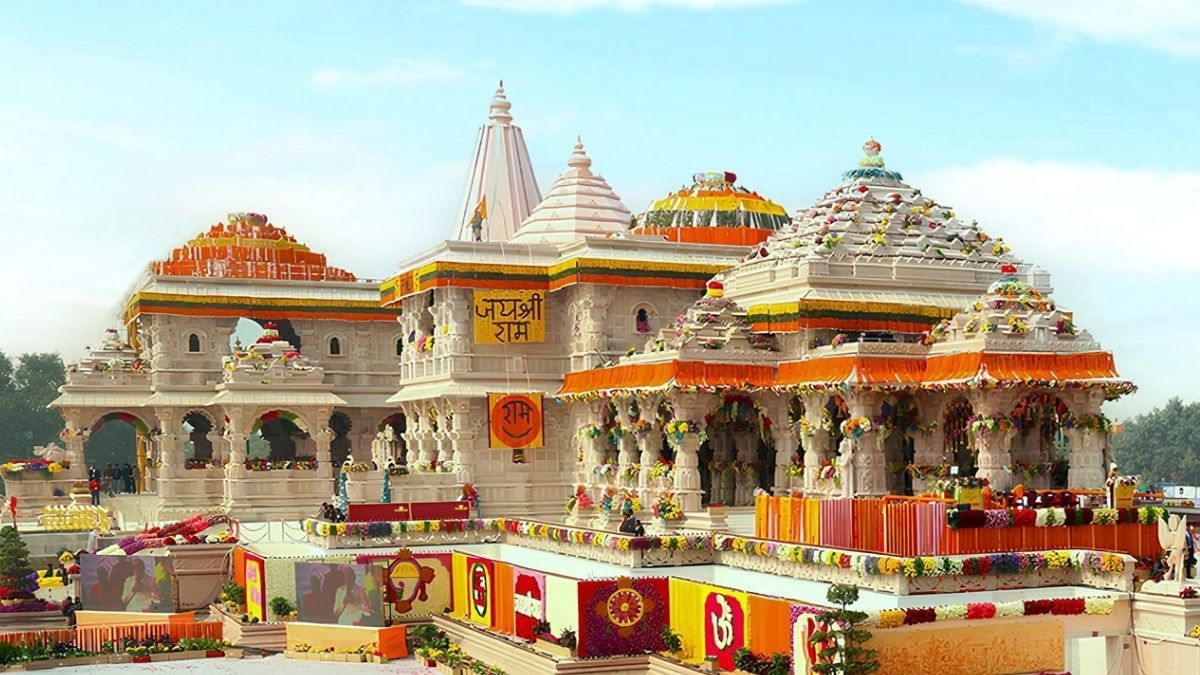
What began as an investigation into alleged theft of donation money at Ayodhya’s Ram Mandir has expanded into a debate over institutional oversight
A temple built as one of the country’s most powerful religious and political symbols is now at the centre of a major controversy that has left the ruling Bharatiya Janata Party and its allied organisations, notably the Vishwa Hindu Parishad and the Rashtriya Swayamsevak Sangh facing uncomfortable questions over accountability.
What began as an investigation into alleged theft of donation money at Ayodhya’s Ram Mandir has expanded into a debate over institutional oversight, political protection and whether the probe has stopped short of examining those responsible for supervising the temple’s finances.
The CCTV footage itself of the temple, once investigators sat down and went through it frame by frame, told an unremarkable story of theft small, repeated, almost in how openly it was carried out. Between April 27 and June 5 this year, employees inside the donation-counting room at the Ram Temple were allegedly caught on camera taking cash on close to 70 separate occasions. Eight people have been arrested and even weeks later it is not yet clear how much money has been stolen, but a former city legislator has alleged more than INR 70 million has gone missing.
Also Read: Airattix opens luggage storage facility near Ram Mandir in Ayodhya
Of the eight arrested, only two Tinnu Yadav and Subhash Srivastava actually worked for the Shri Ram Janmabhoomi Teerth Kshetra Trust, a trust nominated by the government, which manages the shrine. The rest were linked to the bank, the State Bank of India, the country’s largest bank, that handles the temple’s cash. That distinction matters, because it is roughly where the story stops being a routine theft case and starts becoming a test of how institutions close to the government get treated when something goes wrong inside them.
Champat Rai, a long-time VHP official and the Trust’s General Secretary and its most recognisable public face after the temple’s chief priest, resigned the same week the arrests were made. The Special Investigation Team (SIT) report doesn’t accuse him of personally running the counting or surveillance operations, but it does raise questions about his oversight as the counting staff were reportedly placed there on his recommendation and that of fellow Trust member Anil Mishra, and complaints about theft are said to have reached senior officials well before any police complaint was filed. Rai has denied any direct involvement, saying he had ordered an internal inquiry the moment he learned of the irregularities and that he himself approached the SIT to file the complaint that led to the FIR. His only mistake, in his telling, was the delay caused by that internal review.
That delay, and the fact that Rai’s name doesn’t appear among those held responsible in the SIT’s preliminary findings, is now the crux of the opposition’s attack. The Congress has been the most aggressive, with the party’s communications chief Jairam Ramesh accusing the Prime Minister Narendra Modi of taking credit for the temple’s construction while now staying quiet on accountability for the alleged theft. Senior Congress leader and Gujarat MLA Shaktisinh Gohil went further, demanding that the government dissolve the Trust altogether, arrest those actually responsible, and hand the entire probe over to a Supreme Court-monitored investigation, adding that Modi ought to apologise for inducting figures like Rai into the Trust instead of relying on seers and religious figures.
Also Read: Ram Mandir reinforces Ramayana Trail tourism
Congress leaders have also flagged what they call a suspicious jump in daily donations after the case became public, saying it points to money having gone missing on a near-daily basis for months before the theft was exposed.
The BJP’s response has been to close ranks rather than engage the specifics. Uttar Pradesh Deputy Chief Minister Keshav Prasad Maurya dismissed the opposition’s questions about Rai outright, while fellow Deputy Chief Minister Brajesh Pathak insisted the investigation was proceeding without fear or favour and that the guilty, whoever they turn out to be, would face action. Pathak also turned the attack back on the opposition, asking why the Congress and Samajwadi Party had never raised similar questions about financial irregularities at religious institutions run by other communities a line that has since become the BJP’s standard talking point whenever the case comes up.
Political analysts following the case say the way this dispute is unfolding is, in itself, revealing. Sajid Abbas, a Delhi-based political analyst and Senior Associate at Ground Zero, a political research & consulting company, says that the optics of the investigation are doing more of the government’s talking than the substance of it.

Sajid Abbas
“An SIT, raids and arrests look like a serious inquiry on paper. But look at who’s actually been named and questioned it’s the lower-level staff and the bank employees. Nobody at the top of the Trust has faced anything close to that scrutiny, even though the SIT’s own report raises real questions about oversight,” Abbas tells Media India Group.
That gap, he added, is exactly why petitioners have gone to the Supreme Court seeking a forensic audit, a review by the Comptroller Auditor General, the country’s highest public auditing body, and an investigation run outside the state machinery that answers, politically, to the same party that the Trust is closely associated with.
Abbas is careful not to call this proof of interference, but he thinks the pattern is hard to ignore. “RSS and BJP leaders keep stepping out to defend Champat Rai personally, calling him beyond reproach, while the case is still open. I am not saying that is interference. But the timing and the repetition create exactly the impression that the leadership is being shielded from scrutiny any other institution would face,” says Abbas.
He also flagged the unresolved questions around how quickly people close to the Trust, including allegations involving Rai’s own driver, appear to have accumulated land and assets since the project began while cautioning that these remain allegations needing independent verification, not conclusions to assume in advance.
Also Read: Ram temple dispute: a timeline
For Abbas, the case was never going to stay a purely criminal matter, given what the Ram Mandir represents. “It is arguably the single biggest ideological project that the BJP and RSS have built their identity around for three decades, so any allegation against it was always going to carry political weight,” he said. What has deepened that, in his view, is less the investigation itself than the political response running alongside it senior leaders defending the institution’s image well before the probe has reached any conclusion, which shifts public conversation away from accountability and toward reputation management.

Rohit Bhatia
“Defending an institution against sweeping accusations while letting the investigation continue is one thing. Doing it repeatedly, before any conclusion, is what makes people ask whose interest is really being protected,” says Abbas.
Supporters of the government’s approach don’t see it that way; to them, standing by an institution while a probe runs its course is not the same as obstructing it, and that gap in interpretation is exactly why this case refuses to stay confined to a courtroom.
Not every voice weighing in has settled on a side. Rohit Bhatia, who writes on finance and stock markets but also follows politics closely and has been a regular commentator on this case, says that he is not ready to draw a conclusion either way just yet.
“At this stage, I don’t think it is appropriate to reach that conclusion. A theft has been acknowledged and an investigation is underway. Whether there was preferential treatment can only be determined after the investigation is completed and all the facts are made public,” Bhatia tells Media India Group.
His view is that the matter should first be treated strictly as a criminal case. “Legally, it should first be treated as a criminal investigation. Political debate is natural in high-profile cases, but accountability should be based on evidence,” says Bhatia.
Where he does agree with the critics is on what the episode ultimately represents: “The case highlights the importance of transparency and accountability in every public institution,” he adds.
Both readings remain live right now. The government’s defenders point to the SIT’s formation, the speed of the arrests, and the money already recovered as evidence the system is working as it should, and argue that a financial probe spanning weeks of CCTV footage and multiple accused simply takes time to conclude properly.
Critics counter that speed was never really in question direction was. An investigation can move fast and still be carefully bounded, in the sense that it never quite reaches the people at the very top of the chain, even when that chain is what the allegations are actually about. The Supreme Court petitions for an independent audit exist precisely because, for a section of petitioners, the SIT’s closeness to the state government is itself part of what needs fixing.