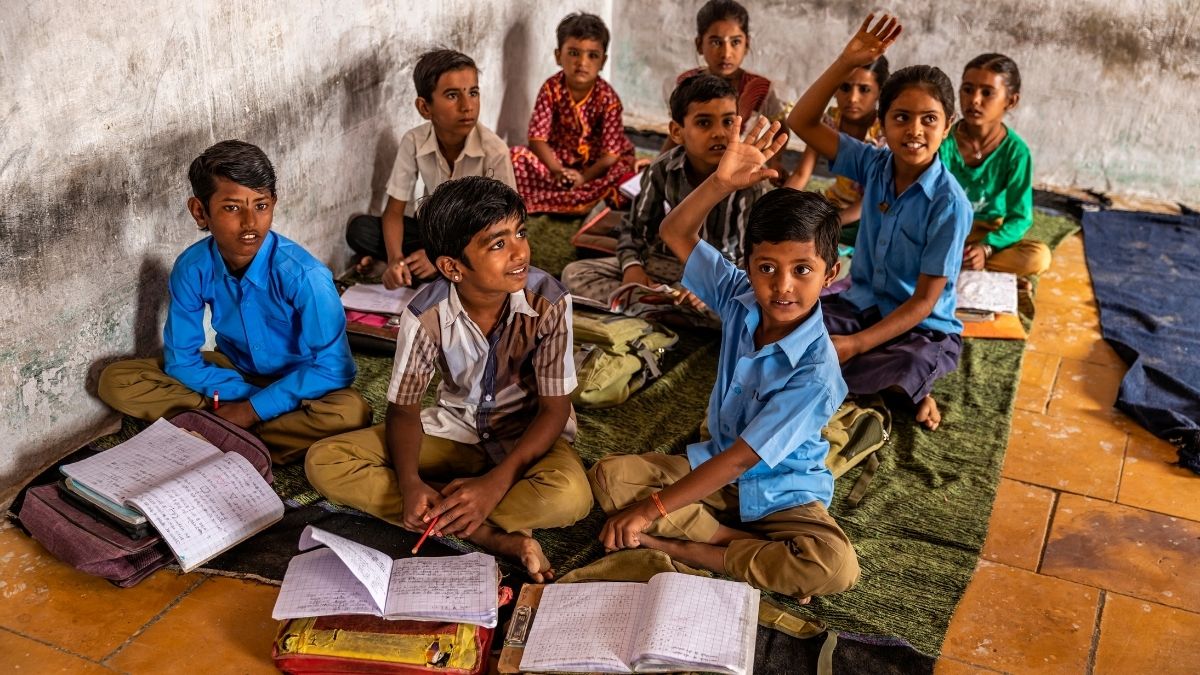
India's education spending sits at 4.1 pc of GDP, falling significantly below the 6 pc target
Carrying the fate of nearly 250 million children, the most in the world, India’s education system continues to struggle with persistent gaps in access, retention and learning despite its vast scale. Around 46 million children aged 6 to 17 remain out of school, while public spending on education has stayed at about 2.7 to 4 pc of GDP, far below the 6 pc target set six decades ago. UNESCO’s SDG 4 Scorecard, released recently, highlights the wider challenges facing education systems.
India runs one of the largest school systems in the world. The Ministry of Education’s UDISE+ 2024-25 report counts 1.47 million schools, close to 247 million students, and over 10 million teachers across the country. Yet the same dataset, along with independent surveys, shows the system has significant gaps in access, retention and learning outcomes, and these gaps vary sharply by state.
Also Read:Need to ground India’s ambitions as global education hub in reality
This comes against the backdrop of the UNESCO Institute for Statistics and Global Education Monitoring Report’s SDG 4 Scorecard, published every year, which reviews how 170 countries are doing against the education targets they set themselves for 2025 and 2030. This year’s edition finds that most countries are behind on training pre-primary teachers, expanding early childhood education, and getting children to read by the end of primary school, and that public education spending globally moved further away from recommended thresholds in 2024 than it was a decade earlier.
India does not appear by name in the Scorecard’s public dashboard; it is one entry among 170, folded into regional and global averages. India’s own government data, published around the same time, gives a far more specific picture of where the country stands.
The clearest gap is in how many children are outside school altogether. UDISE+ 2024-25, released in August, puts the number of out-of-school children aged 6 to 17 at roughly 46 million, about 17 pc of that age group. UNESCO’s statisticians have noted for years that India’s out-of-school estimates vary widely between surveys, sometimes by more than 10 pc, partly because states use different starting ages for school entry and because household surveys and administrative enrolment records do not always match. That gap in the data means the true number could be higher or lower than 46 million, but the scale of the problem is not in dispute.
Dropout data from the same UDISE+ release shows where children leave the system. Primary-level retention is comparatively strong, but the numbers fall as students get older. Secondary dropout is estimated at 8 to 11 pc depending on the measure used, and higher secondary retention nationally is around 47 pc, meaning under half of children who start school stay through class 12.
Also Read: Budget 2026: Test of government’s priorities for underfunded education
Enrollment ratios show a similar pattern. Secondary gross enrolment is about 78.7 pc, but net enrollment, which measures children studying at the age-appropriate level, is closer to 47.5 pc. Higher secondary net enrollment is under 36 pc. Common reasons cited for this drop-off include early marriage, the need to work, migration, and the cost or distance of secondary schools compared with primary schools.
State-level figures vary considerably. Chandigarh’s secondary gross enrollment ratio is above 110 pc and Delhi’s is above 100 pc, reflecting dense urban infrastructure. Bihar’s secondary GER is around 51 pc, and its higher secondary figure is close to 38 pc; researchers studying UDISE+ data have linked this to weak school infrastructure, including reports that only about a third of schools in the state have functional toilets. Madhya Pradesh’s secondary enrollment is around 68 pc. These differences mean a child’s access to secondary and higher secondary education in India still depends heavily on which state, and often which district, they live in.
For children who do stay on in school, another major concern is what are they actually learning. The Annual Status of Education Report, published by the Pratham Education Foundation’s ASER Centre, surveys reading and arithmetic skills in rural India. The 2024 edition, based on responses from close to 650,000 children across nearly 18,000 villages, found that 44.8 pc of Class V students in government schools could read a Class II-level text.
This is an improvement from 38.5 pc in 2022, a period affected by pandemic-related school closures, but it has not fully returned to the 2018 level. For Class III students, the numbers are lower. More than three in four children in that grade could not read a text meant for the grade below them. On arithmetic, roughly 70 pc of Class 5 children surveyed could not do calculations expected at a lower grade.
These learning outcomes also vary by state. Kerala, Tamil Nadu, Himachal Pradesh and Mizoram post foundational literacy numbers above the national average, while Bihar, Uttar Pradesh and Madhya Pradesh remain below it. Uttar Pradesh is an exception worth noting: government-school reading levels there rose by about 15 pc points between 2018 and 2024, among the largest gains recorded by any state. Overall, though, the gap between the best- and worst-performing states on basic reading has not narrowed much over this period.
Spending is part of the explanation. The Kothari Commission recommended in the 1960s that India should spend 6 pc of GDP on education; the country has never reached that figure. The Economic Survey 2024 put combined central and state education spending at 2.7 pc of GDP for 2023-24, using the narrower general government expenditure measure tracked in budget documents. Broader World Bank estimates, which include capital and transfer spending, put the figure closer to 4 pc in recent years. The two numbers differ because they use different accounting methods, but both are below the 6 pc target. In absolute terms, the Union education budget has grown as INR 1.20 trillion were allocated for 2024-25, up from INR 1.12 trillion the year before. However, as this increase has not necessarily kept pace with GDP growth or with total government spending, education’s share of total public expenditure has declined over the past decade according to several budget analyses.
Also Read: UNESCO calls for regulation of technology in education
Higher education shows a comparable pattern. The GER for the 18-to-23 age group, the standard measure of participation in college-level education, is around 32.5 pc in the most recent estimates, up from 28.4 pc a few years earlier. That means roughly two out of three young people in that age bracket are not enrolled in any form of higher education. Given current dropout rates through school, some researchers estimate India is unlikely to reach a 50 pc higher education GER by 2035. State figures again vary widely as Chandigarh, Delhi and Tamil Nadu report GERs in the 45 to 65 pc, while several states with larger rural populations are closer to 25 to 30 pc.
Taken together, the data points to a system that has expanded significantly in scale but still has substantial gaps in access, retention and learning outcomes, with wide variation between states. India’s National Education Policy 2020 sets targets to address several of these issues, including a 100 pc GER by 2030 and stronger foundational literacy through the NIPUN Bharat mission, and some states have shown measurable progress under these programmes. However, the latest report shows that there is a significant gap between policy ambitions and the measures taken on the ground, including most importantly funding. And as a result, there is a significant gap between the targets and the actual situation on the ground. Worryingly, that gap is increasing and rapidly, making achieving the 2030 targets a fading dream.