
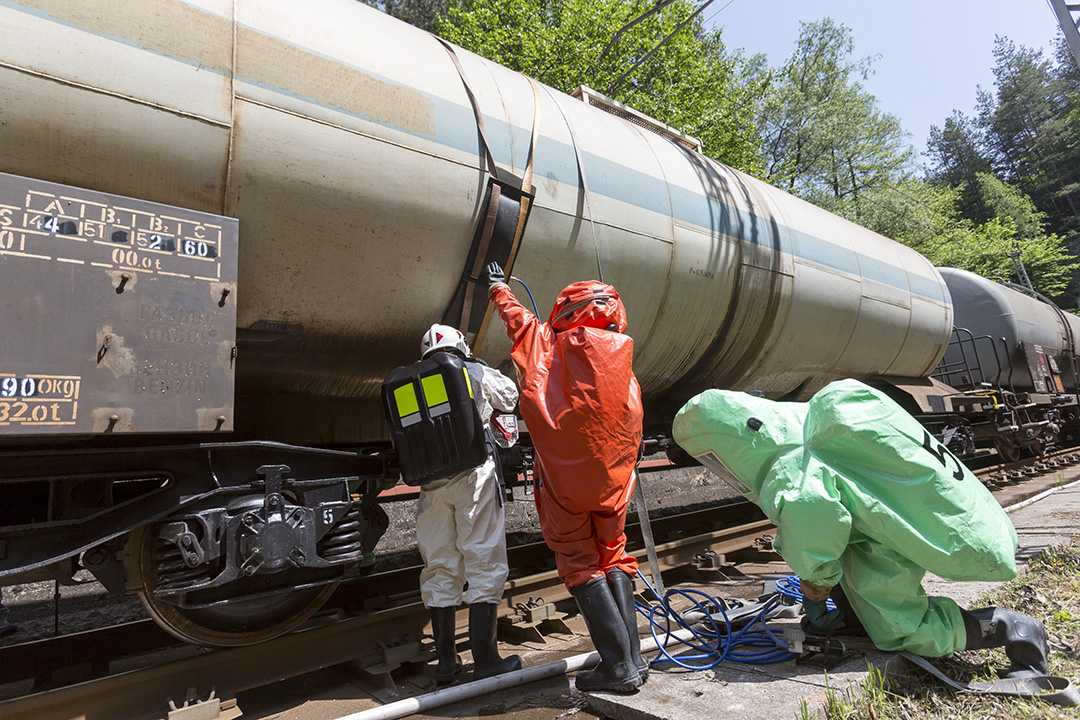
Unless Montreal Protocol negotiations tackle the next challenges, Earth will be left with dealing with extremely hazardous forever chemicals forever (Photo: UNSDG hub)
In Kinyarwanda, a Bantu language and the national language of Rwanda, Kigali, means ‘broad, vast and wide’. When I reflect on the 38th Meeting of the Parties to the Montreal Protocol-typically called MOP38, that begins in the Rwandan capital from November 2, I have an intense feeling that the negotiators to this should not lose the ‘broad, vast and widely open’ opportunity to ‘go beyond Kigali!
As I write this, nearly four decades of the amazing negotiations under the Montreal Protocol and its unique implementation work flash before me. The Montreal Protocol, has been described as ‘the most successful international agreement ever’ by none other than former United Nations Secretary-General Kofi Annan,.
I had seen most of the negotiations closely and their implementation first as part of the Indian delegation for negotiations and later as a chief of the UNEP’s work as the implementing agency. Now, as founder of a non-governmental organisation that has initiated the global movement of a network of universities for Net Zero campuses, I have the advantage of looking back on the summit that was scaled, and more than that, the summits are yet to be scaled, but can be, provided the negotiating parties, meaning all the governments and increasingly business, come with the same earnestness, zeal and honesty to get there.
I will not be in Kigali when MOP38 starts on Monday, but having attended nearly all MOPs, I can imagine the familiar rhythm echoing from the conference rooms: technology and economic assessment panel reports, phase-down and phase-out and destruction of HydroChloroFluoroCarbons (HCFCs), HydroFluoroCarbons (HFCs) and their by-products and most importantly, replenishment of the total funding requirement in coming years. Indeed, for those who are familiar with the process, this looks routine. The Protocol has made disciplined cooperation possible, and success is acclaimed.
Yet success carries its own subtle risk. It makes the parties complacent and confines them within some set boundaries. Over the decade since the Kigali Amendment was agreed in 2016, the Montreal Protocol has rightly received international appreciation for its exceptional record in protecting the ozone layer and extending its work to the climate challenge. But when success becomes a source of reassurance, it can also make the next frontier less urgent. The lesson, that I would like the MOP38 and the future meetings, to draw from the Protocol’s history is that success should generate the confidence and momentum to go beyond, and not put us in a false comfort of assuming that the hardest work is behind us.
Also Read: World Ozone Day 2025: Need another Montreal moment to address HFCs
I know this process from several vantage points: as head of UNEP’s OzonAction Programme, working with countries on implementation, and later as a Senior Expert Adviser to the Technology and Economic Assessment Panel. At recent ozone meetings, including OEWG-48 in Bangkok, I felt admiration for the system we have built but more than that, the urgency and need to ‘Go Beyond’ was diminishing.
The fact is that the world outside the meeting rooms is changing faster than the language of many negotiations. The question is not whether the Montreal Protocol deserves its reputation; that it certainly does. The question is how that achievement can renew the ambition to respond to challenges of super energy efficiency, sustainable cooling, the fast-growing cooling needs of artificial intelligence and life-threatening issues of ‘Forever Chemicals’, which once produced just do not go away and continue to pose a serious hazard to the health and the well-being of not just the humans, but the entire planet.
The energy insecurity, insane levels of geopolitical rivalry, life-threatening heat waves, emerging health risks and the rapid expansion of artificial intelligence are converging on a singular inferno augmented by El Niño. The recent Emission Gap report of UNEP urges a ‘Point of Return’. It is indeed a point of return to cooling the warming world. The question is whether negotiators in Kigali can look beyond familiar boundaries to this emerging new world and at the same time without losing sight of the mandate that brought them together.
The next cooling challenge is not refrigerants alone
The Kigali Amendment’s HFC phase-down was indispensable. HFCs do not deplete the ozone layer, but many have very high global-warming potentials. The Amendment needs to be implemented in an accelerated way. But the refrigerant transition that neglects the energy performance of the cooling equipment can leave a large share of cooling’s climate impact untouched.
This is why energy efficiency should move from a ‘side benefit’ to a central implementation priority. Low-global-warming-potential refrigerants, super energy-efficient compressors and exchangers and responsible lifecycle refrigerant management should be treated as a combined system, not as separate technical checklists.
The Protocol already has a basis for this approach through Parties’ decisions on energy efficiency in the context of the HFC phase-down. MOP38 should strengthen practical implementation by linking refrigerant conversion with performance standards, technician training, servicing quality, finance and reliable data. The aim is not to cross the treaty’s mandate, but to reimagine and secure the full climate benefit of the transition.
This is the path of evolution I have watched: first the move away from ozone-depleting substances, then the climate consequences of some substitutes. Today, changing a refrigerant is not enough. We must also ask how much energy equipment consumes, how well it is serviced, and what happens to refrigerant at end of life. This is the logic of Lifecycle Refrigerant and Energy Management (LREM) and not just LRM.
Cooling is new infrastructure: It must be sustainable
Rising global warming threatens health, labour productivity, food systems, medicines, education and urban resilience. Sustainable cooling is increasingly essential infrastructure, not merely comfort. Yet expanding conventional air-conditioning without changing how cooling is designed and delivered risks raising electricity demand, peak loads, refrigerant emissions and pressure on water resources.
MOP38 should encourage a broader cooling hierarchy, by avoiding unnecessary heat through shade, reflective surfaces, insulation, ventilation and climate-responsive design, by reducing demand through efficient buildings and equipment, by delivering cooling through efficient systems, including district and shared cooling where appropriate and using refrigerants and lifecycle practices that minimise climate harm. Cold chains deserve particular attention because better refrigeration can reduce food loss and protect vaccines and other temperature-sensitive medicines.
National Cooling Action Plans (NCAPs) should connect these measures across buildings, appliances, electricity planning, refrigerant management, heat-health strategies and skills development. Their value is greatest when they are financed and implemented—not left as documents on a shelf. MOP38 can encourage countries and development partners to align cooling plans with HFC phase-down schedules, national climate commitments and adaptation priorities, while preserving each institution’s respective mandate.
Gigawatt guzzling data centres
The digital transition is adding a fast-growing source of cooling demand. AI data centres concentrate computing power and heat; their cooling systems must operate continuously while managing electricity and water use. As AI becomes embedded in economies and public services, the resources required for cooling data centres, both electricity and water, will influence energy systems, climate goals and water security.
The response must be more ambitious than adding conventional chillers. Depending on workload and site, options include direct-to-chip liquid cooling, engineered immersion systems, higher-temperature operation where feasible, advanced controls, thermal storage, heat reuse and low-carbon electricity. No single technology is best everywhere; assess energy, water, refrigerants, reliability, embodied impacts and heat reuse across the full system.
MOP38 is not the body that regulates AI or data centre electricity or water use. Nevertheless, it can bring its ‘success expertise’ to the table through technological exchange, industry partnerships, voluntary demonstrations and cooperation with energy and digital-policy institutions. It can help ensure that the refrigerants, servicing capacity and cooling technologies used in this rapidly expanding sector are compatible with HCFC and HFC mitigation and high-efficiency objectives. Data centre operators, equipment manufacturers, utilities, researchers and governments should be part of that conversation.
The other half of sustainable AI: Use less Computation
The energy used by AI is shaped not only by the cooling system around servers, but also by computational choices inside them. Larger models and infrastructure are not always the most useful answer. Fit-for-purpose models, efficient algorithms, compression, reuse of existing models, retrieval methods that avoid unnecessary generation, and better workload scheduling can reduce computation for a given task. Efficient model architectures and training and inference design can reduce demand before cooling engineers must remove the resulting heat.
This is a valuable meeting point between digital innovation and the Montreal Protocol’s tradition of engineering-led problem solving. The Protocol’s community understands that environmental progress comes not from a single substitute, but from improving the whole system: substances, equipment, operating practices, training the technicians, skilling customs to avoid dumping and institutions that think out-of-box. AI offers another test of that system’s thinking.
After UV rays, deal with ‘forever chemicals’
For me, the ongoing decade, declared by the United Nations as the ‘Decade of Healthy Ageing (2021–2030)’, is not only for the ageing humanity, it is for an ageing planet. The onslaught of development needs to ensure healthy practice for the planet.
Per- and polyfluoroalkyl substances (PFAS), universally known under the ‘harmless’ or even ‘sweet’ sobriquet as ‘forever chemicals’, are extremely hazardous chemicals as these are highly persistent synthetic compounds that do not easily break down in nature, leading to widespread accumulation in water, soil, and even human blood reaching to brains.
Paradoxically, a significant driver of global atmospheric PFAS pollution stems from the chemical industry’s transition to Hydrofluorocarbons (HFCs) and Hydrofluoroolefins (HFOs)-the very replacements mandated by the Montreal Protocol to phase out older ozone-depleting substances. The delegates arriving in Kigali have a critical window to address this unintended environmental legacy of their success.
Kigali, the word and the host of the meeting beginning on November 2, literally has ‘broad, vast and wide’ opportunity to established cross the replenishment boundaries. And Kigali Amendment can really prove to be the amendment to the way world deploys the successes for unveiling human imagination and not just Artificial Intelligence!
Why shouldn’t the Parties at MOP38, apart from finalising the replenishment, innovate and pioneer dynamic, return-seeking ‘Start-Up Funds’? MOP38 can unlock self-sustaining capital through targetted mechanisms like an Energy Efficiency Fund, an AI Data-Centre Cooling Fund, a Sustainable Cooling Fund, and a Forever Chemicals & Healthy Ageing Fund.
By structuring these initiatives to capture long-term commercial or societal returns, the Montreal Protocol can transform legacy of successful compliance into an engine of social and economic cutting-edge innovation. The Montreal Protocol’s greatest tribute is not the appreciation it continues to receive for what it has achieved, but its capacity to keep achieving what the changing world needs next.
(Rajendra Shende is an IIT-Alumni and former Director in the United Nations Environment Programme (UNEP), where he coordinated the implementation of singularly successful global environmental accord for the protection of the ozone layer. He is also the founder and Chairman of TERRE Policy Centre and is a leading expert in sustainable development technologies and policies at global and local level. In United Nations. The views expressed in the article are his own and do not necessarily reflect those of Media India Group.)
