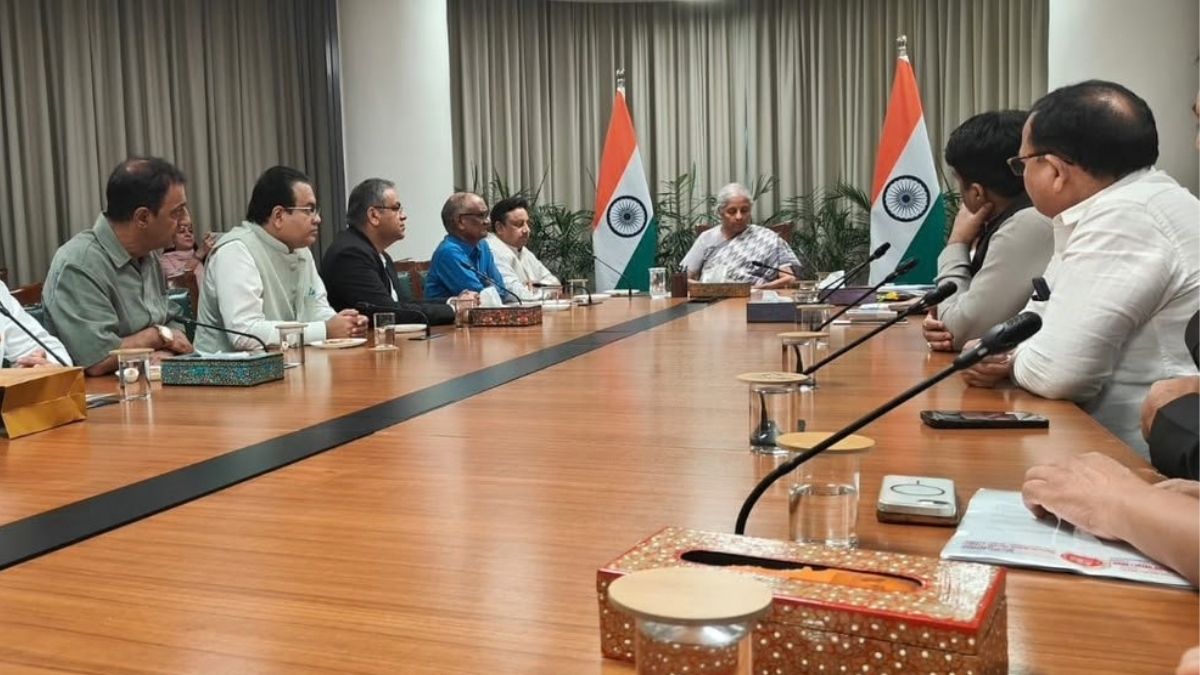
The associations have proposed that implementation be deferred because of the upcoming festive season and that the MDR be introduced in phases
The All India Mobile Retailers Association (AIMRA) and the All India Consumer Products Distributors Federation (AICPDF) have withdrawn their proposed “No UPI Day” protest scheduled for tomorrow after a trade delegation met Union Finance Minister Nirmala Sitharaman and presented its concerns over the proposed Merchant Discount Rate (MDR) on UPI transactions.
The decision came after the (AIMRA), an apex advocacy body representing over 1,50,000 mainline mobile and electronics retailers across India, and AICPDF, a national trade organisation representing hundreds of thousands of fast-moving consumer goods (FMCG) distributors, stockists, and traditional retailers across India sought changes to the proposed MDR framework, including deferment of its implementation, a phased introduction of the rate, a higher transaction threshold and exclusion of merchant-to-merchant (M2M) transactions. The delegation was led by Praveen Khandelwal, Secretary General, Confederation of All India Traders (CAIT), and Kailash Lakhyani, Founder Chairman, AIMRA.
Also Read: Mobile retailers pushback against MDR with ‘No UPI Day’ on October 2
The proposed MDR of 0.40 pc on eligible merchant UPI transactions is scheduled to take effect from October 15. The trade bodies had earlier announced the October 2 protest to highlight the additional cost they expect the MDR to create for retailers.
Following the meeting, the associations said the Finance Minister heard their concerns and assured them that the issues would be considered. However, the association leaders admitted that they had not obtained any commitment from Sitharaman about acceptance of their demands.

Kailash Lakhyani
The associations have proposed that implementation be deferred because of the upcoming festive season and that the MDR be introduced in phases. Their proposal calls for an initial rate of 0.2 pc during FY2026-27, followed by annual increases of 0.05 pc points until it reaches 0.4 pc. They have also sought that the proposed INR 1,00,000 threshold be raised to INR 5,00,000 and that M2M transactions remain outside the MDR framework.
Kailash Lakhyani, Founder Chairman, AIMRA said the meeting gave the associations an opportunity to put the operational concerns of retailers directly before the Finance Minister.
The associations had earlier said that the proposed MDR would put pressure on retailers operating on narrow margins, particularly as digital payments have become part of day-to-day retail transactions. AIMRA had estimated that the proposed 0.4 pc charge could translate into an additional monthly cost for small mobile retailers, depending on their UPI transaction volumes.
Navneet Pathak, National Joint General Secretary, AIMRA, said the decision to withdraw the protest was based on continued engagement with the government rather than the immediate acceptance of the associations’ demands.

Navneet Pathak
“We have been in constant touch with the government and have been working to find a solution. This is not just about whether our demands are accepted. There were certain facts and ground-level concerns that the government was not fully aware of earlier. Those concerns have now been brought to their attention, and the government has agreed to look into them and work with all the relevant stakeholders,” Pathak tells Media India Group.
He said the associations had consolidated their concerns before approaching the government.
“Based on the inputs collected from all major associations, we submitted a comprehensive list of our demands. The government has acknowledged these and asked us to re-engage as soon as possible,” he says.
Also Read: Despite government’s assurance, consumers set to bear brunt of UPI MDR costs
For the trade bodies, the key issue now is what follows the government’s assurance and whether their proposals are incorporated into the final framework. For retailers, the issue is not limited to the rate itself. They are also concerned about the threshold at which MDR would apply and the inclusion of business-to-business transactions.
Rajesh Kumar, a mobile retailer in Lajpat Nagar, says that the proposed threshold did not reflect the way transactions are conducted in the trade.
“The margins in mobile retail are already tight, and a charge on UPI transactions will have a direct impact on our business. The INR 10,00,00 threshold does not take into account the transaction volumes of retailers because payments can cross that amount quickly in a normal business cycle. This is why we are looking at our associations to put the ground reality before the government and seek a practical solution. We trust our associations to take up the issue on our behalf, and we hope the discussions with the government will result in a decision that is in the interest of retailers,” Kumar tells Media India Group.
For AIMRA and AICPDF, the withdrawal of the protest now shifts the focus from mobilisation to negotiations. The associations have said their decision was based on the government taking note of their concerns and opening the door for further engagement.
Pathak says that the industry now expected the discussions to move quickly.
“Ultimately, imposing an additional burden on retailers and businessmen was not appropriately calculated. Now that the government has taken note of our points and the teams are working on them, we are hopeful of a positive outcome for the retail industry. We expect further discussions to take place soon, potentially as early as this week,” he says.