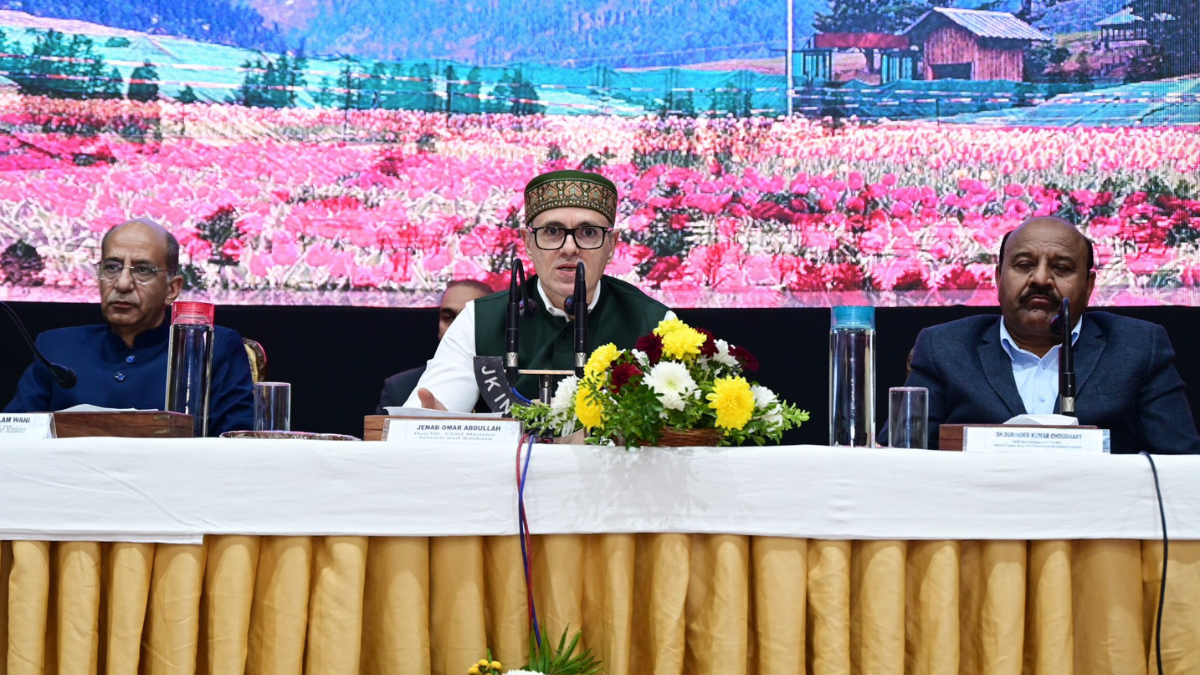
The budget has drawn sharp reactions from young people across the Union Territory (Photo: Omar Abdullah X )
On Friday, the Jammu and Kashmir government presented its Budget for the financial year 2026–27, outlining a fiscal roadmap that seeks to balance infrastructure-led growth with incremental social sector spending in a region navigating economic recovery, administrative transition and employment stress. With a total outlay of INR 1,137.67 billion only marginally higher than last year’s allocation of around INR 1,120 billion the budget has sparked intense political debate and public scrutiny over whether headline spending can deliver jobs, welfare and tangible economic relief on the ground.
Of the total outlay for 2026-27, INR 806.40 billion has been earmarked for revenue expenditure, while INR 331.27 billion has been allocated towards capital expenditure. In comparison, the 2025-26 budget had provided approximately INR 785 billion for revenue spending and around INR 335 billion for capital works. The marginal dip in capital expenditure this year reflects a cautious fiscal stance, even as infrastructure remains the dominant theme of the budget.
Also Read: Jammu & Kashmir’s first budget in 6 years: A turning point or another missed opportunity?
The government has projected total revenue receipts of INR 900.18 billion for 2026–27, with the Union Territory’s own tax and non-tax revenues estimated at INR 318 billion. Central assistance and share in central taxes together account for over INR 427 billion, once again underlining Jammu and Kashmir’s continued dependence on transfers from the Union government. Last year, own revenues were projected at roughly INR 300 billion, suggesting a modest improvement in revenue mobilisation but not a structural shift.
Despite such framing by the government, reactions to the budget have been mixed and often sharply contested. Leaders from the ruling National Conference welcomed the plan, but opposition politicians labelled it “anti-people” and “disappointing,” saying that it failed to address urgent needs on the ground. Outside the Assembly, Leader of the Opposition and senior BJP legislator Sunil Sharma described the budget as a “stark disappointment” that had “shattered the hopes and aspirations of all sections of society in Jammu and Kashmir,” and criticised it for prioritising party interests over common welfare. He accused the government of failing to deliver meaningful relief to daily wagers, unemployed youth and economically vulnerable families
The budget comes against the backdrop of a regional economy that is estimated to have grown by around 5.8 pc in 2025-26, with services continuing to dominate the Gross State Value Addition. Agriculture and allied activities contribute a little over one-fifth to the economy, while industry remains relatively underdeveloped. These structural realities are reflected in how sectoral allocations have evolved between the two budgets.
Also Read: Poor snowfall in Kashmir hits tourism & agriculture
Agriculture and allied sectors have seen a noticeable contraction in direct budgetary support. For 2026–27, the allocation stands at approximately INR 18.78 billion, down from INR 22.22 billion in the previous year. This decline of nearly INR 3.44 billion has raised concerns among farming communities, particularly in a region where a significant portion of the population remains dependent on horticulture, livestock, and small-scale agriculture. While the government says that many interventions are now routed through centrally sponsored schemes and convergence models, the reduced standalone allocation suggests a gradual deprioritisation of agriculture in the Union Territory’s own spending.
Healthcare and medical education, by contrast, have received a moderate boost. The allocation for the sector in 2026–27 has been increased to INR 18.66 billion, compared to INR 17.51 billion in 2025–26. The additional INR 1.15 billion is intended to support hospital upgrades, expansion of diagnostic facilities, telemedicine services, and staffing of new medical colleges. The government has positioned this increase as part of a longer-term strategy to improve access to secondary and tertiary healthcare, particularly in remote districts, as well as to prepare the system for the operationalisation of large central institutions such as AIIMS Kashmir.
Education continues to receive incremental increases, reflecting its status as a politically and socially sensitive sector. The 2026–27 budget allocates INR 15.13 billion for school education, higher education, and skill development, up from INR 13.89 billion in the previous fiscal year. The rise of INR 1.24 billion is expected to be channelled into classroom infrastructure, teacher support, digital learning tools, and vocational training aligned with national education reforms. While the increase is modest, it signals an attempt to address learning gaps that widened during years of disruption and to respond to persistent youth unemployment.
“This is a budget for National Conference MLAs. There is nothing in it for the common people of Jammu and Kashmir,” Sharma said. He alleged that funds allocated by the Centre were diverted to NC-held constituencies.
He accused the government of betraying daily wagers by failing to announce a clear, time-bound regularisation policy and ignoring unemployment. “Nearly 24,000 jobs have been outsourced with no written exam or transparent process. This budget is deceptive and disappointing,” he said, adding that earlier promises of free electricity and LPG cylinders remain unfulfilled.
The budget has drawn sharp reactions from young people across the Union Territory, many of whom say the document fails to address their most pressing concern: employment. With youth constituting nearly two-thirds of the population, expectations from the budget were high, particularly among those preparing for government jobs amid shrinking recruitment and rising competition. For many aspirants, the budget’s emphasis on infrastructure and welfare offers little reassurance in the absence of a clear roadmap for stable public-sector employment and opportunities for local youth.
Also Read: Kashmiris face fresh wave of suspicion & harassment after Red Fort blast
“I find this budget hopeless and vague. It doesn’t offer any healing or hope for people like us. Around 60 to 65 pc of our population is young, but there is nothing here that speaks directly to our future. We keep hearing about opportunities, yet thousands of posts are being outsourced while local youth continue to wait. When so many workers from outside are employed here and local aspirants are left uncertain, it feels like we are being ignored,” Hamid Bhat, 27-year-old graduate from Srinagar, who has been preparing for government recruitment exams for the past three years, tells Media India Group.
The most dramatic change between the two budgets is visible in infrastructure spending, particularly roads and connectivity. For 2026-27, allocations linked to road construction, highways, tunnels, and transport infrastructure together amount to over INR 615.28 billion, a sharp rise from the roughly INR 40.63 billion allocated specifically for roads and bridges in 2025–26.
The government has framed this expansion as essential for economic integration, tourism growth, and logistical efficiency in a geographically challenging region. Large-scale connectivity projects are also expected to generate short-term employment, even as questions remain about execution capacity and timelines.
However, from a corporate law and investment perspective, infrastructure spending alone does not automatically translate into business confidence. Legal predictability, regulatory clarity and administrative efficiency remain critical variables. According to Mushtaq Dar, Advocate, the signals businesses should watch in the budget are not limited to sectoral allocations, but to whether the government addresses deeper institutional frictions.
“From a corporate law perspective, the key signals investors look for are not just incentives or infrastructure spending, but certainty in how laws are applied. The core issue in Jammu and Kashmir is not the absence of policy frameworks, but the gap between law and implementation,” Dar tells Media India Group.
Dar points out that while systems such as the Single Window clearance mechanism exist on paper, they often fail to deliver time-bound outcomes. “In practice, these systems frequently become file-movement platforms between departments, without enforceable deadlines or accountability. Even straightforward and lawful transactions like land registration or cross-border investment approvals can take months, not because the law is unclear, but because officials are hesitant to take decisions,” says Dar.
This hesitation, he says, stems from a combination of legal uncertainty, fear of post-facto scrutiny, and insufficient training in commercial and corporate law. “Officials are often reluctant to exercise discretion, even when the law permits it. The result is regulatory paralysis, which investors interpret as risk.”
The 2026–27 budget, like previous ones, focuses largely on funding sectors rather than addressing these institutional bottlenecks. Dar notes that while ease-of-doing-business reforms are frequently referenced, budgets rarely invest in the “human infrastructure” of governance. “What is needed is systematic investment in legal training, clear operational guidelines, and enforcement of timelines under existing laws like the Public Service Guarantee Act. Without fixing this human side of the system, new announcements will not translate into faster approvals on the ground,” he adds.
Also Read: Missing placement cells in Kashmir universities undermine job prospects for students
Rural development expenditure has seen a contraction in comparison to last year. The sector has been allocated INR 34.56 billion in 2026–27, down from INR 37.74 billion in 2025–26, a reduction of nearly INR 3.18 billion. Programmes related to rural employment, village infrastructure, and Panchayati Raj institutions will now operate within tighter fiscal space. The government has indicated that convergence with central schemes will offset some of this reduction, but local representatives have flagged concerns about delayed payments and reduced flexibility at the grassroots level.
Tourism, one of Jammu and Kashmir’s most visible economic sectors, does not yet have a fully disaggregated allocation in the detailed budget documents for 2026–27. In the previous year, the sector received INR 3.90 billion, aimed at destination development, promotion, and infrastructure support. While official statements suggest continued focus on tourism-led growth, the absence of a clearly stated increase has generated uncertainty within the hospitality industry, particularly after recent security-related disruptions that affected tourist inflows.
Social welfare remains embedded across departments rather than consolidated under a single headline figure. The 2026–27 budget introduces several targeted measures, including support for vulnerable households, students from low-income backgrounds, persons with disabilities, and orphans. While the fiscal impact of these measures is relatively limited in aggregate terms, they play a significant political role in signalling a people-centric approach amid rising living costs and employment insecurity.
Scepticism over the welfare promises announced is particularly pronounced among low-income households and daily wage workers, many of whom say past commitments remain unfulfilled. For families struggling with rising food and fuel costs, announcements such as free LPG cylinders have triggered more doubt than relief, especially when earlier entitlements were delayed or irregular. Among daily wagers, the absence of any direct mention in the budget has reinforced fears of continued economic neglect.
“When people could not even receive the 12 gas cylinders promised over one-and-a-half years ago, who is going to ensure six more now. Every budget talks about welfare, but this one did not say a single word about daily wagers not even a sentence. We are the ones who work without job security, without regular wages, and without social protection. Big announcements sound good, but for people like us, this budget feels empty on substance because it does not address our daily reality,” Ghulam Mohammad Bhat, a 41-year-old daily wage worker in Baramulla who has worked on road and irrigation projects for over a decade, tells Media India Group.