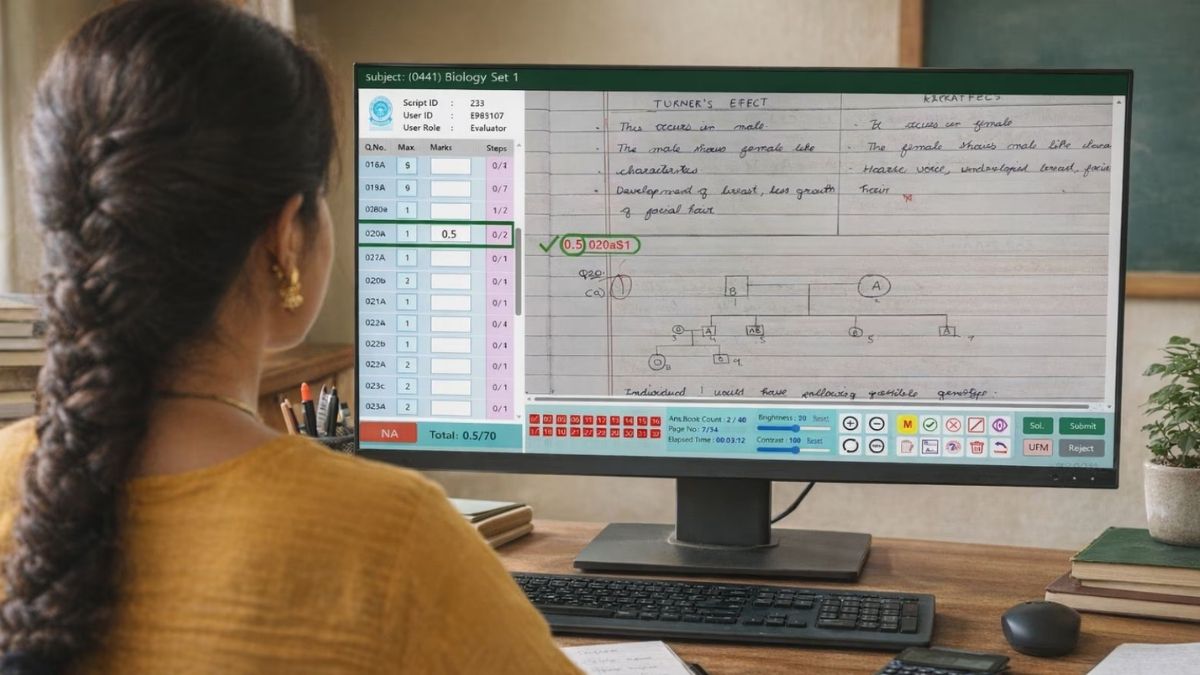
CBSE’s new on-screen marking system has triggered outrage over alleged score drops (Photo: CBSE)
The Central Board of Secondary Education’s (CBSE) abrupt introduction of the On-Screen Marking (OSM) system for Class 12 board examinations on February 9 has triggered a nationwide backlash after thousands of students reported unexplained score drops, unchecked answers and stricter evaluation patterns, in their results that were announced on May 13, exposing a deeper problem in India’s education governance where major policy reforms affecting millions are often rolled out without adequate pilot testing, stakeholder consultation, transition timelines or public feedback.
Over the past decade, India’s education system has repeatedly witnessed abrupt policy changes introduced with compressed timelines and inadequate consultation and prepration, often leaving students to deal with confusion, uncertainty and flawed implementation.
In 2020, the National Education Policy (NEP) radically altered curriculum and assessment structures even as schools struggled through the Covid-19 pandemic. In 2022, the Common University Entrance Test (CUET) was rolled out nationwide within months of announcement, triggering technical glitches, cancelled exams and confusion over university admissions.
The National Testing Agency (NTA) has also repeatedly changed examination formats, normalisation methods and eligibility rules for exams like Joint Entrance Examination (JEE) and National Eligibility cum Entrance Test (NEET), often with limited notice to students.
During the pandemic years between 2020 and 2022, CBSE itself repeatedly revised board examination patterns, term systems and evaluation criteria mid-academic session.
The latest controversy surrounding the CBSE’s newly introduced On-Screen Marking (OSM) system for Class 12 board examinations now reflects the same pattern, where a sweeping evaluation reform was implemented barely weeks before exams, triggering nationwide complaints over unexplained score drops, unchecked answers and stricter marking standards.
Several students who had successfully cleared highly competitive entrance examinations like Joint Entrance Examination (JEE) Mains reportedly failed to secure the 75 pc board marks eligibility required for admission into premier engineering institutions, intensifying concerns over the fairness and reliability of the new digital evaluation system.
Also Read: CUET creates confusion, not uniformity in colleges, say critics
“I scored well above 90 percentile in JEE Main and was confident about my board results, but the marks I got in Physics and Chemistry were unexpectedly low. Some answers were not even checked properly,” Sachin Panwar, a Class 12 science student, Delhi Public School in Delhi, tells Media India Group.
Another student from Paramount International School, Dwarka, Delhi, echoed similar concerns, saying the shift came without preparation time. “We were never told that scanned answer sheets would be evaluated so strictly. Even neatly written answers lost marks. It feels like the rules changed after the exam without informing us,” Jheel Mishra tells Media India Group.
The issue has triggered widespread criticism not simply because CBSE adopted digital marking, but because it introduced one of the biggest changes in India’s school assessment system barely weeks before examinations began, without consultation or transition time for students and teachers.
CBSE officially announced the implementation of OSM for Class 12 evaluations on February 9, shortly before the board examinations commenced. In its circular, the board stated that it would conduct multiple dry runs for practice, organise training programmes and establish a dedicated call centre for issue resolution.
Critics argue that these preparations themselves highlighted the rushed nature of the rollout, since training, testing and troubleshooting mechanisms were being planned after the policy had already been announced with hardly any time for a proper implementation.
Unlike global examination systems such as Cambridge Assessment International Education, International Baccalaureate (IB) and Pearson, which introduced digital marking gradually, after multi-year pilots, limited subject testing and published feedback cycles, CBSE implemented OSM across the entire Class 12 in one sweep.
Students, parent groups and teachers say they were not consulted on whether the transition required a phased introduction or a grace period. Nor were students informed that the new evaluation process could fundamentally alter long-standing marking practices.
Sunita Panwar, mother of Sachin Panwar of Delhi Public School, says the impact went far beyond marks and into admissions anxiety. “My son had 92 pc in pre-boards and strong competitive exam scores, but the board result suddenly dropped him below eligibility for engineering counselling. We had never prepared for such a sharp mismatch between entrance exams and board evaluation. No one explained how this new marking system would actually affect admissions timelines,” Sunita tells Media India Group.
Assessment experts believe the OSM system reduced the discretionary moderation traditionally exercised by human examiners. Under conventional manual checking, evaluators often awarded ‘benefit of doubt’ marks for partially correct steps, borderline answers or unclear handwriting.
“The problem is not digital evaluation itself but its implementation. The issue is the suddenness. When you move from manual marking to full OSM in one cycle, without phased pilots, even minor calibration errors get amplified across millions of papers. Ideally, CBSE should have started with a limited subject pilot, published error reports and then expanded over 2-3 academic cycles. That is how systems like IB and Cambridge avoid shock transitions,” Anil Bansal, Educationist at Udemy, an online learning platform in Gurugram, tells Media India Group.
“If we had been told earlier that evaluation rules had changed, I would have written differently. Even small things like diagram clarity or step marking suddenly mattered in a way we were never trained for,” Panwar adds.
“I would say it is not that failed. It is that I cannot understand how the marks were decided. One answer is fine in one subject and wrong in another even though the logic is identical. We kept hearing about digital evaluation, but nobody explained what it meant in practice. It feels like expectations changed after the exam was already over,” adds Mishra.
Also Read: Need to ground India’s ambitions as global education hub in reality
Another parent Renu Mishra, mother of Jheel Mishra, highlights the uncertainty around transparency and evaluation consistency. “There is complete lack of clarity in how marks are being awarded. When two students with similar preparation levels are getting very different outcomes, it creates confusion about the system itself. We are not against digital evaluation, but the rollout should have been tested properly before being applied to an entire batch,” Renu tells Media India Group.
With standardised digital marking introductions and scanned answer sheets, students allege that the evaluation became significantly stricter without prior warning.
“Even if a reform is sound, it collapses if students are not told how assessment behaviour is changing. Something as basic as scanning sensitivity, answer structuring or marking rubric shift should have been explicitly communicated through mock evaluation samples. A simple national-level sample paper with OSM grading simulation would have reduced this panic significantly,” Bansal adds.
Many students complained that they had not been informed about practical changes required for digitally scanned evaluations, including the need for darker handwriting, clearer diagrams and more structured answer presentation to improve scanner readability.
The CBSE Class 12 result of this year recorded an overall pass percentage of 85.2 pc, marking a decline of 3.19 percentage points from the previous year. Several reports described it as the lowest performance result in seven years.
More than 163,000 students were placed in the compartment category, to reappear for the exam, creating serious implications for university admissions, scholarship eligibility, engineering counselling and medical entrance processes.
For students preparing for professional courses, the consequences have been immediate and severe. Failing to secure the mandatory 75 pc board marks beginning for engineering admissions can invalidate years of preparation despite strong performance in competitive entrance examinations.
The controversy rapidly intensified online as students began comparing their board marks with their JEE and National Eligibility cum Entrance Test (NEET) performances, questioning whether the new evaluation process had unfairly penalised them.
CBSE has defended the system, stating that OSM promotes uniformity and objectivity in the assessment of answer scripts across subjects and regions.
Also Read: Youth-led private libraries spark educational revival in Kashmir
The board has also argued that evaluating more than 100 million answer sheets annually requires technological systems capable of improving consistency and reducing manual errors.
While many experts agree that digital evaluation is eventually necessary for a system of CBSE’s scale, they argue that efficiency for administrators cannot come at the cost of fairness, transparency and preparedness for students.
Following mounting criticism, CBSE opened the re-evaluation process from May 19 and sharply reduced the fee for obtaining answer sheet copies from INR 700 to INR 100 for scanning the answer sheet and INR 25 for re-evaluation of each answer.
However, many students and parents viewed the fee reduction as a reactive damage-control measure rather than evidence of careful planning. Re-evaluation requests still carry additional costs per question and also risk reducing marks further after reassessment, discouraging many families from challenging disputed scores.
From entrance examination changes to curriculum revisions and digital learning mandates, major educational decisions frequently arrive with compressed timelines and limited or without stakeholder consultation.
“There should be a mandatory minimum 18-24 month implementation window for any assessment reform affecting board exams. No change should be applied in the same academic cycle unless it has been piloted in at least 10-15 pc of schools. Without that, you are effectively experimenting on an entire cohort,” Bansal notes.
The larger debate now extends beyond CBSE or digital marking itself. The question confronting India’s education system is whether reforms can continue to be implemented without transparent timelines, independent audits, public consultation and accountability mechanisms.
Because when policies shaping the futures of millions of students are introduced like emergency administrative notifications rather than carefully managed transitions, the issue is no longer only about examinations or technology, but about transparency, accountability, fairness, policy planning and the growing trust deficit between students and India’s education system.