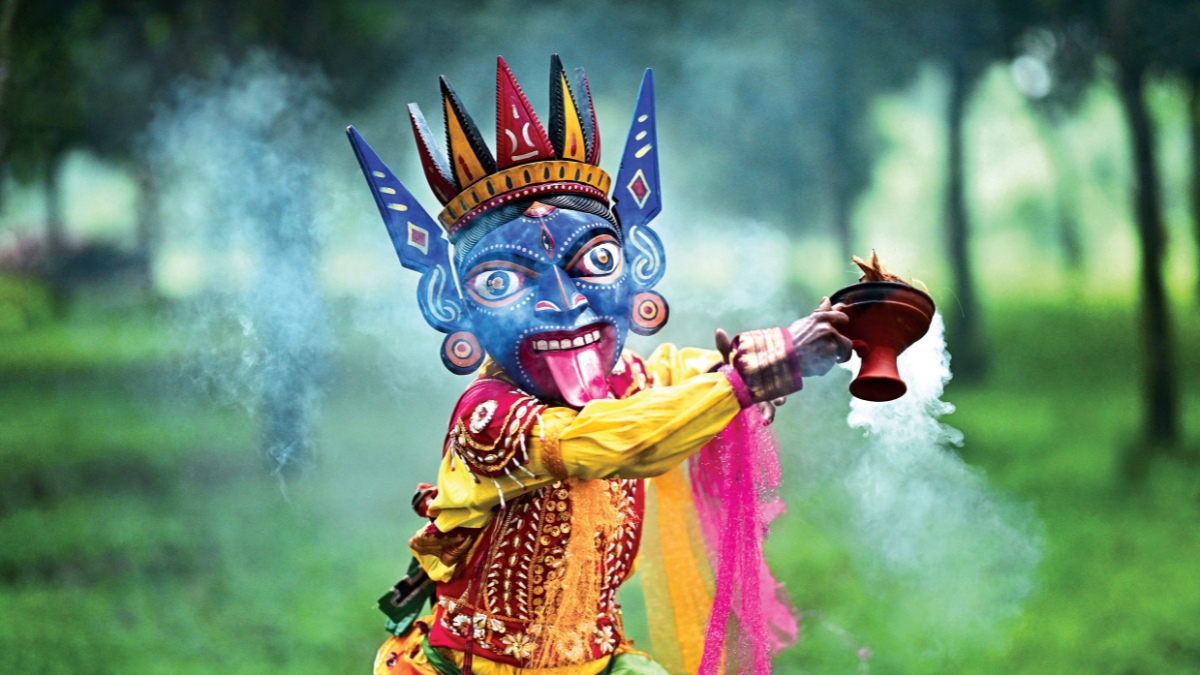
The wooden masks are not decorative trinkets, indeed they are sacred, ritual objects (Photo: Sammya Brata Mullick )
Nestled in the remote stretches of Kushmandi, in Dakshin Dinajpur district, West Bengal, lies a village that seems to exist entirely in the shadow of its own faces. Here in Mahishbathan and in several surrounding hamlets nearly every household makes Gomira masks, wooden ‘mukha’ that are not mere artifacts but living vessels of myth, ritual and collective memory.
At first glance, Mahishbathan might look like any other agrarian outpost. With a population of just under 4,000, the village is quiet, green and bound by the rhythms of rural Bengal. But humming behind the quiet ambience is an age-old art that has emerge and evolved in the village for centuries, the art of making Gomira masks.
Inside a typical courtyard, one is likely to find a log of wood soaking in water its sides split, the surface rough, waiting to become something else entirely. The art of mask-making in this region is deeply rooted in the soil not just because of the trees whose wood is used, but because the very livelihoods of families are shaped by it. The masks are carved from local trees like gamhar (Gamar), neem, mango, pakur, kadam and sometimes teak. Logs are first cut into manageable blocks and submerged in water, a process of seasoning that softens the wood, making it easier to carve.
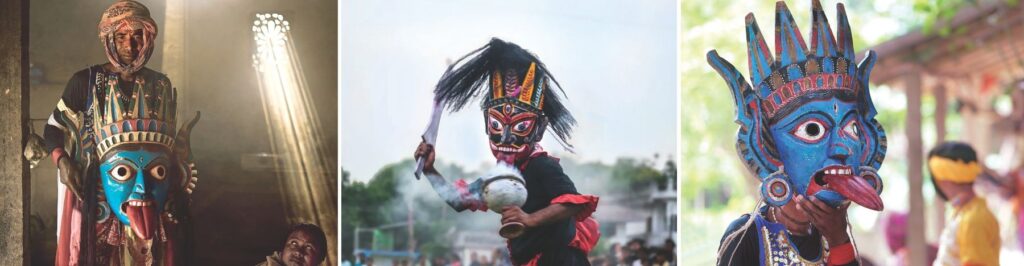
During a performance, the dancers appear one by one, entering the stage in masks of gods, demons, animals Kali, Hanuman, Narasingha, Tiger, Dakini, Bibhishan, Ravana and more (L-Photo: Lopamudra Talukdar) (M-Photo:Jeet Saha) (R-Photo: Sammya Brata Mullick)
Using broad chisels and heavy hammers, artisans chip away to form a basic shape. Then, they hollow out the back of the mask to make room for the dancer’s face. Finer chisels and sandpaper help smoothen the features. It takes four to five days, depending on the complexity of the design, to complete the carving.
Once carved, the masks are painted. Traditional makers still use natural dyes: black derived from fruits of the jia or basatbot tree, red from teak leaves, green from sheem leaves, and violet from jamun. These pigments are mixed with sap from bael or powdered tamarind seeds. Finally, each mask receives one or two coats of pine-tree varnish, making it smooth, durable and ready for ritual use.
Also Read: Durga Puja in Delhi: Idolmakers of C R Park preserve traditions
The wooden masks are not decorative trinkets, indeed they are sacred, ritual objects. They belong to the world of Gomira, a non-vocal dance tradition performed by the Rajbongshi community, especially by men, because the masks can be very heavy.
The name “Gomira” is believed to have derived from “Gram-Chandi,” a local female deity tied to the community’s animist practices. The dancers wear these masks during Gomira performances, but there is also a second performance style called Ramer Bonobas, which depicts scenes of Lord Rama’s exile as per the Hindu epic Ramayana.
During a performance, the dancers appear one by one, entering the stage in masks of gods, demons, animals Kali, Hanuman, Narasingha, Tiger, Dakini, Bibhishan, Ravana and more. There is no singing or spoken dialogue as Gomira is a mime, and the body movements, rhythm, and mask do the storytelling.
Traditional instruments accompany the dance, including dhak, a kind of drum, kansar, and at key moments, the Sanai or a double reed oboe more popularly known as shehnai, which marks dramatic peaks. The performance is at once ecstatic and solemn and is believed to usher in good forces and banish evil.
Ritual, belief & identity
For the people of Mahishbathan, making a mask is as much a spiritual act as an economic one. Villagers often pledge masks to deities. When a family seeks blessings or fulfillment of a wish, they vow to create and offer a mask. The mask becomes, in their belief, an offering equal to a ritual sacrifice.
There is also a very practical side, the mask acts as a mediator between the human and divine. Once worn, the dancers believe they enter a trance-like state; the face of the mask is not just a covering but an identity.
In this sense, the mask is never just “done.” Each mask has to be accompanied by subsidiary figures smaller characters sculpted along the edges because in their worldview, the main character, say Kali or Narasingha, cannot exist alone.
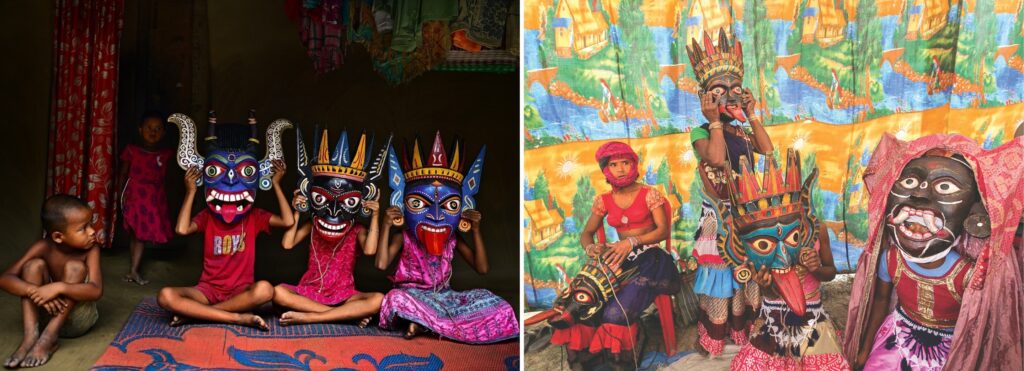
Gomira dances happen mostly from mid-April to mid-July, corresponding to Baisakh, Jyeshtha, and Ashar months in the Bengali calendar (L-Photo: Sammya Brata Mullick) (R-Photo: Lopamudra Talukdar)
Mahishbathan is at the heart of this craft ecosystem. It is here that Mahishbathan Gramin Hasta Shilpa Samabay Samiti, a cooperative registered with the Government of West Bengal operates, bringing together craftspeople from nearby villages like Madhupur, Ruanagar, Sabdalpur, Sindurmuchi and others.
Many artisans from Dakshin and Uttar Dinajpur are involved in mask-making, working collectively to preserve, sustain and evolve this tradition. Women, historically, do not make masks; nearly all artisans are men.
The Samiti runs a Folk Art Centre, supported by the state government and the United Nations Educational, Scientific and Cultural Organisation (UNESCO), that functions as a workspace, a production hub and potentially a touristic site.
For many in Kushmandi, the lines between work, art and worship blur. In a single day, a craftsperson might cycle between the fields and the workshop, between carving a mask and tending to his paddy. Agriculture remains the primary livelihood for a large part of the population but in mask-making households, every courtyard is a studio and every home resonates with chisel strikes and the quiet hum of varnishing.
Masks destined for ritual use still follow traditional cycles. Gomira dances happen mostly from mid-April to mid-July, corresponding to Baisakh, Jyeshtha, and Ashar months in the Bengali calendar. Tourists or outsiders who arrive at random times may find the workshops active, but the dance performances remain intimate and seasonal, anchored in village pujas like Chadak puja, Amat Kali puja, Gombhira puja and even Durga puja.
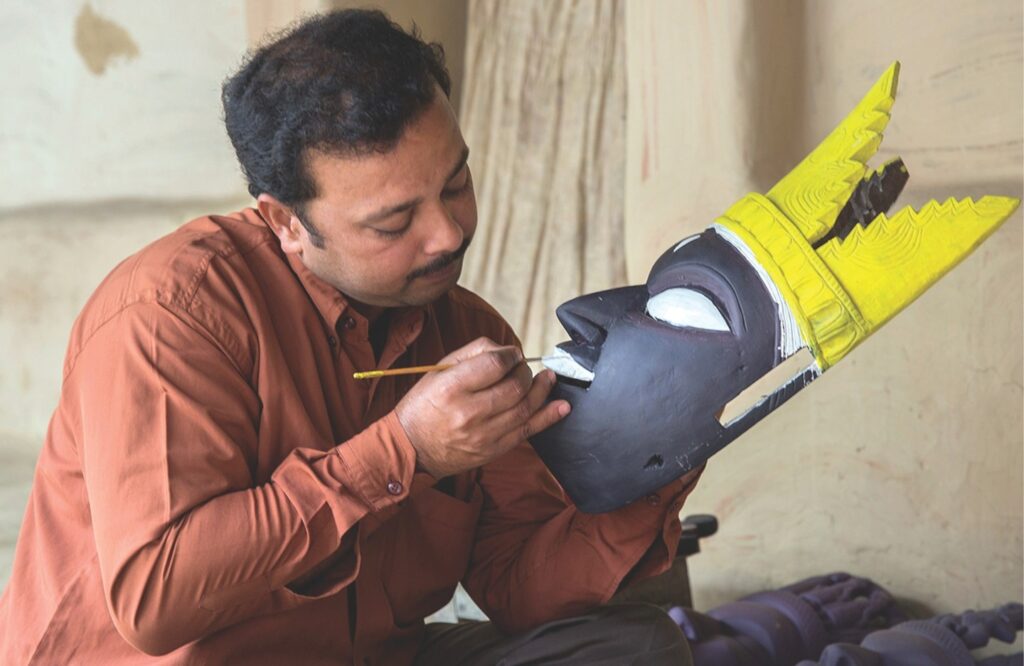
Many artisans from Dakshin and Uttar Dinajpur are involved in mask-making, working collectively to preserve, sustain and evolve this tradition (Photo: Lopamudra Talukdar)
Youngsters in these villages grow up watching their fathers, uncles, or grandfathers turn raw timber into expressive faces. Some of them learn the craft, others drift toward agriculture or migrate for other work. But the cooperative ensures that at least the core tradition remains shared.
Despite its richness, this tradition faces serious obstacles. According to the West Bengal Khadi & Village Industries Board, there are around 186 artisans working in Kushmandi’s mask-making hub. The common problems are a limited market, the high cost of making large masks and irregular demand.
Also Read: Kali Puja au Bengale
While the artisans initially made masks only for ritual purposes, over the decades, demand has grown among collectors inside and outside India. But expanding into decorative or export markets has not been simple: many craftsmen feel that mass production or commercialisation may erode the spiritual essence of what they create.
Moreover, raw material is not unlimited. While older mask makers used neem, now they rely more on gamhar, mango, kadam and other woods. Seasonal migration, agricultural demands, and the lure of more lucrative jobs continue to threaten the continuity of mask-making as a full-time occupation.
In Kushmandi’s most underexplored potential lies slow cultural tourism. The Mahishbathan Folk Art Centre, run by the cooperative, already provides a space where visitors can see artisans at work, attend workshops and learn about the process from raw log to finished mask.
Yet tourism remains limited. This is perhaps by design as the tradition is deeply rooted in ritual and community, not in spectacle. There are no massproduced souvenirs, no tourist trinkets massed on shop shelves instead, each mask is personal, made with devotion and intention.
Local stakeholders and policymakers have talked of promoting Kushmandi as a rural craft hub, not as a flashy tourist spot. The cooperative, in partnership with the government and UNESCO, hopes to draw visitors who come not just for selfies, but to witness a living tradition.