
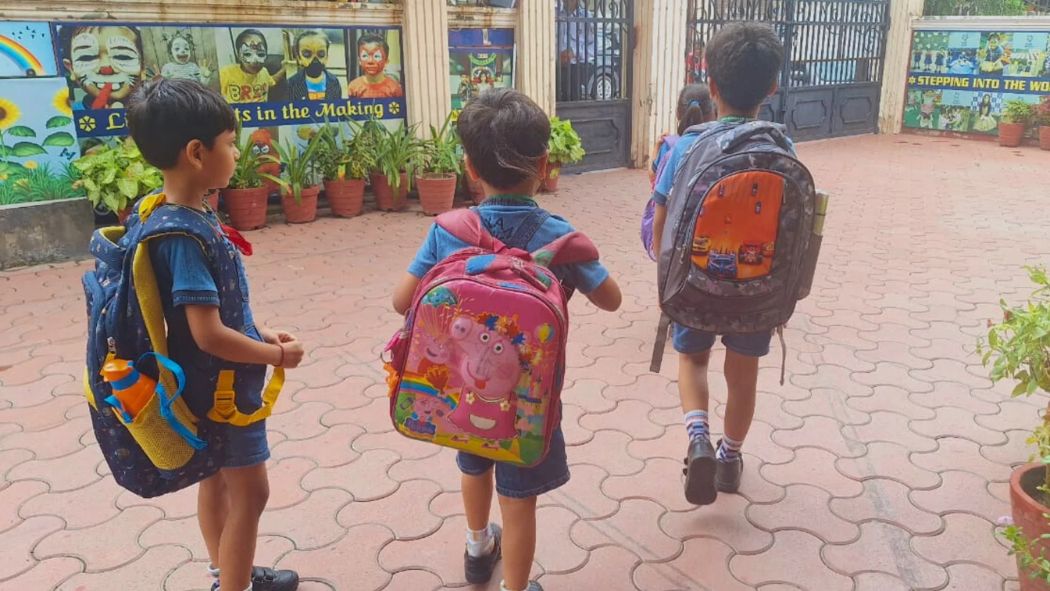
Continuous switch of education from offline to online mode in New Delhi has affected the quality (Photo: Media India Group)
Amid worsening air quality in Delhi, schools have been directed to shift classes up to Grade 5 to the online mode. For the past six weeks, the city has been recording Air Quality Index (AQI) levels in the “severe” to “hazardous” category, frequently crossing 400, posing serious health risks to residents across age groups, particularly children.
While air pollution has become an annual crisis in the national capital, conditions this year have been especially alarming. Data shows that average particulate matter (PM) levels in 2025 were nearly 30 times higher than the limits recommended by the World Health Organisation (WHO). The spike has triggered emergency measures under the Graded Response Action Plan (GRAP), including restrictions on outdoor activities and the closure of schools.
Although the decision to move younger students to online classes has been taken in the interest of children’s health, concerns are growing over repeated disruptions to academic continuity and the long-term impact on learning outcomes.
Priya Rastogi, a parent of a Class 4 student at Salwan Public School in New Delhi says online classes fail to match the effectiveness of physical classrooms and, paradoxically, introduce new challenges.
“As a parent, I understand that the move to online or hybrid classes is meant to protect children during periods of extreme pollution. However, frequent disruptions are clearly affecting the quality of education. Online classes, which became common after Covid-19, cannot fully replace classroom learning for younger children. They struggle with concentration, screen fatigue and the lack of personal interaction with teachers,” Rastogi tells Media India Group.
Also Read Death by breath in Delhi: Irate residents complain of inaction over air pollution
She adds that the responsibility of supervising online education often falls heavily on parents, particularly working professionals.
“Many parents cannot constantly monitor online classes, which affects children’s discipline and understanding of lessons. Practical subjects, discussions and peer learning suffer the most. While health must remain the priority, the repeated switching between offline and online modes is creating learning gaps and adding stress for families. What we need is a long-term solution to address pollution at its root, so education is not repeatedly compromised,” she says.
For students, the shift to online and hybrid learning has disrupted the rhythm of the school day. Instead of structured classroom environments, many attend lessons from their bedrooms, struggling to stay engaged through screens, while others battle isolation and screen fatigue.
Amit Srivastava, a Class V student of M R Vivekananda Model School, Dwarka says the constant switching of learning modes has affected his ability to focus and stay motivated.
“My studies have been affected to a large extent because of the hybrid mode. At this age, we need more face-to-face interaction with teachers,” Srivastava tells Media India Group.
“There are frequent network issues and breaks during classes, which leads to a lack of interest. Half of us don’t understand what is being taught, and the other half are unable to concentrate,” he adds.
As per education experts, foundational learning years are critical for cognitive development, social skills and classroom discipline areas that are difficult to nurture through virtual platforms alone.
A survey conducted by Indian Management Services, a teaching institute, found that 58.4 pc of students prefer offline education due to better engagement and understanding. In contrast, a significantly smaller proportion favoured online learning. The survey also revealed that 64 pc of students felt bored during online classes, while 86 pc reported feeling highly motivated in offline classrooms.
As pollution-related school closures become more frequent, parents and educators are calling for predictable academic planning alongside stronger pollution-control measures. Without long-term solutions to Delhi’s air quality crisis, they fear emergency responses may continue to protect children’s lungs, but at the cost of their learning.
While schools have been shut to safeguard younger students, most colleges continue to function offline, forcing students from distant areas to commute daily despite hazardous air conditions.
Priyanshi Khanna, a BA Psychology student at Christ University in Ghaziabad, says attending college has become increasingly difficult as she struggles to balance her health and education.
“Although I study in Ghaziabad, I travel five days a week from Delhi to attend lectures. The commute itself is exhausting, but the pollution has made it unbearable. I am constantly coughing, my eyes water, and I feel my breathing capacity has reduced. Unlike school students, college students cannot take leave because attendance is mandatory,” Khanna tells Media India Group.
“I can’t help but feel envious of younger students who are studying from home, even though I know their education may be suffering. My parents are worried about my health. If the government can grant holidays to students, why are college students excluded? Aren’t we students too?” she asks.
