

Prime Minister Narendra Modi inaugurated the India AI Impact Summit 2026 at Bharat Mandapam New Delhi (Photo: PMO)
The Global AI Impact Summit which began in New Delhi on Monday reflects this historic turning point. Humanity stands at the threshold of a technological transformation that will shape economies, societies, and governance.
Fundamental Question
Yet amid this excitement, a deeper and more fundamental question remains largely absent from public discourse. As humanity accelerates toward Artificial Intelligence, is it drifting away from nature’s intelligence that has sustained life on Earth for 4.5 billion years and survived five series of extinctions?
This question has critical and focussed significance as India hosts the 2026 global summit, the largest of four such summits held so far. Traditional Indian knowledge system rates wisdom high over intelligence. It encompasses observations of microbes to mammoths, teachings from mountains to meadows, understanding of fins to forests that along with others constitute ‘the nature’.
The human-civilisation framed the science, philosophy, technology, yoga, agriculture, and arts by observing the nature over 10,000 years. In the race to lead the creation of artificial intelligence in the 21st century, India’s AI Impact Summit of 2026 must not therefore forget the deep rooted wisdom of nature, that built India’s wisdom system . India has unique opportunity to present this fundamental positioning of the nature by virtue of its scriptures like Vedas to address what the United Nations is attempting to address AI-related risks and sharing its transformative potential by developing globally inclusive and distributed architecture for AI-governance based on international cooperation and by addressing gaps in current AI governance arrangements.
Also Read: Artificial Intelligence: Transforming design, manufacturing and operations
The UN is trying to call on all governments and stakeholders to collectively protect ‘human rights’ in context of emerging AI . India has opportunity to get the much needed attention to the ‘planet’s rights’ to balance their natural cycles for its well-being . AI should not ‘chip-in’ to disturb the delicate balance that Nature has maintained over millennia but which is extremely threatened today due to the triple-crisis of climate change, biodiversity loss and pollution.
Silicon Valley descends on Delhi
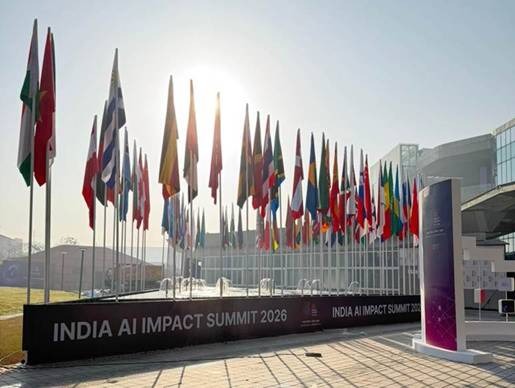
The Global AI Impact Summit reflects this historic turning point
Does the arrival in New Delhi of global Big Tech leaders like Sundar Pichai and Sam Altman, political leaders like India’s Prime Minister Narendra Modi, French President Emmanuel Macron, President Lula of Brazil among 20 others would get the much needed Ascent of attention to the Nature-Wisdom’ over Artificial Intelligence?
Nature is not merely a passive ecological regime . It is the most powerful, durable and resilient wisdom system, ever known to the humanity. It has repeatedly proved its regenerative potential after each of the past five mass-extinctions. The ecosystems were rebuilt after each of the planetary scale disasters, last of which being 65 million years back when dinosaurs were wiped out. Nature’s intelligence has repeatedly maintained earth’s balance and rebuilt the sustainability after each of the five catastrophes without holding global summits, world-wide debates and fire-side chats!
Neither did nature recall earlier patterns through coding as AI does, but through power of resilience, adaptation and regeneration. Indigenous civilisations developed systems based on nature’s balance and regeneration. These observations created ecological wisdom. Sustainability began not with algorithms, but with actions based on observation of Nature’s cycle. Sadly, exception to these history regeneration is the short period of last 300 years, called the Industrial Revolution, during which we are resorting to Artificial Intelligence. Human activity has destabilised planetary balance that was achieved after last extinction. Artificial Intelligence arrives at this fragile and threatening moment. It does offer extraordinary potential and at the same time, a profound risk.
Also Read: Artificial Intelligence transforming disease diagnosis
AI can accelerate climate modelling, optimise energy systems, improve resource efficiency, and enhance environmental monitoring. It can empower policymakers, engineers, and students to make more informed sustainability decisions. It can compress learning cycles and democratize access to knowledge. Used wisely, Artificial Intelligence could become humanity’s most powerful sustainability accelerator.
Its rapid advancement commands attention, attracts investment, and raises ambition on a scale rarely seen before. There is, however, a growing risk that humanity becomes so focused on building artificial intelligence that it neglects its relationship with nature’s intelligence.
Today, there is a risk that Artificial Intelligence becomes an obstructive intermediary between humans and nature. While AI can enhance understanding, it may also reduce direct engagement with nature’s systems. When humans stop observing nature, they stop understanding it. When they stop understanding it, they stop protecting it. And when they stop protecting it they expose themselves to self-destruction. Artificial Intelligence must enhance humanity’s connection with Nature, not end it. There is another critical distinction between artificial and natural intelligence. Artificial Intelligence optimises efficiency, while nature optimises resilience. Efficiency improves short-term performance, but resilience ensures long-term survival.
Artificial Intelligence does not get generate and operate independent of planetary eco-systems
Ever since the beginning of life, nature has preserved biodiversity, redundancy and diversity to ensure adaptability. Human technological systems often eliminate redundancy in pursuit of efficiency, making them vulnerable to disruption. The sustainability-challenge requires resilience, not efficiency alone. Does Artificial Intelligence learn from nature’s resilience principles to adapt itself ? AI, importantly and unfortunately, has very large and rapidly growing environmental footprint. It is becoming a bigger contributor to climate crisis as data-centres, which are coming up by the dozen every day, consume vast amounts of electricity. AI hardware itself depends on resource extraction of rare-earths. Electronic waste continues to grow rapidly as we are witnessing not only in computers, but the batteries and solar panels. Artificial Intelligence does not get generate and operate independent of planetary eco-systems. It draws vast amounts of energy and materials from the Earth and both are rising rapidly every passing month.
What to expect from AI era
The first and foremost, AI must itself become sustainable. The next deeper challenge, however, is ethical. Artificial Intelligence can generate answers based on patterns that humans have sketched . But it cannot generate conscience. It can process information. But it cannot define responsibility.
The planetary crisis was not caused by lack of intelligence but lack of wisdom. It was caused by intelligent systems deployed without sufficient regard for ecological consequences. Indigenous civilisations have developed systems based on observing nature’s balance and regenerative capacity. These observations resulted in ecological wisdom that helped humanity not just in survival but in making progress and in their well-being.
Also Read: Global funding for AI, ML soars
This is where experiential education becomes critical. Universities must evolve beyond teaching sustainability as theory. They must become living laboratories where students use AI to measure emissions, manage energy systems, and implement real sustainability solutions. In the era of AI, they must – not only be the centres of knowledge, but also the hubs of the solutions.
Artificial Intelligence should accelerate human capacity, not replace human responsibility. The ultimate goal is not Artificial Intelligence, but planetary intelligence that leads to the wisdom, the ability of humanity to align technological progress with ecological stability. Nature has already demonstrated how intelligence sustains balance. Humanity must now ensure that its Artificial Intelligence strengthens that balance rather than disrupts it. Artificial Intelligence represents neither inevitable trauma nor guaranteed turning point. It is an amplifier.
It is hoped that AI-Impact Summit in Delhi would be able to convey this natural wisdom-system that helped the planet to survive without Artificial Intelligence. The future of the nature will depend not on how intelligent our machines become, but on whether humanity remains intelligent enough to align them with the wisdom of the only system that has sustained life for billions of years.
Artificial Intelligence may be the talk of the planet, but Natural intelligence remains the foundation of its survival. It is always the case that we may set the rule books but if implementation with conscience is not set-in our actions would be artificial! The solution may indeed lie in ensuring that the meaning of AI changes from Artificial Intelligence to Accelerated Implementation.
(Rajendra Shende is a former Director UNEP, Founder Director Green TERRE Foundation, coordinating lead author, IPCC that won Nobel peace prize, Prime Mover SCCN, IIT Alumnus. The views expressed here do not necessarily reflect those of Media India Group.)
