
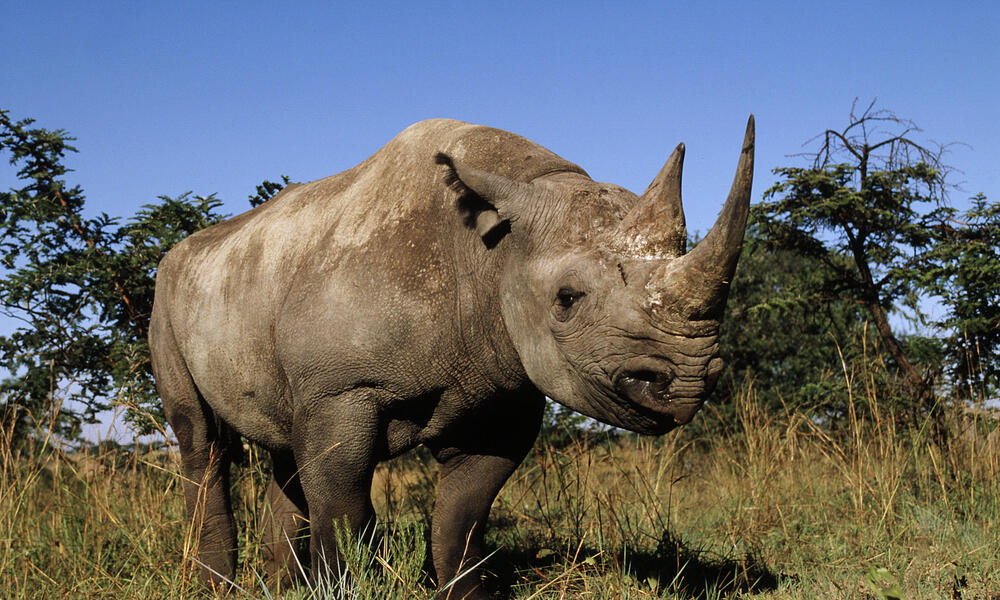
Allowing black rhinos to move freely across their natural habitats could be the best way to protect these critically endangered animals from the hidden genetic dangers of inbreeding
A study by University of Glasgow suggests that allowing black rhinos to move freely across their natural habitats, rather than confining them to fenced sanctuaries, could be the best way to protect these critically endangered animals from the hidden genetic dangers of inbreeding.
According to a press statement, published in the Proceedings of the National Academy of Sciences, the research is the first to analyse the whole genomes of black rhinos from Tanzania.
The statement adds that the study was a collaboration between the Tanzania National Parks Authority, the Tanzania Wildlife Research Institute and the University of Glasgow.
“Black rhino populations have survived several historic bottlenecks across Africa, most recently due to poaching. Often these populations have been reduced to just a few individuals which requires focused conservation and research efforts to ensure their recovery. Whole genome sequencing provides a powerful tool for us to gain greater insights about how to manage these populations better,” says Ronald Mellya, first author, who undertook the study while carrying out his PhD at the University of Glasgow.
“The study uses cutting edge techniques for analysing sequences of whole genomes of individual rhinos. The method allowed us to study billions of base pairs of DNA and the approach of dividing the population into various cohorts helped us gain unprecedented insights to understand the effects of translocation and natural dispersal,” says Anubhab Khan, a lead author of the study, from the University of Glasgow’s School of Biodiversity, One Health & Veterinary Medicine.
The statement adds that for decades, black rhinos have been kept in enclosed zones to shield them from poaching, their greatest threat. However, this isolation has raised concerns about inbreeding, which can weaken populations over time. It says that traditionally, conservationists have tried to address this by moving rhinos between populations, a costly and risky process.
According to the statement, the new genomic analysis found that while translocated rhinos showed reduced inbreeding, they also carried more harmful genetic mutations. In contrast, rhinos that were able to roam and interbreed naturally across different areas benefited from reduced inbreeding and, crucially, showed fewer dangerous mutations, likely because natural selection was able to purge these from the population.
“Translocations can bring in new genetic variants, but they may also introduce hidden genetic risks that build up in captivity. Our findings suggest that maintaining habitat corridors to allow rhinos to move naturally might be a more sustainable solution,” says Barbara Mable, Professor of Evolutionary Genetics at the University of Glasgow and a lead author of the study.
“Translocations are often very expensive and risky operations. While they are a useful approach, this research has shown that rhinos do best when they have space to live and move in natural ways,” says Philbert Ngoti, Tanzania’s Rhino Coordinator and co-author of the study.
The statement adds that the findings highlight a trade-off: while moving animals can boost genetic diversity, it may also introduce mutations that are maladaptive in new environments.
According to the statement, the researchers argue that, where possible, opening natural corridors for rhino movement is more effective and less expensive than constant translocations. In Tanzania’s Serengeti ecosystem, for example, investing in ranger teams to protect rhinos as they move freely could cost less than a single translocation operation.
“What we see from this research is that supporting the natural movement of rhino across these landscapes is key to the species’ survival, rather than relying solely on translocations,” says Massana Mwishawa, Deputy Conservation Commissioner of TANAPA.
Additionally, with Tanzania now home to 253 black rhinos as of December 2023, up from just 161 in 2019, this research offers hope that a more natural approach could secure the future of one of Africa’s most iconic species.
“This research comes at a time when the continental populations of African rhinos no longer occupy their natural distribution range but rather are site-bound and fragmented in relatively small populations. As conservationists debate the best strategies for managing species like the rhino across Africa in the wild, we need the kinds of insights that emerge from this research to improve our interventions. Captive populations can play a short-term role in conservation but should not be seen as a long-term solution. The best thing for rhinos is the protection and connection of rhino habitat at scale,” says Dr David Balfour, the Chair of the IUCN Rhino Specialist Group.
