
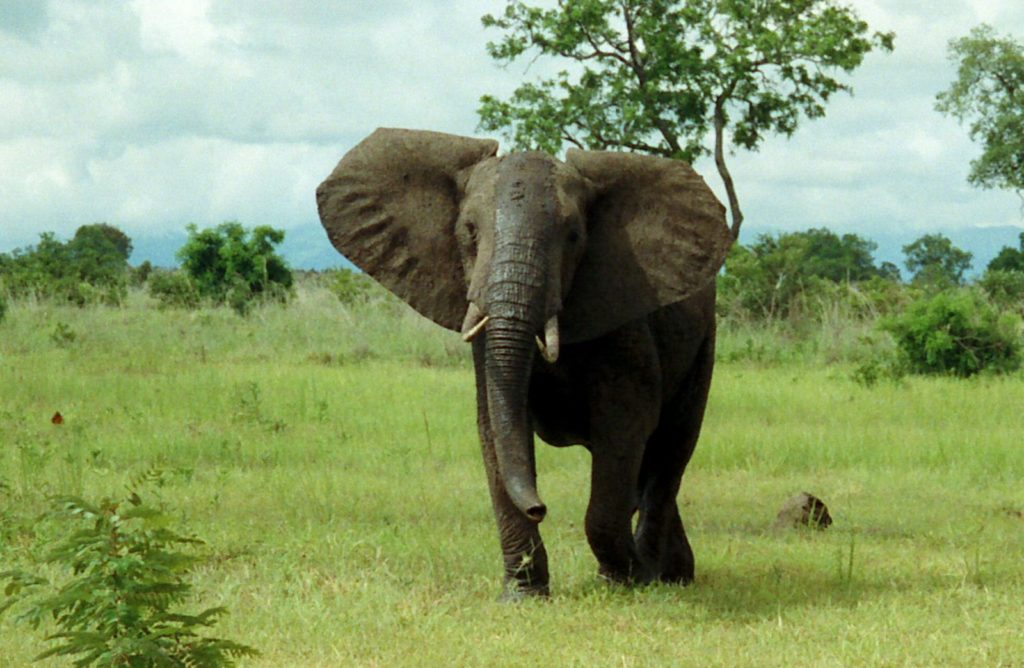
Elephants play a key role in regeneration of trees and forests with their feeding & migratory habits
Elephants, because of their size, appetite and migratory habits, disperse more seeds of more species further than any other animal. They have been described as ecosystem engineers and mega- Gardeners of the Forest. On World Elephant Day 2020, we in South Asia should be proud that we also produce mega size engineers!
I requested a quote from my new friend Ian Redmond, ambassador, UNEP Convention on Migratory Species, on the occasion of World Elephant Day. Ian is also chairman, Ape Alliance and chairman, The Gorilla Organization. No one understands elephants’ multi-dimensional contributions to ecology of our planet better than Ian. All his elephantine knowledge comes from his close observations by living with elephants right in their habitat. I have heard him speaking a number of times not only on elephants’ size and their appetite but also on characteristics that few talk of. For instance, how the big ears of elephants help in controlling their body temperatures and their mind boggling emotions including their anger, friendship and sad feelings on losing a child or a member of the herd. So, naturally I was pleased when Ian wrote to me last night (August 11, 2020) and I quote him:
“Elephants, because of their size, appetite and migratory habits, disperse more seeds of more species further than any other animal. They have been described as ecosystem engineers and mega- #GardenersoftheForest. They prune branches as they feed, fertilise the soils of Africa and Asia with their dung (about 1 tonne per week per elephant) and so maintain the health of globally important forests and savannah-woodlands. Thus we must Protect the #GardenersoftheForest today so we have more #trees tomorrow to prevent dangerous #ClimateChange.”
Can one imagine that elephants help in mitigating climate change by dispersing the seeds through their enormous quantities of dung? Not only do they have a high IQ and an equally high Emotional Quotient, the descendants of the Mammoth have now redefined EQ to include Environmental Quotient or the positive impact made by a living being on the environment. Here few could compete with the pachyderms. Research on wild animals emerges from a passionate study like what Ian has accomplished. No wonder he has been UNEP’s Ambassador for more than a decade now. Another of his quotes that I like the most is :
“I am a naturalist by birth, a biologist by training and a conservationist by necessity. But conservation for me isn’t just about saving species. On a larger scale, the planet needs us to save functioning eco-systems; on a smaller scale, we must also recognise that species are made up of individual animals. For me, it became personal when I had the privilege of getting to know individual wild animals in the wild… I can truthfully say that some of my best friends are gorillas and I care passionately about them and the future of all life on Earth.”
I first met Ian in Gandhinagar in Conference of Parties of the Convention on the Conservation of Migratory Species of Wild Animals between February 15-22, 2020. We had jointly organised an event with India and China on conservation of wild animals, the first of its kind. While the Indian speakers joined us onsite, the Chinese speakers participated virtually from Beijing due to COVID19.
It was a privilege for me to sit with Ian on dais during that event. Ian has been decorated with Order of British Empire (OBE) and had introduced Gorillas to famous filmmaker David Attenborough who later produced a number of documentary films on wild animals, with Ian’s help. His work on animals was recognised in 1996 with the presentation of the PAWS Humane Achievement Award, at a ceremony in Hollywood, California and a Lifetime Achievement Award at the New York Wildlife Conservation Film Festival in 2013.
Interestingly, at the event in in Gandhinagar, we also had speakers from a Chinese NGO called China Biodiversity Conservation Global Development Foundation (CBCDGF). The speakers from China took a pledge not to trade in wild animals, one of the possible sources of the VCovid-19 pandemic that has since crippled the world.
‘‘We all have seen the elephants and their pictures in jungle. But do you know that elephants that live in caves?’’ Ian asked the participants in Gandhinagar, leaving them speechless. He then went on talk about his research on ‘underground’ elephants or elephants in the caves of Mt Elgon in Kenya which had helped Sir David Attenborough to film them for the acclaimed BBC series ‘Life of Mammals’.
Last night, besides his best wishes and thoughts on the World Elephant Day, Ian also sent me a load of interesting and important reading material written by him in the National Geographic and The Guardian. These, I intend to read on the World Elephant Day and truly celebrate it!
-The author is the former director UNEP and chairman TERRE Policy Centre. The views expressed are his own and do not necessarily reflect those of Media India Group.
