
Using molecules as quantum sensors, future devices could measure magnetic fields with nanometre precision and ease of deployment
A study conducted by the University of Glasgow, in partnership with Imperial College London and UNSW Sydney, says that molecular quantum states can now be manipulated and observed under ambient conditions. This breakthrough holds significant potential for enhancing advanced sensing technologies.
In a press statement, the University of Glasgow says the findings could lead to a new class of quantum sensors for probing biological systems, novel materials and electronic devices with high sensitivity and spatial resolution.
It adds that using molecules as quantum sensors, future devices could measure magnetic fields with nanometre precision and ease of deployment.
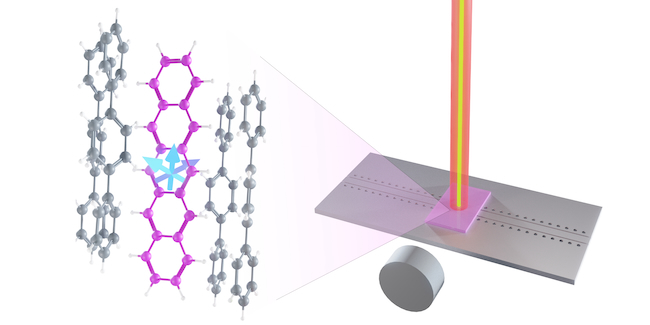
According to researchers, the paper in Physical Review Letters, a scientific journal, demonstrates how they manipulated the ‘spin’ quantum property in organic molecules and measured it with visible light at room temperature.
The report says the team used lasers to align electron spins in molecules, akin to tiny quantum magnets. They controlled these spins with microwave pulses and measured their states by analysing visible light from a second laser pulse.

Sam Bayliss
The statement adds that the team detected quantum coherence in molecules for up to a microsecond at room temperature, allowing future sensors to gather more information by maintaining quantum states longer.
“Quantum sensing offers an exciting opportunity to probe the world around us in new ways and holds promise to measure quantities such as magnetic and electric fields or temperature in ways which classical systems could not. By showing that we can optically detect quantum coherence in molecules at room temperature, this work provides a proof-of-principle that the key properties needed for room-temperature quantum sensing can be achieved in a system which can be chemically synthesised,” says Sam Bayliss of University of Glasgow’s James Watt School of Engineering.

Max Attwood
“We are excited by the opportunities these results could open up, from easy to apply layers for magnetic resonance imaging over short length scales, to probing biological systems with quantum enhanced sensitivity,” Bayliss adds.
“This demonstration is particularly exciting because, unlike inorganic sensors, molecules can be chemically tuned and deployed in various ways. Future research could enhance their quantum properties, target a wider range of sensing applications and employ precise placement techniques to effectively sense targets of interest,” says Max Attwood, of Imperial College London’s Department of Materials and London Centre for Nanotechnology, who lead the synthesis and materials science in this work.
