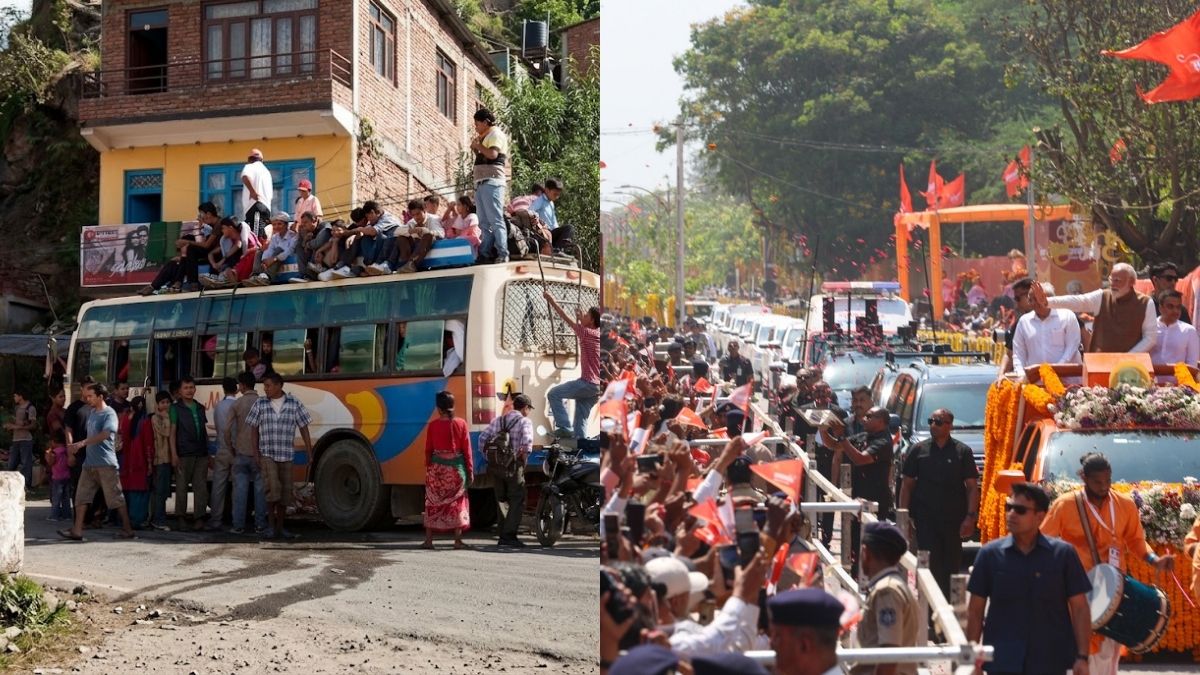
PM's appeal to conserve fuel and reduce travel amid the global oil crisis has drawn criticism over continued use of large government convoys at all levels (Photo: Ministry of Road Transport and Highways/PM Office)
As the world and India faces rising fuel prices due to the prolonged conflict between US-Israel and Iran and the resultant disruption in global oil supplies, Prime Minister Narendra Modi recently urged citizens to use public transport, avoid foreign travel and cut fuel consumption. However, the appeal has drawn sharp criticism after videos of Modi’s own large convoys and tours across the country as well as overseas surfaced.
What was intended as a call for collective national sacrifice has instead opened up a larger debate about political hypocrisy, selective restraint and whether ordinary people are once again being asked to absorb the consequences of a crisis while those in power continue unaffected.
Since February, tensions in the Middle East have intensified following US-Israeli military operations against Iran and Iran’s subsequent restrictions around the Strait of Hormuz, one of the world’s most critical oil shipping routes. Nearly one-fifth of global oil supply normally passes through the narrow waterway and repeated blockades, naval tensions and military confrontations have sent crude oil prices soaring globally.
For India, which imports the majority of its crude oil requirements, the impact was immediate and severe. After maintaining for weeks that there was no risk to Indian economy, even as cooking gas began to disappear from the markets, rising fuel prices, pressure on foreign exchange reserves and fears of supply disruptions have pushed the government into damage-control mode.
Speaking at a public event in Hyderabad on May 10, Modi urged citizens to place duty paramount and adopt fuel-saving measures. He advised Indians to not buy gold or silver for a year, and not to use their private vehicles and instead use metros where available, carpool, shift to electric vehicles, reduce edible oil consumption, avoid unnecessary travel and postpone foreign trips for a year.
On paper, the message sounded straightforward. India was facing an energy shock because of a global geopolitical conflict and citizens were being asked to cooperate. But the speech began attracting criticism within hours, not because public was not aware of the seriousness of the crisis, but because of what happened immediately afterwards.
Also Read: Inbound tourism into India down by 20 pc due to US-Iran conflict: PHDCCI
Videos of Modi’s large convoy and roadshow in Gujarat began circulating online soon after the speech, with Opposition leaders and social media users pointing out the contradiction between asking citizens to conserve fuel while moving with a convoy reportedly comprising over 100 vehicles.
For many, the optics became impossible to ignore.
The public was being told to take the metro. The government, meanwhile, appeared to be demonstrating the automobile sector’s annual sales parade in real time.
One recurring point of criticism has been about the gap between instructions on reducing travel for the common citizens and the visible scale of political movement and security convoys. Another highlighted the perception that conservation advice applies unevenly depending on position and responsibility.
Vrishank Sharma (name changed), a political analyst at Nation with NaMo, political consulting organisation, based in Delhi, says that the controversy is not merely about one convoy or one speech, but about the symbolism attached to leadership during periods of economic pressure.
Sharma says the criticism is being amplified because fuel inflation affects nearly every aspect of daily life in India, from food prices to school transportation.
“When diesel prices rise, vegetable prices rise, bus fares rise, delivery charges rise and farmers pay more for irrigation and transportation. So when citizens are told to sacrifice, they are not hearing an abstract patriotic slogan. They are hearing a direct warning that their monthly expenses are about to increase again. That is why people expect visible restraint from leadership first,” he says.
The impact is particularly severe for workers whose livelihoods depend directly on fuel consumption. Delivery workers, auto drivers, transport operators and small food vendors are among the first to feel the pressure when petrol, diesel and LPG prices increase.
Also Read: BJP’s historic West Bengal win meets a divided public mood
Rakesh Kumar, a food delivery worker in Delhi who spends nearly the entire day on his motorcycle, says rising fuel costs immediately reduce what he takes home every month.
“People say use less fuel, but my bike is my livelihood. If petrol prices go up, my earnings automatically go down because delivery incentives do not rise at the same speed. I already try to save fuel by switching off the engine at signals and taking shorter routes. Ordinary people are already adjusting every day because we have no option,” Kumar tells Media India Group.
Similar concerns are being voiced by small business owners who depend on Liquified Petroleum Gas (LPG) cylinders and transportation costs to keep their businesses running.
“Gas cylinders, cooking oil and transportation everything has become expensive together. A small food stall cannot function without fuel. If prices rise again, either we reduce food quantity or increase prices and then customers complain. We are being told to cut consumption, but for small businesses there is nothing left to cut,” says Mahesh Yadav, who runs a roadside food stall in West Delhi.
The criticism intensified further after details of Modi’s five-nation foreign tour emerged. The six-day ongoing visit includes the UAE, Netherlands, Sweden, Norway and Italy.
The contrast was widely noted. Citizens were asked to postpone overseas plans for the national interest, while official diplomatic travel continued on a large international scale involving aircraft, entourages, logistics and security arrangements across multiple countries.
This pattern is not limited to the Prime Minister alone, but extends to travel by ministerial and even district-level officials, where multiple vehicles and elaborate security arrangements are routinely deployed for official movement, even as citizens are urged to cut down on personal fuel usage.
The so-called VIP movement restrictions in major cities during political events and visits have often involved temporary road closures, deployment of additional police vehicles and large-scale security arrangements, all of which require significant logistical and fuel resources.
According to Sharma, the issue is not whether leaders should travel, but whether governments can convincingly ask for restraint while continuing highly visible displays of political scale and expenditure.
“No one is arguing that the Prime Minister should stop governing or travel without security. The issue is proportionality and optics. In moments of economic pressure, citizens look for symbolic leadership. If governments had simultaneously reduced non-essential convoys, scaled down campaign extravagance or publicly demonstrated fuel-saving measures within the political establishment itself, the public response would likely have been very different,” he says.
Also Read: Manipur burns in silence with three more deaths in a week
When asked whether it feels fair to watch political leaders continue travelling in large convoys while ordinary citizens are being asked to reduce consumption, both workers says the imbalance is becoming increasingly difficult to ignore.
“It honestly feels unfair. A common person uses one bike for work and family needs, and even then we are being told to reduce travel and save petrol. But political leaders move with so many cars together for one event. If sacrifice is necessary, then it should start equally from everyone,” says Kumar.
Yadav, a roadside food stall owner, echoes a similar sentiment.
“We are not saying leaders should stop working or stop travelling. But if the government is asking people to save fuel and cut expenses, then leaders should also show some reduction publicly. Otherwise it feels like rules are different for ordinary people and different for politicians,” adds Yadav.
Opposition leaders quickly seized on the contradiction. Leader of the Opposition, Rahul Gandhi, described the Prime Minister’s remarks as ‘proof of failure,’ arguing that responsibility is repeatedly shifted onto the public whenever economic pressures intensify. Manoj Jha, an Indian Politician and member of Rashtriya Janata Dal, questioned why the language of sacrifice emerged after periods of high public expenditure during political campaigns.
Adding to the criticism, Swami Avimukteshwaranand, the Shankaracharya of the Jyotir Math in Uttarakhand, publicly remarked in a sarcastic comment that the Prime Minister should “sell his own aircraft first and use a more fuel-efficient plane” before advising citizens on austerity, arguing that restraint should begin at the level of those in power rather than being imposed only on the public.
That contrast has become central to public criticism.
During recent state election campaigns, political parties especially the BJP held large-scale rallies, roadshows and extensive outreach events across multiple states. Convoys of vehicles, chartered transport and large public gatherings were widely used as standard campaign tools. After the elections, however, the public messaging shifted toward reduced consumption and restraint.