India is running out of stocks of Liquified Petroleum Gas with a nationwide rationing already in place (Photo: Sunil Yadav)
In barely a week since the beginning of the attack by the United States and Israel on Iran, India is in throes of a serious, if not the most critical, energy shortage in decades as not only have fuel prices risen sharply, but the country seems to be already running out of stocks of Liquified Petroleum Gas (LPG), with a nationwide rationing already in place.
The situation is set to dramatically worsen in the coming days without an urgent resumption of supplies from the Gulf Cooperation Council (GCC) and Iran, which are the biggest suppliers of petroleum-based fuels to India.
This is the first, most visible and highly painful price that India and its people are paying for the unprovoked attack launched by Israel and the US. The scale and duration of damage to the national economy and to the vast majority of households and businesses like restaurants who depend on LPG for cooking remains unknown as of now. However, this damage, however, severe, will and can be overcome with time.
But there is another damage that India has suffered and which could take decades if not more to repair and resest, the stature of India as a non-aligned and independent country that sets its policies, foreign or domestic, based on its own national interest.
Also Read: US-Iran tensions spell trouble for India
The handling of the crisis, at least so far, by the Indian government risks to destroy the decades-long policy of an independent and non-aligned foreign and strategic policy of India as the Indian government quietly submits to the numerous diktats issued by the United States President Donald Trump, however, outrageous and humiliating they may be for the country which has long been a champion of non-alignment and has followed a fairly independent foreign policy right from the independence.
It may yet be a coincidence, but the visit of Narendra Modi to Israel just two days before the US and Israel launched the unprovoked attack on Iran raised several questions about the timing and the content of the discussions that Modi had with Israeli Prime Minister Benjamin Netanyahu, whose sole agenda seems to be launching new wars all around Israel since it guarantees him not just a longer tenure as the Prime Minister but also protection from prosecution that he could possibly face in view of the numerous investigations had been launched in the past few years.
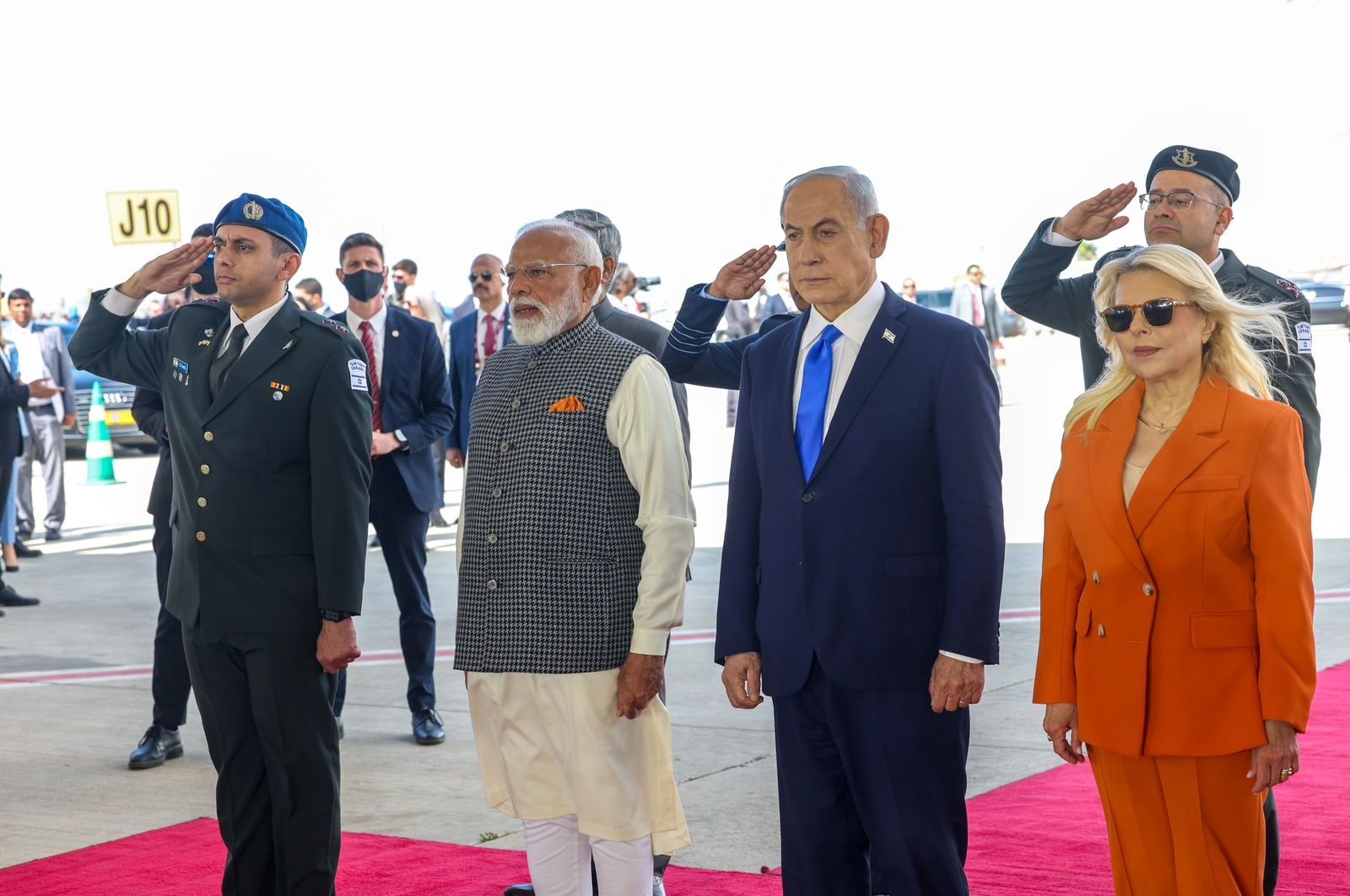
The visit of Narendra Modi to Israel just two days before the US and Israel launched the unprovoked attack on Iran raised several questions about the timing and the content of the discussions
But the possibility of Modi’s visit being only a coincidence starts to wear off when one views the statements made by the Indian government about the conflict, even though India has a huge stake not just in the outcomes of the war, but also in how it is conducted for many reasons.
First and foremost, all the countries in the region, namely GCC plus Iran, are important suppliers of India’s massive energy needs and just like any other country would, India ought to ensure that nothing, and certainly not an unprovoked conflict, has the potential of disrupting or impacting the energy flows from the region to India.
The second and perhaps equally important reason is that the GCC region is home to the largest Indian diaspora in any region of the world, with close to 10 million Indians living there. A war of this nature, which is impacting all the countries in GCC and of course Iran, should be extremely worrrying for India and the government ought to have proactively convinced US-Israel axis to not launch the war from which there would no material gain for India and only losses all around, whatever be the outcome of the conflict.
Looking at the relatively few statements issued by Modi and the External Affairs Minister S Jaishankar, in the first few days of the conflict, a stark ommission was the mention of any discussion with Iran. While Modi and Jaishankar posted on their social media handles about their discussions with their counterparts in each of the GCC nations and even Israel, but the first 48 or 72 hours did not mention any discussion that India may have had with Iran, an omission that could be easily read as India being a partner, even if a silent one, in the attack on Iran. It was only on March 5 that Jaishankar posted an unusually cryptic note on X saying that he had a conversation with his Iranian counterpart, without disclosing anything that may have been discussed between the two.
India even failed to condemn the violation of Iran’s sovereignity even though in his social media posts, Modi repeatedly raised the issue of violation of sovereignty of the GCC countries, which have been at the receiving end of several attacks from Iran as the country tries to attack what it calls as the US military installations across the GCC. While several of the Iranian attacks have targetted the US military, there have been many others which were either aimed at civilian places like the airports across the region or residential and office buildings. But such ‘collateral’ damage is now commonplace in practically all conflicts.
Just look at the rather indiscriminate bombing of Palestine by Israel for the past 30 months, which has perhaps hit more residential buildings, hospitals and schools than the hideouts of Hamas or other militant groups. In Iran conflict, too, one of the first major targets of the US bombing run was a school that killed over 150 children.
Irrespective of his antecedents and the repressive nature of the regime that he led, the assassination of Iranian spiritual leader Ayatollah Khamenei is a clear violation of Iranian sovereignity just as the kidnapping of Venezuelan President Nicolas Maduro by the United States forces a few weeks ago. India had raised the issue of the US attack on Venezuela and expressed concern over the well-being of Maduro.
That is why India’s silence on the legality of the US-Israel attack on Iran is even more worrying and appears to be under duress from Washington DC as over the past several month, Delhi has been extremely weak-kneed and seems to be vulnerable in front of Trump and his bizarre diktats, which appear to have been followed to a tee by Modi and his government.
Also Read: On Day 7 of US-Iran war, Indian diaspora remains stranded in Iran
Though India appeared has behaved in particularly Trump’s unilateral declaration of US and India having reached a trade agreement and he spelt out the terms. India’s first response was our Prime Minister profusely ‘thanking’ Trump for the agreement, indicating that he was as taken aback by the announcement of an ‘agreement’, something which by definition need both parties to be onboard!
Over the following days and weeks, Trump continued to announce various aspects of the ‘deal’ and made outlandish claims about India buying USD 500 billion worth of goods from the US, which is not only about one fifth of the Indian economy, but also five times the total bilateral trade between the two countries. But India did not clearly counter any of the statements coming from the White House, resorting to ‘off the record’ briefings to select media about its own version, which in absence of any written document or any oral countering of Trump remains as vague and incredible as Trump’s own statements.
To heap even more insult on injury, Trump said a couple of days ago, that he had ‘allowed’ India to buy oil from Russia for a 30-day period. Once again, this humiliating statement, which clearly showed who was calling the shots, was swallowed by Modi government, without as much as a whimper. Perhaps, the saving grace, if it any grace was left, could be that at least Modi did not thank Trump for this as he had done for the news on trade deal.
Never since independence has the Indian government appeared to be as weak as this government, which is obliged to follow orders from a foreign leader, without so much as a whimper. There is clearly something that is forcing Modi to follow Trump’s orders.
India’s interests lie in a clear disclosure of why exactly the Indian government is no longer able to assert itself in front of Trump and what lies behind the clearly visible weakening of Modi’s position vis the US President. The sooner this becomes clearer the better it would be for India and its people and allow the country to reclaim the stature and position that it has always enjoyed at an international level, instead of being reduced to the status of a pawn in the hands of Trump or any other foreign leader, for that matter.