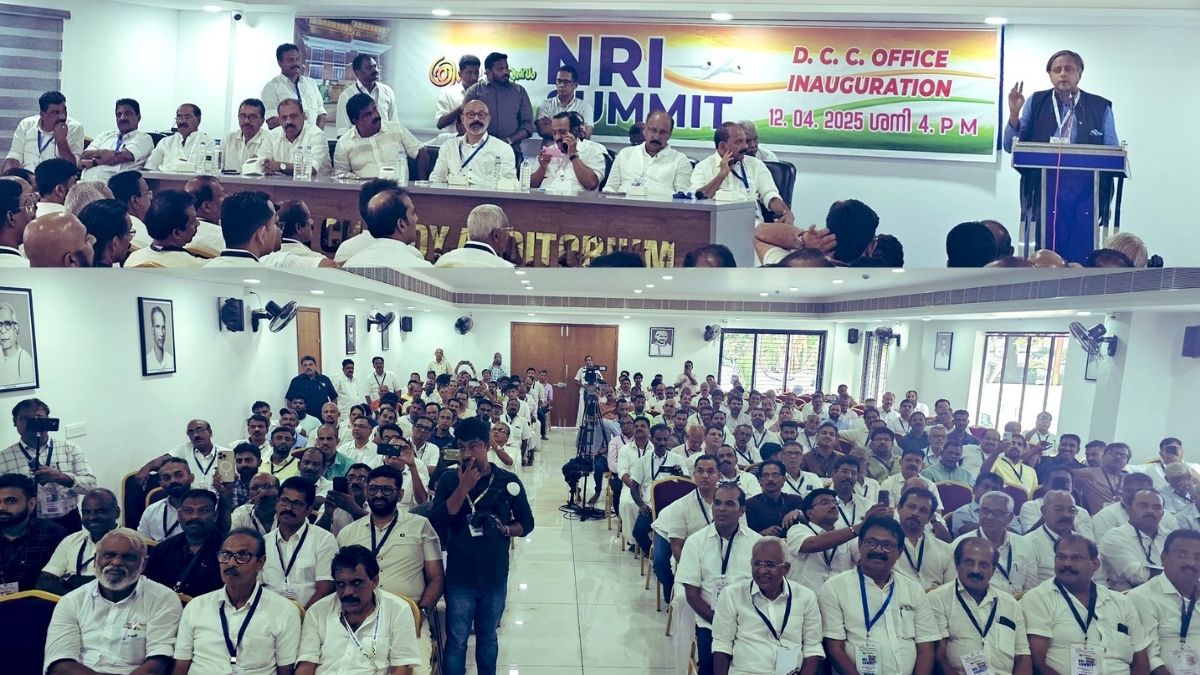
India granted NRIs the right to vote in 2011, through an amendment to Section 20A of the Representation of the People Act, 1950 (Photo: @Shashi Tharoor X)
Abel Varghese has been managing a hotel in Kuwait for the last 11 years. He is 26 years old, fluent in three languages, handles a team of 14 people, and knows how to navigate a foreign country with the quiet competence that most migrants develop out of necessity. But recently when the assembly elections were held in his home state Tamil Nadu, and despite having his permanent address in Chennai on his passport, he could do nothing but watch the results trickle in on his phone, thousands of miles away.
“I left home when I was 23. Chennai is everything to me my family is in Jambuli, my roots are there, and I always thought my vote mattered that it was one small thing I could do for my people, for my place. But the way the system works, I might as well not exist on that electoral roll. I cannot fly back every time there is an election. My employer won’t give me that leave. My savings won’t allow that ticket. So I just watch,” Varghese tells Media India Group.
Varghese is not alone. He is one of several million Non Resident Indians (NRIs) and the recently concluded assembly elections across four states and one Union Territory once again threw a harsh light on one of Indian democracy’s most glaring blind spots. Despite 2,45,000 overseas electors being registered and eligible to vote, only around 20,383 actually cast their ballots, a turnout of barely 8 pc. Notably, only one of the 157 registered NRI voters turned up to vote in West Bengal, In Assam, the number was zero.
Also Read: Election Commission seeks more overseas Indian voters
India granted NRIs the right to vote in 2011, through an amendment to Section 20A of the Representation of the People Act, 1950. It was celebrated as a progressive step the world’s largest democracy finally recognising its diaspora. But there was a catch buried in the fine print, overseas electors must be physically present in India, at their registered constituency’s polling booth, on election day, to cast their vote.
There is no online voting, there is no postal ballot and there is no proxy voting system currently operational. You have to show up in person, original passport in hand, at the booth that corresponds to the address listed in that passport.
For people working overseas, this is not a practical option. It is, in effect, no option at all.
“The law gave people hope and then took it away in the same sentence, I know many people who went through all the paperwork, got themself registered, and then realised what exactly they have registered for? To feel included in a system that doesn’t actually include them,” says Varghese
The pattern of NRI non-participation is not new, and it is not limited to assembly elections. In the 2024 Lok Sabha elections, that was the biggest democratic exercise on the planet a total of 1,19,374 overseas Indians had registered as electors. Only 2,958 actually voted. That is a turnout rate of roughly 2.5 pc.
Of that 2,958, a staggering 2,670 were from Kerala alone, a state with a long tradition of Gulf migration and a better organised NRI community. Large states like Karnataka, Uttar Pradesh, and Tamil Nadu saw zero NRI voter turnout. Gujarat, the Prime Minister’s home state, had 885 registered overseas electors and saw just two votes. Maharashtra, with 5,097 registered NRI electors, managed only 17 votes.
In 2019, of the 99,844 registered overseas electors, only 25,606 voted and even that figure, which looks relatively better, was driven almost entirely by Kerala’s numbers.
As far back as 2018, the Lok Sabha passed a bill that would have allowed proxy voting for overseas Indians. It lapsed in the Rajya Sabha. In 2020, the ECI formally recommended to the Ministry of Law and Justice that the Electronically Transmitted Postal Ballot System already used for armed forces personnel deployed away from home be extended to overseas electors. That recommendation has gathered dust for the past six years.
Beyond the policy debates, there are real people caught in this gap.
“I pay taxes in India on my remittances. I send money home every month. My children study in India. My parents live there. Why am I being told that I have to buy a INR 40,000 return ticket and take a week off work just to press a button on a voting machine? This is not participation, this is punishment,” Varghese adds.
Maymoona Shaikh, a domestic worker from North Kashmir based in Abu Dhabi, says the conversation about NRI voting rights often leaves out people like her. “Everyone talks about the Gulf NRIs as if we are all businessmen and IT professionals. Most of us are workers. We cannot take leave. Our employers do not understand Indian elections. We send money home so our families can survive, and then we are told our vote doesn’t count because we can’t be there in person,” Shaikh tells Media India Group.
Also Read:NRI voter registration doubles in numbers
There is also a gendered dimension that rarely makes it into the policy debate. Women migrants, who make up a significant portion of the Gulf labour force from states like Kerala, Tamil Nadu, and Telangana, face additional barriers such as restrictive employment contracts, passports forcibly taken by the employers as a measure of safety for themselves, and less family support to navigate the bureaucratic process of voter registration.
Most electoral democracies with large diaspora populations have already figured it out. Countries like France, the United States, the United Kingdom, and Australia all allow overseas citizens to vote by postal ballot, online, or through embassies. As India has extended postal ballot rights to its armed forces and election officials on duty, the legal and logistical framework, in principle, already exists.
Civil rights groups and NRI associations have repeatedly called for the ECI to implement the Electronically Transmitted Postal Ballot System (ETPBS) for overseas voters without further delay. Some have also pushed for embassy-based voting allowing Indians abroad to walk into their nearest Indian consulate or high commission and cast a vote there, which would eliminate the requirement to fly home entirely.