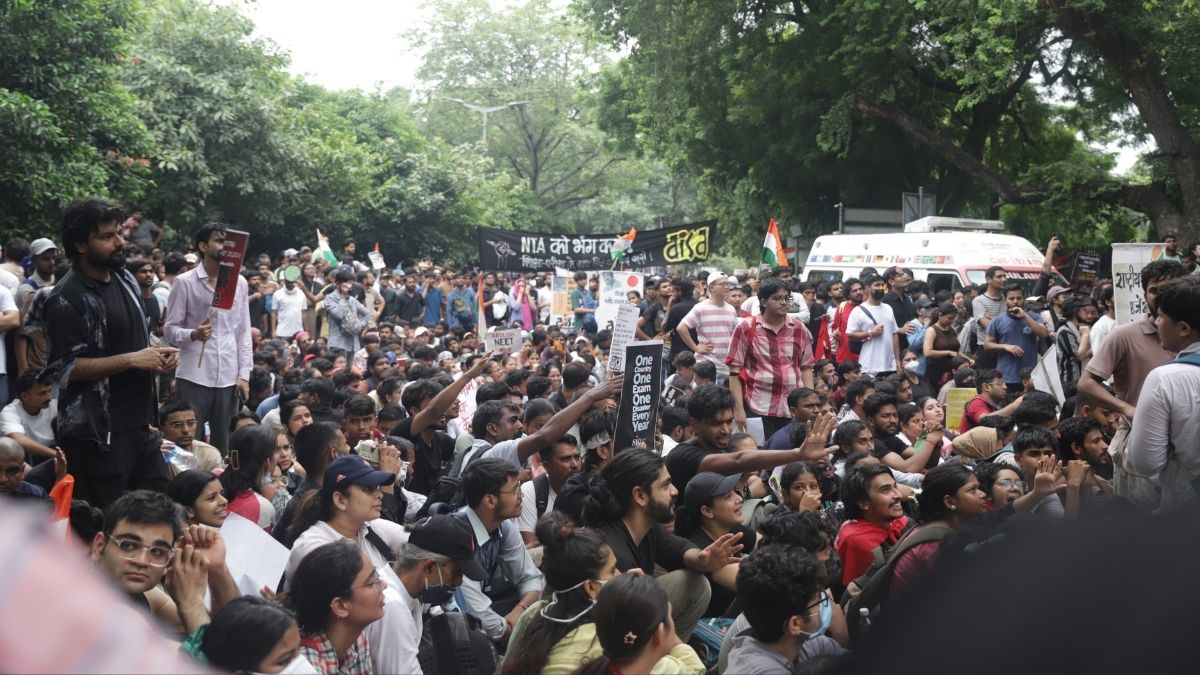
Thousands of students and supporters gathered at Jantar Mantar in New Delhi (Photos: Aman Kanojiya)
The 30th day of the ongoing protest against the National Eligibility cum Entrance Test (NEET)-UG 2026 paper leak turned violent as thousands of students, parents and supporters gathered at Jantar Mantar before marching towards Parliament under the Chalo Sansad campaign.
Police resorted to a heavy baton charge and fired numerous tear gas shells to disperse protesters after they attempted to move towards Parliament, leaving several students injured.
The demonstration that had stayed remarkably peaceful for a month had also drawn families from across the country, reflecting growing frustration over repeated examination irregularities, while the issue also echoed inside Parliament, where opposition members disrupted proceedings over the police action and the paper leak controversy.
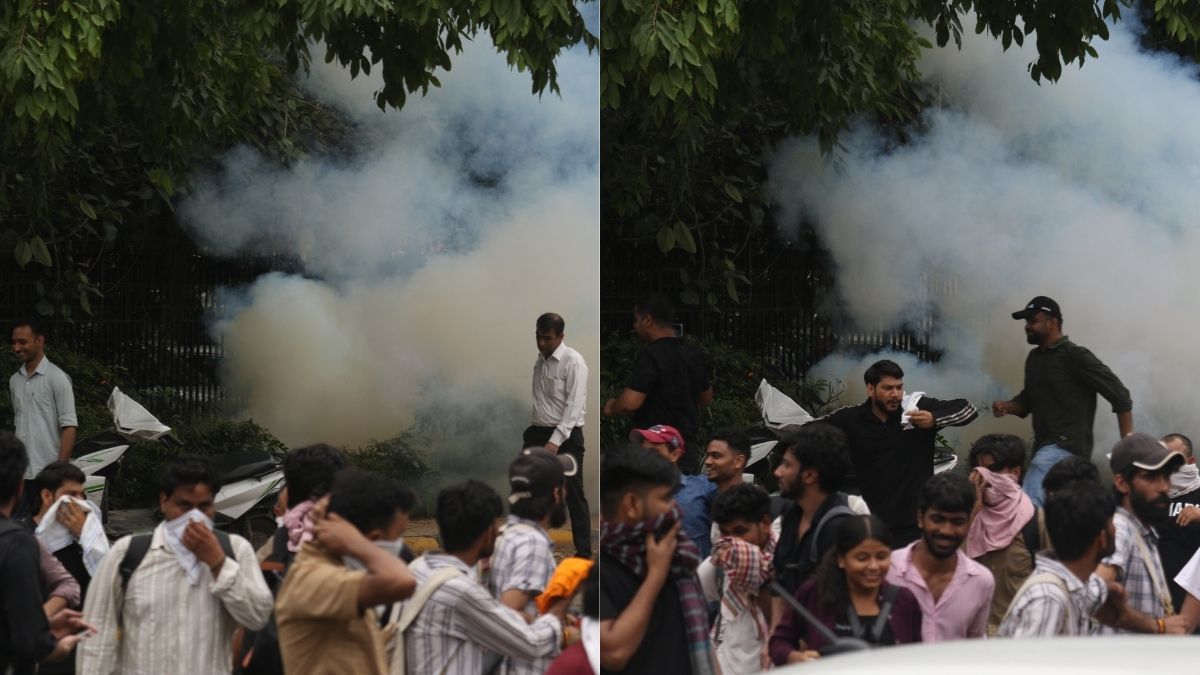
Delhi Police deployed tear gas shells and batons to disperse protesters
By late morning, the crowd outside Jantar Mantar had swelled well beyond what anyone at the site had anticipated. Coaching-centre students who had been camping there for a month were joined, on this particular day, by an unusual set of new arrivals, including mothers, fathers, and entire families who had travelled from outside Delhi just to stand with their children.
Bhumika, a NEET aspirant from 2024, attending her first protest with her father, said repeated paper leaks for various centralised examinations had drained her confidence in the system. After two unsuccessful attempts at NEET, she said, she had decided to walk away from the exam altogether.
Also Read: Hundreds from across India gather at Cockroach Janta Party protest in Delhi
“This is my first protest, and honestly, I don’t feel the government is going to take any action. They have become completely deaf and blind. But even then, I don’t think we should give up. Students deserve answers, and we have to keep raising our voices until someone listens,” Bhumika told Media India Group at the protest site.
She added that she had already given two attempts at NEET, and after everything that had happened, she decided not to prepare for it again.
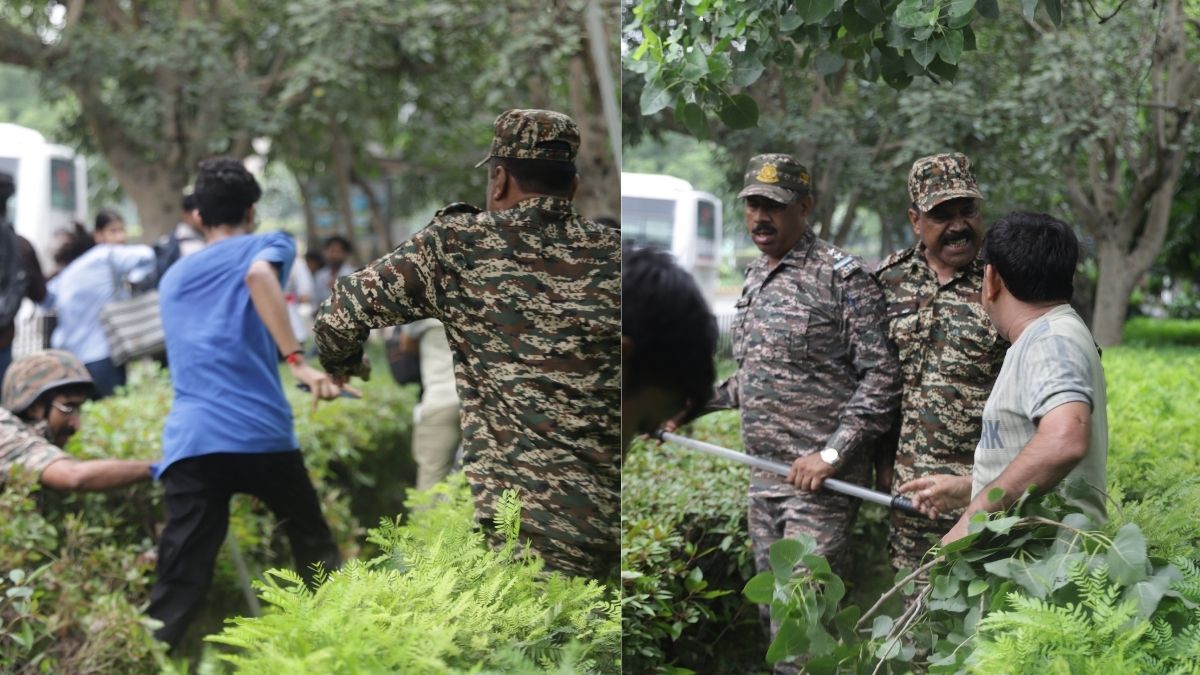
Many students, including women protesters were beaten up
“I am leaving NEET behind and joining college instead. I don’t want to spend any more years waiting for a system that doesn’t seem to care about students’ futures,” she says.
Her father, Anil stood a few metres away, watching the crowd with the particular exhaustion of a parent who has spent years budgeting for a coaching fee.
“This whole situation is playing with the future of our children. People close to the ruling party are getting papers leaked for their own children, while nothing is being done for everyone else,” Anil told Media India Group.
What seemed to weigh on him more than the politics of it, though, was what he saw happening to his daughter. “As parents, we still have expectations for our children to move forward. But the children have broken down so much, and are so fed up with this system, that they would rather kick it aside and move on with their lives,” he added.
Also Read: Students unhappy with Supreme Court ruling on NEET
That sentiment, of children simply walking away from a system rather than fighting it, ran through almost every conversation with a parent at the protest site.
Priyanka Saxena, who works with Skoda in South Delhi and has a six-year-old daughter, said she had come thinking of a future that was still years away. She did not hold back when asked about the government’s response so far.
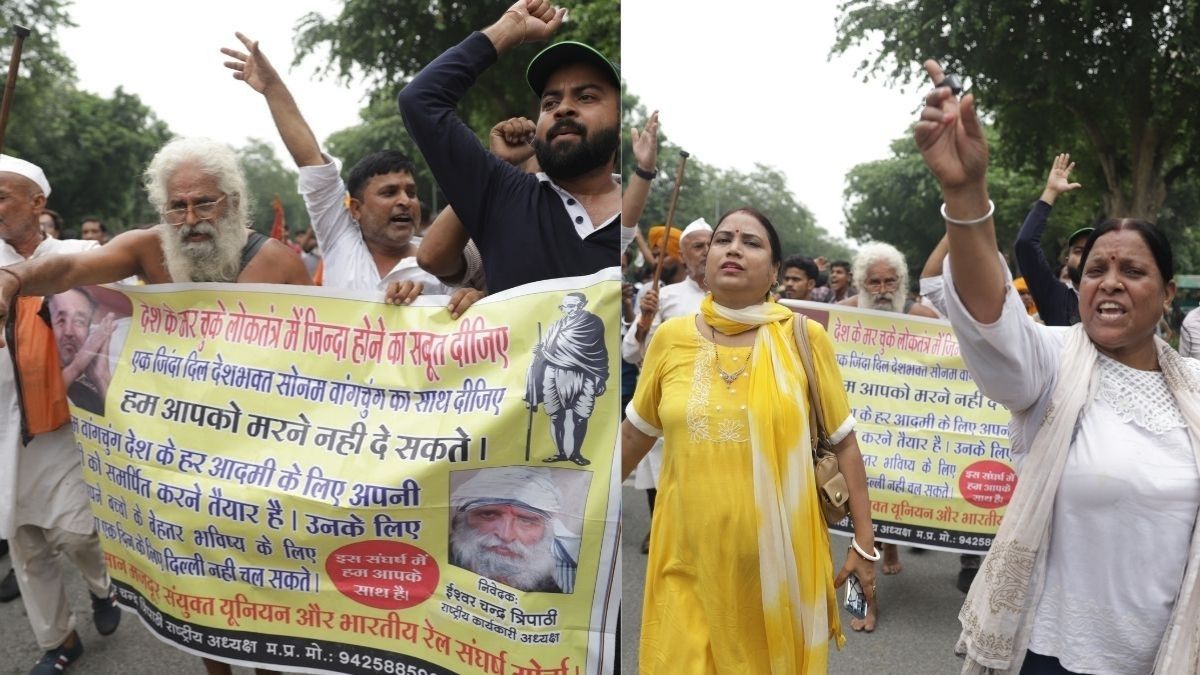
Large groups of parents also joined the protests at Jantar Mantar
“Is this what action looks like? This is a government of thugs. They have barely got power in their hands, and already they are firing tear gas shells at children. What problem do they have with students? Do students have guns in their hands? No. But they are still doing this to them,” Saxena told Media India Group.
Referring to the protest and the march to the Parliament, she said that whatever was happening now needed to happen, because government had to know that no one had gone to sleep, that someone will demand answers.
“This is a democratic country. If you are doing something wrong, you will be held accountable for it. We are not sleeping,” she said.
Kanchan, another mother who had joined the protest, also works in Skoda spoke less about politics and more about arithmetic. “I have an eight-year-old daughter too, so I worry about what things will look like for her by the time she gets there. We don’t have the kind of money that lets us send her abroad to study. So whatever needs fixing, we will have to fix it right here,” Kanchan told Media India Group.
Among the students themselves, the anger had a sharper, more immediate edge, shaped by what many described as a brutal police response earlier in the day.
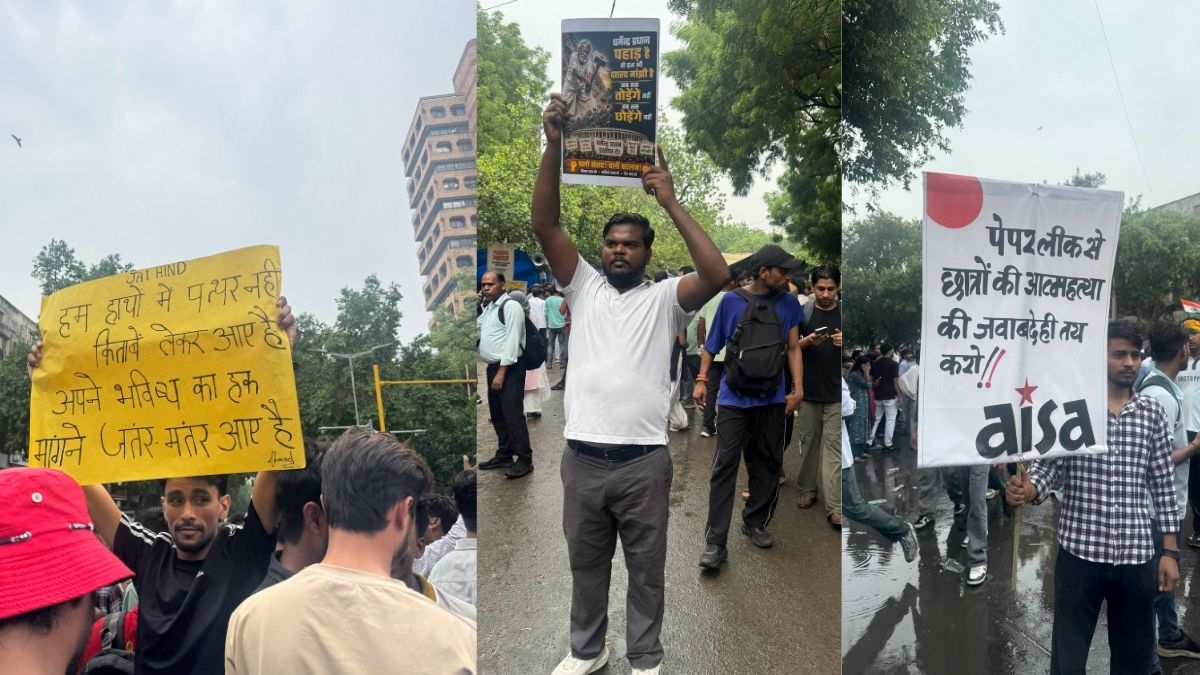
Protesters were spotted carrying placards
Nedhi from Delhi, who is preparing for government exams, said the paper leak was only one part of a longer list of grievances.
“We are preparing for government exams, and right now our main issue is the NEET paper leak, but there is so much else. Our freedom of speech is gone. If we post anything about this online, it gets taken down almost immediately. It feels like a dictatorship, but all we are asking for is transparency,” Nedhi told Media India Group.
She described the police response that unfolded around her that afternoon.
“The police lathi-charged us. A lot of students got hurt, especially the boys. They said they wouldn’t hit the girls, but they did that too. We were sitting peacefully when they threw tear gas and beat us. We aren’t criminals, we are students,” she said.
Also Read: Student suicides on the rise in India
What frustrated her most, she said, was how many years this had already cost her generation. “Our exams keep getting leaked or cancelled. If ours hadn’t been cancelled this time, we wouldn’t even be here. We spend our days and nights studying, and our personal lives just disappear. People are hitting thirty with a degree and no money, still depending on their parents. Who is going to answer for that,” asked Nedhi.
Neha, who studies in Delhi but is originally from Bihar, said the leaks were nothing new where she came from.
“Back home in Bihar, paper leaks happened all the time, no matter the exam. TRE, BPSC, APO, ADO, it doesn’t matter which one. Students from poor families scrape together the money to sit for a single exam, spend years preparing, and the paper leaks anyway,” Neha told Media India Group.
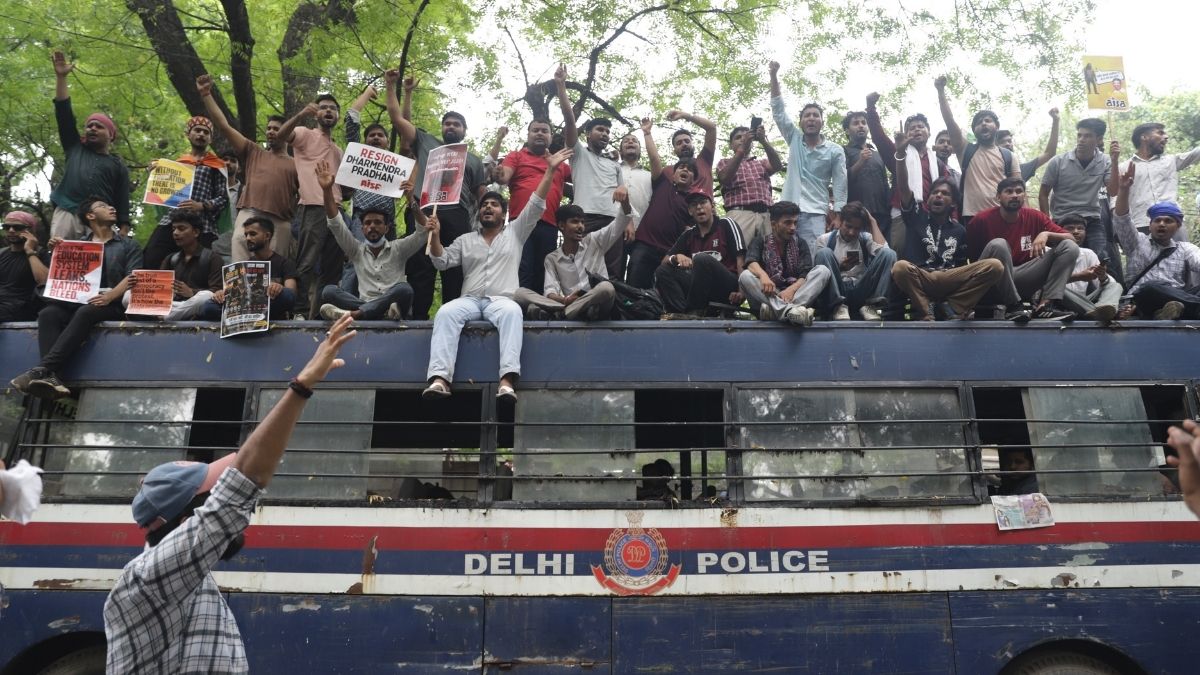
The protests have become a rare public challenge to Modi’s government in its third term
She, too, was caught in the lathi-charge that afternoon. “It happened right in front of me. They beat the girls too. I fell down in the chaos and lost my slippers. All we are doing is raising our demands. If we don’t gather like this, how will anyone even hear us,” says Neha.
What triggered Monday’s protest and where things stand
Monday’s march was organised under the banner of the Cockroach Janta Party, a youth-led movement that grew out of anger over the NEET-UG 2026 paper leak and has, in recent months, positioned itself as a voice for exam aspirants more broadly. The Chalo Sansad march timed its attempt to reach Parliament with the opening day of the Monsoon Session, forcing a heavy security build-up around Parliament Street, Raisina Road, Janpath and Ashoka Road well before the crowd began moving.
Delhi Police had not granted permission for the march, citing the security situation, and barricades were in place from the morning. As protesters pushed towards Parliament, tear gas shells were fired near the Press Club of India and again near Shastri Bhawan to push the crowd back, and police used lathis to disperse demonstrators, including at Patel Chowk and around Rajiv Chowk metro station, where entry gates were shut for a period.
By evening, the main protest site at Jantar Mantar had largely been cleared, though smaller groups continued to gather at other points in central Delhi.
For much of the day, unverified reports circulated that CJP founder Abhijeet Dipke had been detained by police, a claim the party’s spokespersons repeated on social media and used to demand immediate action from sitting MPs. Delhi Police later denied this, saying Dipke had remained on stage throughout and was not detained.
What made the 30th day different from the previous 29 was that the government, for the first time since the sit-in began, opened a direct channel to the protesters. Union Health Minister and former BJP president JP Nadda met two CJP spokespersons, Saurav Das and Ashutosh Ranka, at his residence for roughly 10 minutes after the two had waited more than two hours to see him.
The delegation handed over a written memorandum listing three demands, namely the unconditional release of activist Sonam Wangchuk, who has been associated with the protest, the resignation or removal of Union Education Minister Dharmendra Pradhan and a compensation of INR 10 million to the families of NEET aspirants who are alleged to have died by suicide in the aftermath of the paper leak controversy.
According to the CJP’s own account of the meeting, Nadda did not commit to any of the three demands but said he would raise them internally with the government’s leadership before responding.
Inside the Parliament, the protest spilled into both Houses. The Lok Sabha was adjourned multiple times through the day amid opposition protests, and Rajya Sabha proceedings were similarly stalled.
Leader of the Opposition in the Upper House Mallikarjun Kharge raised the issue on the floor of the House, telling members that thousands of students had gathered at Jantar Mantar and that a lathi-charge had taken place there, and accused the government of using force to suppress the protest rather than address it.
As of Monday evening, no formal response had come from the Education Ministry or from Dharmendra Pradhan himself, and the CJP said it was still waiting to hear back from Nadda’s office.