
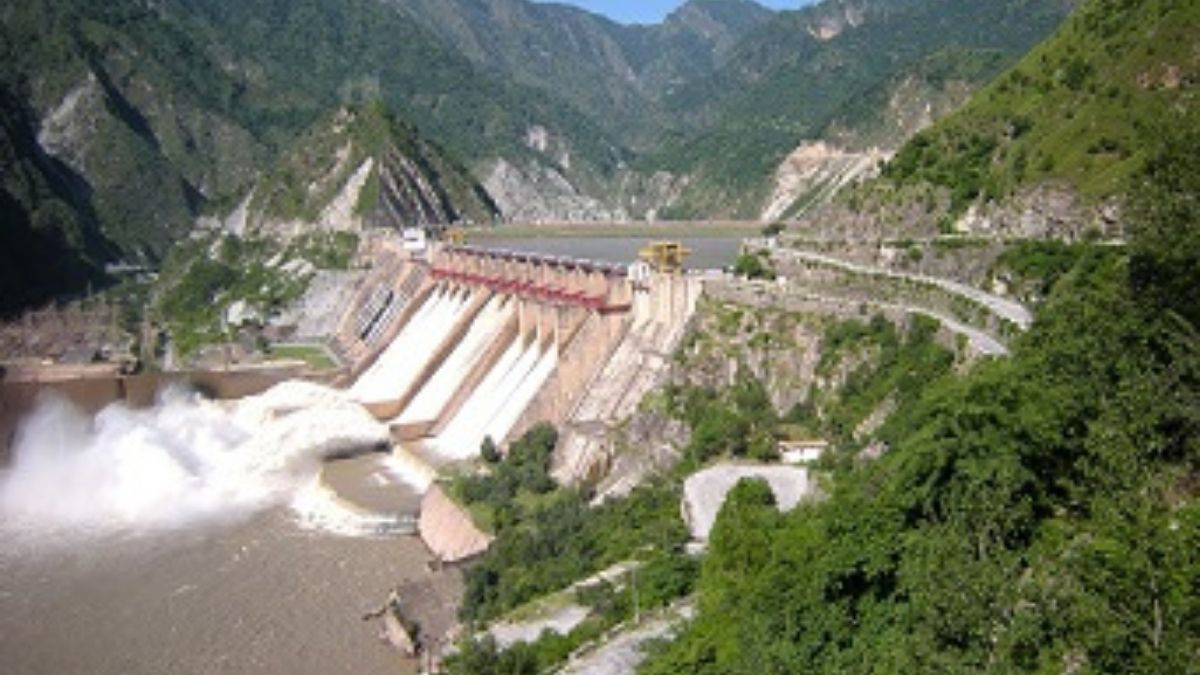
Indus Water Treaty is one of the oldest confidence-building measures (CBMs) between India and Pakistan (Photo: NHPC )
Few have described Kashmir more beautifully than the famous Indo-Persian Sufi poet Amir Khusrau who had said “If there is a paradise on earth, It is this, it is this, it is this”. Sadly, this beautiful paradise was painted with human blood and was converted into a graveyard on April 22, 2025, when terrorists from Pakistan selectively killed 26 civilians in Pahalgam.
India’s response was swift and decisive, demonstrating a full break from the past by suspending the Indus Water Treaty (IWT), a treaty signed in 1960 that had survived three wars and hundreds of proxy attacks in the last four decades. India was forced to accept that the Pakistani establishment does not understand the language of diplomacy or the role it should have been playing as a good neighbour.
The Pahalgam massacre fundamentally changed India’s security strategy and foreign policy. As India’s national security doctrine has shifted from passive strategic restraint to proactive deterrence and decisive retaliation, and any nuclear blackmail by Pakistan will not go unchallenged. The decision to suspend the 1960 Indus Water Treaty therefore is a decisive step taken by the Indian leadership, and since April 23, 2025, the IWT has been held in abeyance.
Chequered treaty
History is a witness that India has always trusted Pakistan, but on all occasions, it has received only betrayals. The 1999 Lahore Summit and Kargil War are an example why India has lost trust on Pakistan. In February 1999, the then Prime Minister Atal Bihari Vajpayee travelled to Lahore by bus to secure a peace accord. Months later, Pakistan Army troops secretly infiltrated Kargil heights, leading to an undeclared military conflict. The 2014–2016 Peace Gestures is another example. Prime Minister Narendra Modi invited his Pakistani counterpart Nawaz Sharif to his swearing-in ceremony in 2014 and made an unannounced stopover in Lahore in December 2015. These overtures were followed by deadly militant strikes on the Pathankot airbase in Kashmir and the Uri army camp in 2016. The ideological undercurrent of this behaviour reflects that Pakistan considers India not merely as a rival state but as a civilisational challenge eternally and unconditionally.
India has stated time and again that it will continue to take firm and decisive steps to respond to cross-border terrorism, and any meaningful dialogue with Pakistan is possible only in an atmosphere free of terror and violence and commitment by Pakistan not to allow its territory to be used for terrorism against India in any manner. Indian government has stated its official position in a very simple language, that is water and blood cannot flow together, and neither can terror and trade go hand in hand.
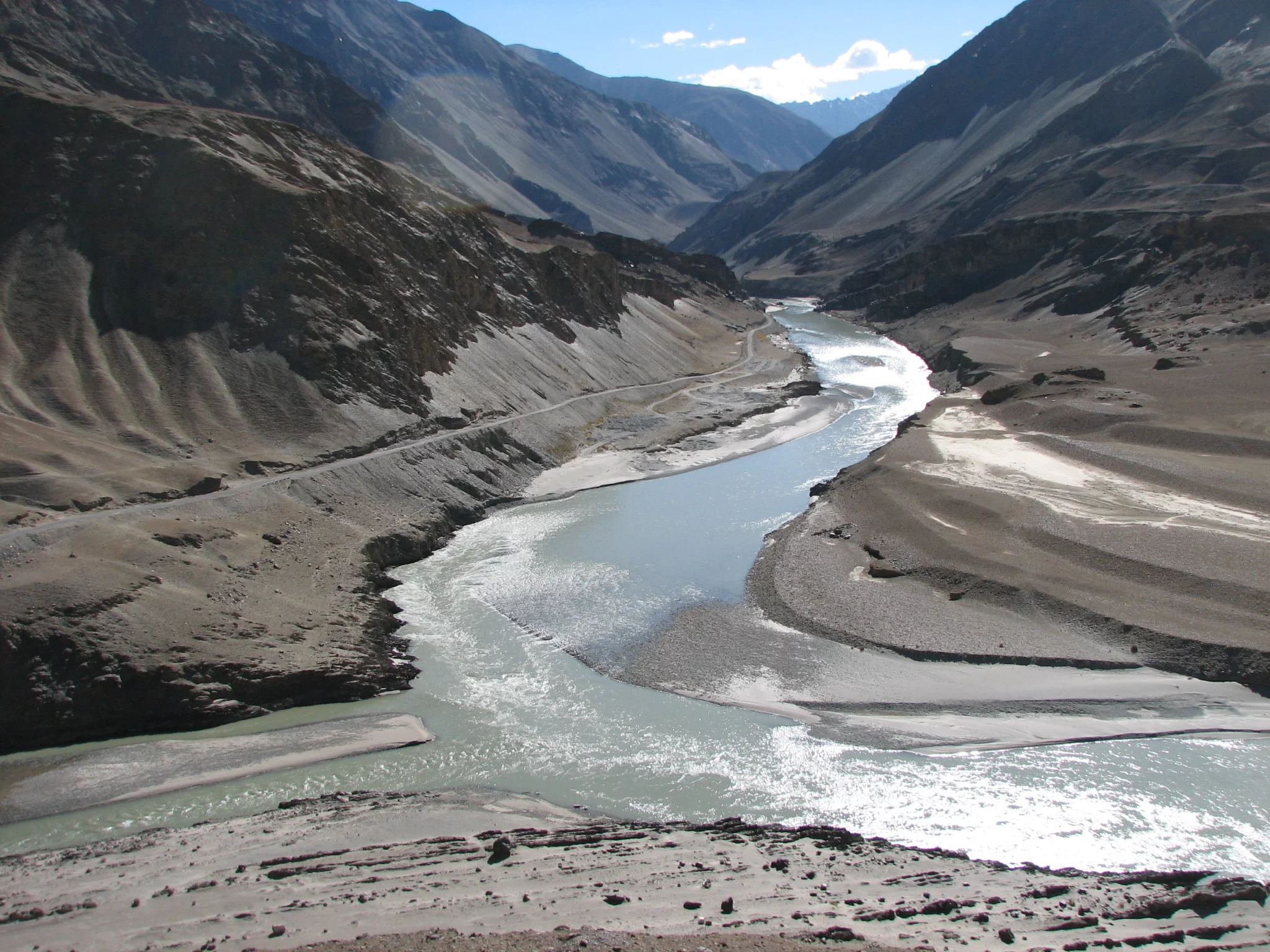
The Zanskar is a tributary of Indus, itness the dramatic meeting of the muddy, silt-laden waters of the Zanskar River with the clearer waters
Pakistan has launched four conventional wars against India, and every one of these misadventures have ended in international embarrassment and diplomatic setback for the country. But more revealing than the defeats themselves is what has followed all these years. Instead of introspection, Pakistan’s military-political establishment redoubled its hostility, choosing denial over accountability, and ideological rigidity over course correction.
Also Read:Pakistan asks World Bank to continue arbitration on Indus Waters Treaty
Therefore, unless and until Pakistan undergoes a radical shift in its national consciousness, a transformation that dethrones the military’s ideological monopoly, embraces democratic accountability, and reimagines Pakistan not as a bulwark against India but as a viable State in its own right, the hopes for regular flow of Indus water and normal cross-border trade are likely to remain a distant dream. Without this metamorphosis and transformation, any dialogue with Pakistan will remain fragile, unsustainable and every overture is destined to be doomed.
Pakistan’s rhetoric
India’s decision to place IWT in abeyance is both strategic and logical because international agreements cannot be disregarded at the convenience of one party. The current Indus Waters Treaty model, which relies on unconditional trust and places the obligations solely on India without offering corresponding benefits, has proven ineffective and needs to be replaced.
Pakistan has consistently demonstrated lack of commitment to any peaceful engagement and constructive dialogue with India and the faithful implementation of the treaty.
Pakistan has been using extensive rhetoric and is resorting to undiplomatic provocative statements including nuke strike against India, but it has itself undermined the very spirit of the Indus Waters Treaty by continuously perpetrating cross-border terrorism. Brokered by the World Bank, India signed this treaty out of goodwill and generosity, expecting good neighbourly conduct from its neighbour – this was an illusion and misplaced hope.
The current Indus Waters Treaty model, which relies on unconditional trust and places the obligations solely on India without offering corresponding benefits, is fundamentally flawed and extremely unequal. With the present situation, there is no spirit of “goodwill and friendship” that underlined the foundations of the IWT. As long as the Pakistani Army continues to see India as an existential threat and maintains its complete grip over political leadership and security policy, it is unlikely that India will ever achieve permanent peace with Pakistan. Every State has an Army, but in Pakistan, the Army has a State and unless there is foundational correction, peace with Pakistan will always elude India.
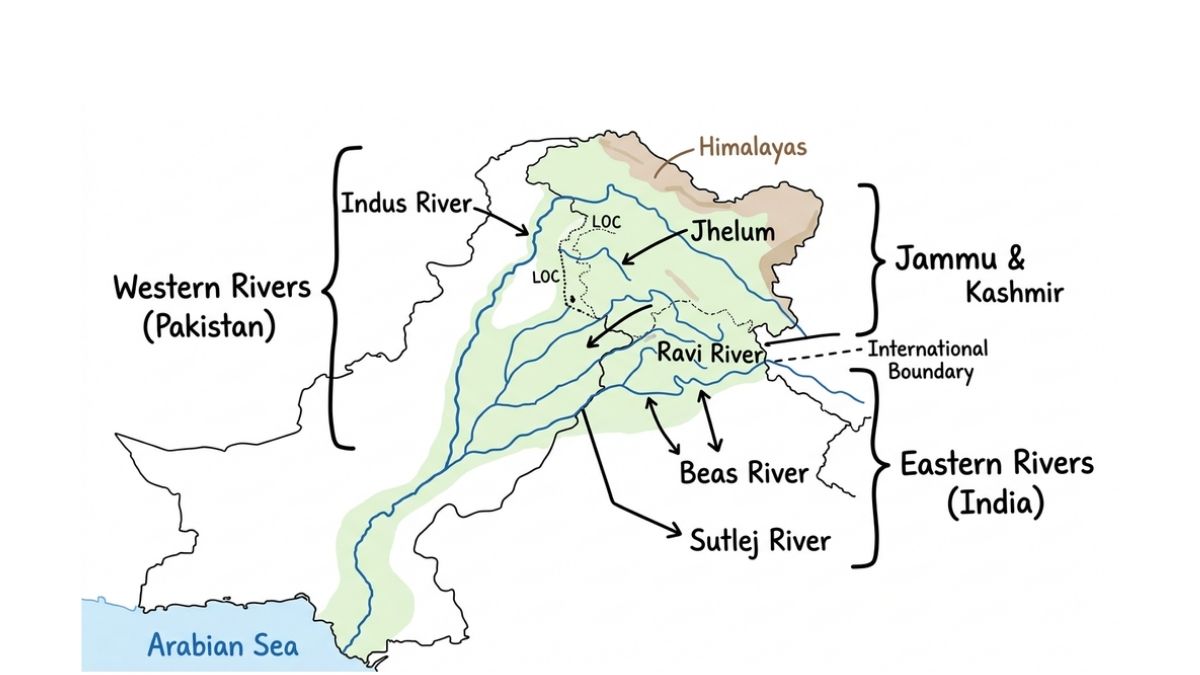
Indus River System Geographical Map
Water has long been entangled with the political and security dynamics between India and Pakistan. If Pakistan today faces a severe water crisis it is entirely of its own doing. This crisis is driven largely by internal issues like a massive population surge, low water storage capacity, agricultural inefficiency and huge transmission losses in unlined canals. Also, the crisis stems from years of underinvestment, poor infrastructure, and inefficient agricultural practices rather than external factors alone. Therefore, Pakistan’s water scarcity is less about India’s actions and more about its own chronic mismanagement of resources.
Also Read: Kashmiri tribal women unseen victims of Pahalgam terror attack
Misconceptions about the IWT
The Indus Water Treaty (IWT) has been one of the most resilient political agreements between India and Pakistan, remaining in force despite several wars and periods of prolonged tension. Suspending the treaty is a new definition of India’s national security policy no matter how Pakistan views it and how it acts upon. Interestingly, India’s decision to merely suspend the agreement and not use water as a weapon of war, at least for now, is a positive sign because it leaves room for hope that the agreement could be revived if conditions change.
In a bid to internationalise the issue of the water treaty and grab the attention of European Union policy makers, last month the Embassy of Pakistan in Brussels sponsored a seminar on transboundary water governance. The debate was hosted by a Belgian think tank the Centre for European Policy Studies (CEPS). Lobbying and campaigning has once again exposed the glaring Pakistan’s contradiction at the heart of its diplomacy.
Pakistan tries to portray itself as a victim of changing geopolitical realities and an advocate of international law before diplomats, legal experts and climate specialists is misplaced and misguided. Water justice after all rests on trust but Pakistan’s establishment has with its actions, has destroyed it. While India has, for decades, abided by the treaty even amid multiple wars and terror attacks, the massacre of Indian civilians in Pahalgam by terrorists has changed the calculus, with India’s strategic posture fundamentally shifting to a proactive deterrent.
The argument put forth by Pakistan turns out to be weaker when historical aspects are taken into account. The Indus Water Treaty stands as testament that despite India having the upper riparian position, it never weaponised water. India even during wars and major crises did not keep the IWT in abeyance which stands in sharp contrast to Pakistan’s frequent attempts to internationalise bilateral issues while avoiding meaningful introspection.
Before asking the world to defend its rights over shared waters, Pakistan must answer a pressing question, of whether it has the moral ground to seek unconditional cooperation from its neighbour, when at the same time, it continues to export violence from across the border.
Threatening India with a rhetorical statement over use of nuclear weapons also won’t help Pakistan, because both the countries possess enough weapons to cause severe damage to the other. Pakistan will need to recognise that ultimately, the future of the Indus Basin cannot be shaped by narrative building or political rhetoric, but by adapting to ground realities of security, climate stress, and developmental imperatives that define the region today.
Thus, Pakistan can create a conducive atmosphere with India only by taking credible steps against cross-border terrorism and encouraging cooperative economic and environmental exchanges. It must take visible, verifiable, and irreversible action against militant groups operating from its soil.
Pakistan must also stop cross-border infiltration and dismantle logistical networks for proxy groups and prosecute masterminds of past terrorist attacks to build baseline trust for any meaningful dialogue with India. The tragedy of Pakistan is that it treats leaders of the terrorist groups as “Messiah” and their organisations as “School of Thought”, a dangerous cocktail of self-destruction and misadventure – for which Pakistan is paying a heavy price.
To distract global community on its role as a hub of international terrorism, Pakistan had run to the Netherlands-based Permanent Court of Arbitration (PCA). India has categorically dismissed the PCA as illegally constituted and has rejected unilateral order by international court that favoured Pakistan’s argument, saying that the tribunal itself is a violation of IWT. India has unequivocally stated that the very formation of the arbitral body represents a serious breach of the Indus Waters Treaty and renders all its proceedings and so-called awards “illegal and per se void”. India has asserted that after the Pahalgam terrorist attack, it had invoked its sovereign rights under international law to place the IWT in abeyance until Pakistan credibly ceases its support for cross-border terrorism.
Structural unfairness of the treaty
Pakistan has consistently demonstrated lack of commitment to peaceful engagement and constructive dialogue with India including the faithful implementation of the treaty. The treaty signed in 1960 did not take into account the climate change because that science didn’t exist then. But the kind of flooding, glacier melt and droughts is seen now were never part of the design. In order to address the challenges of worsening effects of climate change, changing weather and rain pattern, addressing water security, and also to make optimum use of the available resources, on several occasions, India had told Pakistan that it wanted to renegotiate the treaty, but Pakistan has refused all requests. As recently as in in January 2023, India formally issued a notice seeking the modification of the IWT, citing Pakistan’s repeated objections and disputes over Indian hydroelectric projects and the need to revisit the treaty’s dispute resolution mechanisms. It is no surprise therefore that India has rejected demands from Pakistan to stop on-going development projects asserting its sovereign right to expedite infrastructure and hydropower projects on rivers in Jammu and Kashmir, and on other sites.
The Indus Water Treaty is one of the oldest confidence-building measures (CBMs) between India and Pakistan. India in a brave benevolent act and as a big brother neighbour, had given away 80 pc water of Indus system to Pakistan under IWT. This was not a treaty forced on India, but something India gave away to ensure Pakistan never felt insecure about water and thus no reason to target India. If the IWT has survived all these years, it is because India has honoured it in good faith and showed extraordinary generosity despite being attacked by Pakistan repeatedly.
Pakistan has been misusing the IWT to prevent progress on Indian side of the water and has frustrated India’s attempt to build hydro-projects. In fact, this constitutes a weaponisation of the treaty by Pakistan not to allow India to build anything even the ones allowed by treaty.
Also Read: Indus Waters Treaty back in spotlight as World Bank intervenes
It is important to state that the people of India and Pakistan though separated at birth 78 years ago, for all the animosity that has existed at a political level, have not been fundamentally different from each other. Their languages, their food, their customs, their festivals, and their traditions are reflections of a shared past and common future. Therefore, it is unfortunate that Pakistani establishment is unable to recognise that the modern borders divide not two different peoples, but separate people who have been united by a shared culture, heritage and history, and India’s efforts to foster better relations have yielded no result.
It is important to notice that since the suspension of IWT, and launching of the Operation Sindoor, the cross-border infiltration and terror activities along the Line of Control (LoC) and International Border (IB) have significantly declined. This means that India’s new security doctrine has started working and giving expected result.
Pakistan must realise and admit that the IWT was never just about water, it was about trust and when trust erodes, even the most celebrated agreements must confront the realities of a changing strategic landscape. This is what the treaty is going through today. The treaty as we must know was never a symbol of friendship, it was something more practical, an agreement between rivals who understood that some issues were too important to be consumed by politics.
That understanding is now being tested and, in this regard, in the global community, a nuanced understanding is required that contextualises India’s decision within the broader discourse of state responsibility, territorial integrity and the fight against terrorism.
For India, keeping the IWT in abeyance is not about sharing of water but also about geographical challenges and shift in global geo-power politics India will have to address in the next decades. By suspending the treaty, India has sent a clear diplomatic signal to Pakistan: peace and cooperation cannot exist in a vacuum devoid of trust and reciprocity.
(Sunil Prasad is the Secretary General of Brussels based Europe India Chamber of Commerce. The views expressed here do not necessarily reflect those of Media India Group.)
