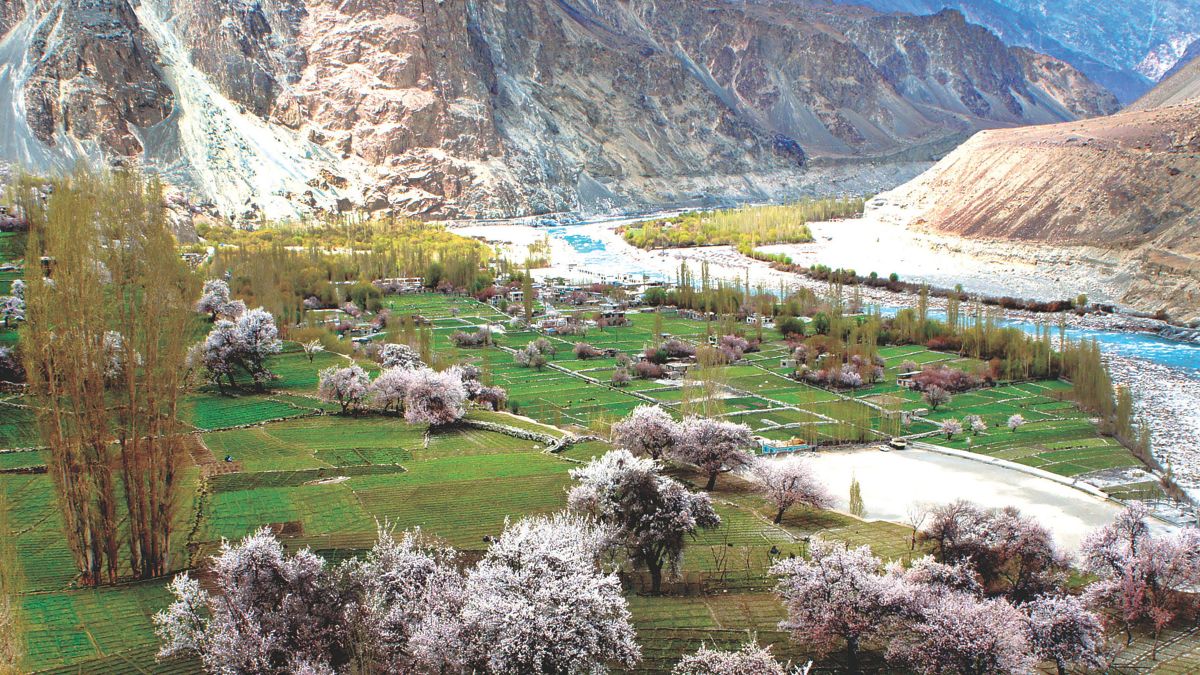
Spring in Turtuk brings a stunning transformation as delicate pink and white apricot blossoms coat the rugged Shyok River valley, typically peaking between mid-March and late April
Literally the last village in India, reaching Turtuk is an adventure in itself. Beginning in Leh, the journey by road, covering approximately 205 km, takes nearly eight hours. The road winds through Khardung La (5,359 m), one of the highest motorable passes in the world, before descending into the stark, surreal beauty of Nubra Valley. From Diskit, about 90 km from Turtuk, the landscape transforms Ladakh’s rugged terrain gives way to lush fields, towering walnut trees and the icy-blue waters of the Shyok River tumbling over smooth boulders.
After eight hours on the frequently uneven road from Leh, I finally arrived in Turtuk, a village that felt untouched by time. Unlike the rest of Ladakh, which is predominantly Buddhist, Turtuk is a Balti Muslim settlement, its wooden homes adorned with intricately carved balconies and its air filled with the scent of fresh bread baking in earthen ovens. But what made my arrival even more enchanting was the spring season that was in full bloom. The village was draped in a sea of delicate pink and white apricot blossoms, their fragrance mingling with the crisp mountain air. I still remember that scent, a sweet, floral aroma with a hint of earthiness, carried by the gentle breeze that rustled through the orchards. It was the kind of fragrance that stays with you, long after you have left, a reminder of a place where time slows down and nature paints its own masterpiece.
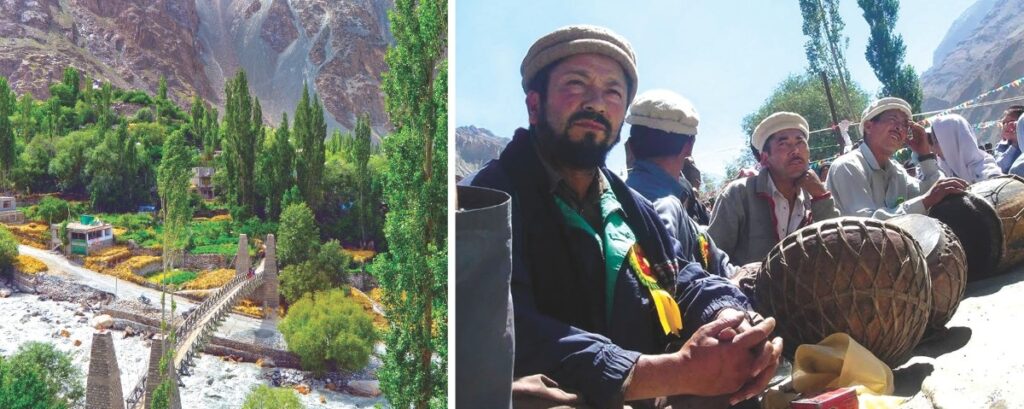
The people of Turtuk are ethnic Baltis living in the northernmost village of Ladakh’s Nubra Valley
I was welcomed by Ali Mohammad, a man in his seventies whose weathered face carried the wisdom of the mountains and the kindness of an old friend. His wooden house, built in the traditional Balti style, stood at the edge of the village, surrounded by fruit-laden trees. The house was simple but full of warmth, ornate carved wooden balconies overlooked the valley and a small courtyard was adorned with prayer flags fluttering in the gentle evening breeze.
Also Read: Turtuk – where digital mail didnt replace postal letters
“Come, sit,” he said, leading me to a handwoven rug laid out in the courtyard, where his family had already begun preparing the evening tea. They treated me like a long-lost friend rather than a stranger, offering me butter tea and freshly baked Balti bread.
“We do not get many visitors who stay for long. But those who do, they never forget Turtuk,” Mohammad tells India & You.
That night, I was given a small, cosy room in the wooden house. The walls were made of timber, the floor covered in thick woollen carpets, and in one corner, a small Bukhaari, a steel stove crackled softly, filling the room with warmth. There was no electricity for most of the evening just the soft glow of an oil lamp and the distant murmur of the Shyok River flowing somewhere in the valley below.
As I lay on the thick mattress, wrapped in layers of handwoven Balti blankets, I realised something incredible. There was no noise, no honking of cars, no buzzing notifications, no rush. The only sounds were the soft ones made by the wind as it whispered through the orchards and the faint sound of Mohammad and his family laughing in the other room.
A morning wrapped in apricot blossoms
At sunrise, I woke up to the gentle sounds of birds chirping outside my wooden room, their melodies blending seamlessly with the distant murmur of the Shyok River. The air was crisp, carrying the unmistakable scent of freshly bloomed apricot flowers. As I pushed open the creaky wooden window, a soft, golden light spilled into the room, illuminating the rustic interiors.
Stepping outside, I was met with a sight so surreal that it felt like stepping into a painting, with endless stretches of apricot and apple orchards, their branches heavy with delicate pink and white blossoms. The entire valley seemed bathed in a soft pastel hue, as the morning sun cast a warm glow over the peaks of the Karakoram mountains in the distance. A gentle breeze rustled through the trees, making the blossoms dance, their petals occasionally floating down like soft, fragrant snowflakes.
Mohammad’s wife, an elderly yet energetic woman with kind eyes and a warm smile, noticed me admiring the view and gestured for me to join her near the traditional Bukhaari, she handed me a steaming cup of butter tea, its salty richness instantly warming my hands against the chilly morning air. Next to it was a plate of freshly baked barley bread, slightly crisp on the outside yet soft inside, accompanied by a generous dollop of homemade apricot jam, thick, golden and bursting with sweetness.
Also Read: Galdan Namchot: Ladakh’s landmark winter festival
As I took my first sip, the creamy, slightly salty tea contrasted beautifully with the sweet jam, creating a flavour unlike anything I had tasted before. I sat there on a small wooden stool, my feet resting on a handwoven woollen rug, watching as the first rays of sunlight kissed the apricot trees, turning them into a shimmering sea of pink and white.
The simplicity of the moment was overwhelming no noise, no rush, just the rhythm of nature and the warmth of hospitality.
Mohammad, noticing my fascination, chuckled softly. “You are lucky, as spring is when Turtuk truly comes alive. These blossoms will soon turn into the sweetest apricots you have ever tasted,” says Mohammad.
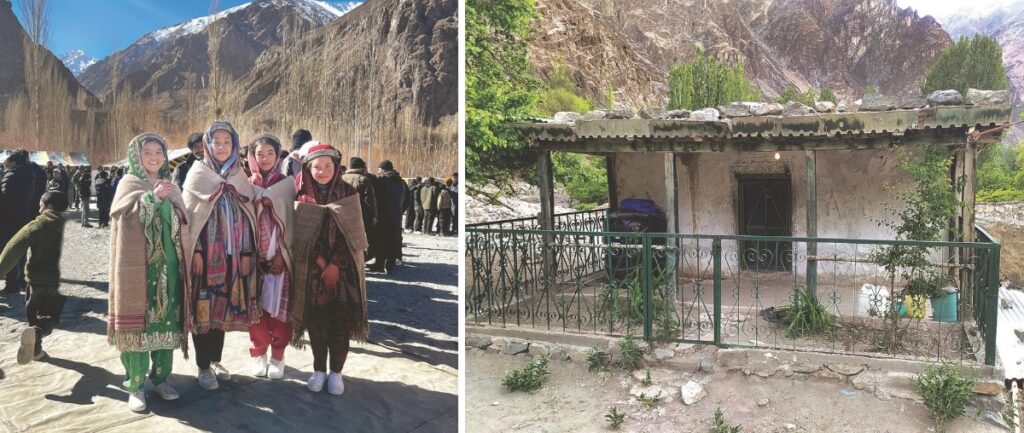
The people of Turtuk are known for their profound warmth, deep humility, and simple way of life rooted in Balti culture, farming, and tight-knit community traditions
I smiled, taking another bite of the warm bread, letting the flavours of this remote, untouched paradise sink in. At that moment, I knew this was not just another destination. This was a place to be felt, to be lived. And my journey had only just begun.
After breakfast, Mohammad decided to take me on a walk through the village. “We will go slow, Turtuk is not a place you see in a hurry, it is a place you feel,” Mohammad adds.
The village, still waking up, had an almost dreamlike tranquility. The morning sunlight filtered through the pink apricot blossoms, casting soft shadows on the narrow stone pathways. Women in vibrant Balti shawls were already at work, tending to their vegetable gardens, while children ran barefoot through the alleys, giggling as they chased each other. Unlike the rush of city life, here, everything moved at its own gentle pace.
The Balti Heritage House
Walking through Turtuk’s narrow stone-paved lanes, where houses are built from wood and mud in harmony with the landscape, Mohammad led me to a place that felt like a portal to the past, the Balti Heritage House.
“This is where we keep our history alive,” he said, pushing the wooden door that creaked under its own weight.
Inside, the room was dimly lit, the only light streaming in through small, carved wooden windows. But as my eyes adjusted, I could see that every inch of the house was filled with objects that told the story of the Balti people. Ancient copper vessels, intricately carved wooden spoons, stone grinders and traditional woollen garments lined the walls. A centuries-old samovar, a metal container used to heat and serve tea, once used for brewing tea, sat proudly in the corner, still gleaming despite its age.
Mohammad picked up an ornate silver amulet, its surface covered in delicate inscriptions. “This belonged to my great-grandmother. Baltistan was once a great trading region, and merchants brought silver from Tibet and silk from Kashmir. Our culture is a mix of many influences,” said Mohammad.
The walls were adorned with faded photographs, some taken before 1971, when Turtuk was under Pakistani occupation. At the centre of the room stood a low, wooden dining table, a reminder of the communal way of eating that Balti families still follow. On it were handmade clay bowls and wooden ladles, all crafted using traditional techniques passed down through generations. But what fascinated me the most was a set of old polo sticks, their wood worn smooth from years of use.
Also Read: Nubra Valley: A hidden paradise in Ladakh
“Polo is not just a sport for us, it is a tradition, a celebration. Every year, during the Baltistan Festival, we play matches just like our forefathers did,” Mohammad adds.
One section of the room was dedicated to Balti weaponry, ancient swords, shields and muskets, remnants of a time when warriors guarded these remote valleys.
The more I explored, the more I realised that this was not just a museum, it was a living memory of Turtuk’s identity. Every object, every artifact had a story to tell, a connection to the past that still echoed in the present.
As I stepped out into the sunlight, I felt as though I had travelled through time, gaining a deeper understanding of Turtuk’s rich history and the resilience of its people and as Mohammad locked the door behind us, I knew that the treasures inside were not just relics, they were pieces of a legacy still thriving in this quiet, forgotten corner of the world.
The natural refrigerator: Ice that never melts
Then, we trekked towards the natural fridge, a hidden wonder of Turtuk. In this remote village, where transport connectivity is minimal, most places can only be reached on foot. But that was never a problem for me, trekking fascinates me, especially when it leads to unique places.
After weaving through narrow trails and climbing over rocky paths, we reached a small cave tucked into the side of a hill. The moment I stepped inside, a wave of cool, crisp air hit me, sending a shiver down my spine.
Mohammad ran his hand over the damp stone wall, revealing patches of thick, clear ice embedded within. “This is where we store our food. Even in the hottest months, the ice never melts,” he said with a smile. It was nature’s own refrigerator, no electricity, no machines, just centuries-old wisdom and the perfect conditions to keep food fresh. Villagers had used this cave for generations, storing dairy, grains, and even meat in a way that defied time and temperature.
I touched the ice, feeling its unexpected chill. In Turtuk, survival was an art and nature itself played the most crucial role.
The King’s Palace (Yabgo Khar)
After a short break, we set off on a slightly steeper climb toward the ruins of Yabgo Khar, the ancient palace of the Balti rulers. The path took us through narrow alleys lined with mud-brick houses, where wooden fences were draped with drying apricots and walnuts, a scene that perfectly captured Turtuk’s simplicity and self-sufficiency.
As we approached the palace, the structure stood as a silent witness to centuries of history. Built on an elevated ridge, the palace once served as the seat of the Yabgo dynasty, the rulers of Baltistan, who controlled these lands when the region was part of the Silk Route. Though much of it had crumbled with time, the stone walls and wooden pillars still retained their grandeur, whispering tales of a forgotten past.
Also Read: We want to make Ladakh a year-round destination
Mohammad led me to what remained of the central hall, where the royal family once gathered. The wooden beams, intricately carved with Balti motifs, had somehow survived the years, though they were now weathered and cracked. We continued to a balcony-like extension and that is where the real magic of Yabgo Khar revealed itself, a panoramic view that seemed to stretch into eternity.
From here, I could see Turtuk’s green fields spreading out like a vast carpet, their shades of emerald and gold contrasting against the rugged, barren mountains. Beyond the farthest peaks lay Baltistan, now controlled by Pakistan, a land that was once connected by culture, language, and family ties, but was now separated by a tense Line of Control.
Mohammad pointed to the distant peaks. “Baltistan is on the other side. My grandfather used to travel freely between here and there. Now, we can only watch from afar,” said Mohammad.
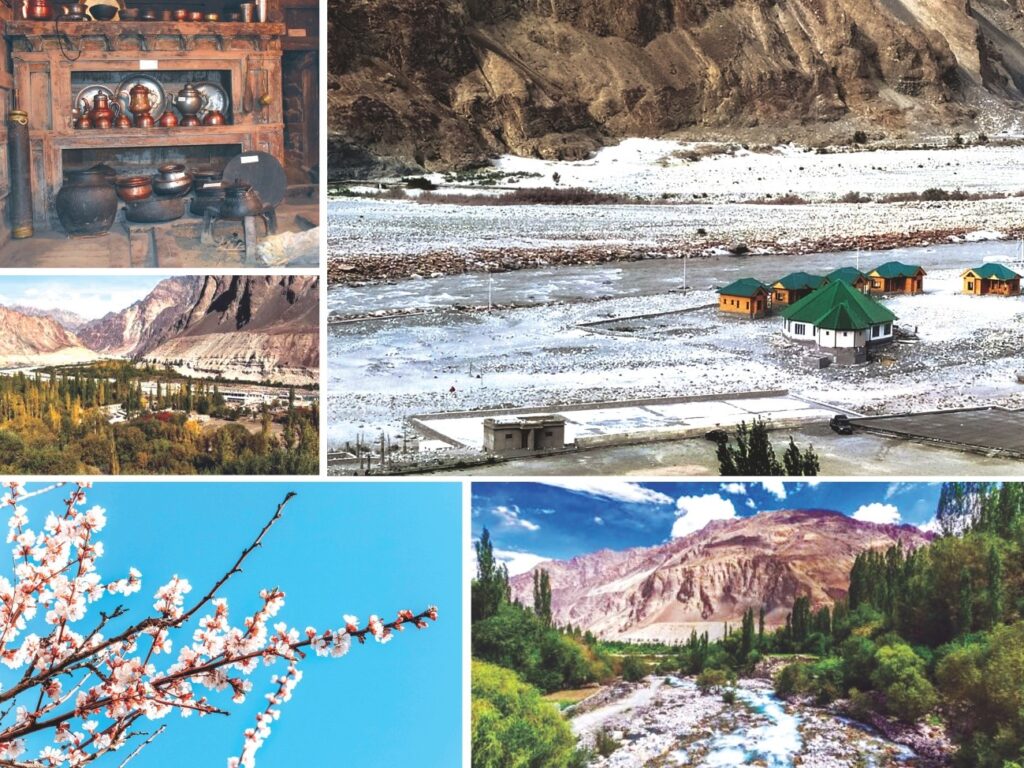
Turtuk is famous for its stunning spring season, when the remote village bursts into color with blooming pink and white apricot and cherry blossoms against snow-capped Himalayan peaks
We sat in silence for a few minutes, absorbing the view, the snow-capped peaks standing like ancient sentinels, the whispering river below, the orchards swaying in the wind. Yabgo Khar was not just a ruin of the past, it was a testament to Turtuk’s unique place in history a bridge between cultures, a land caught between different worlds, yet holding onto its identity with a quiet dignity.
Back to the village
By the time we returned to the village, the afternoon sun was high, casting golden hues over the apricot orchards. I was invited to join Mohammad’s family for dinner, and what awaited me was a meal unlike any other.
They served Prapu, a traditional Balti dish made of handmade buckwheat noodles topped with walnut sauce, rich, earthy and incredibly flavourful. Alongside it was Chhutagi, a hearty dumpling stew, and a refreshing drink made from fermented apricots.
Also Read: Hemis Festival: Ladakh’s vibrant celebration of faith and culture
We ate together on the floor, seated around a low wooden table, sharing stories and laughter. There were no distractions no ringing phones, no blaring televisions just food, conversation and the warmth of family.
As night fell, I stepped outside and was met with a sight so breathtaking it felt almost unreal. With no artificial lights for miles, the entire Milky Way stretched across the sky, a vast, shimmering river of stars so clear and bright that it felt as if I could reach out and touch them.
Wrapped in a thick woollen shawl, I sat there in silence, listening to the gentle rustling of the apricot trees and the distant, rhythmic murmur of the Shyok River winding through the valley. At that moment, I realised that Turtuk was not just a place it was a feeling. A feeling of slowness, simplicity, warmth, and stories woven into the very fabric of the land.
And as I closed my eyes, breathing in the crisp mountain air, I knew that this was only the beginning of an unforgettable journey.