
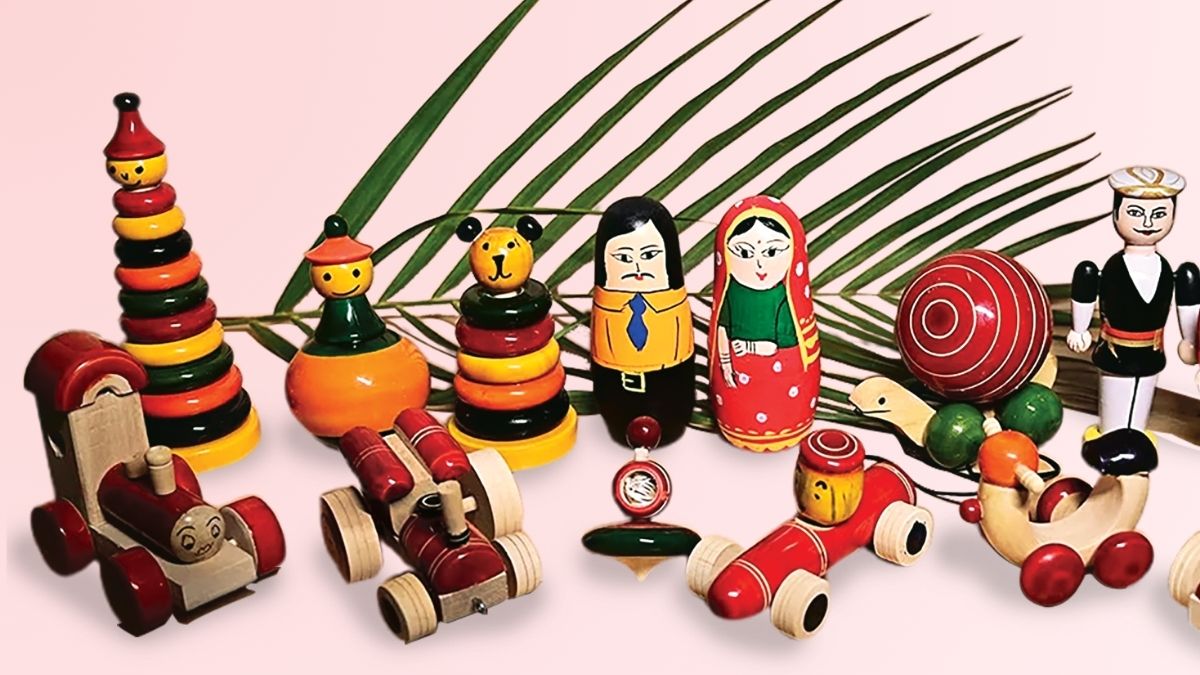
Colourful Channapatna wooden toys showcasing Karnataka’s traditional craftsmanship
In the southern state of Karnataka, Channapatna, a town in the Ramanagara district, is known as Gombegala Ooru or the toy town of Karnataka, as it is famous for handmade wooden toys. The town, located about 60 km away from Bengaluru, is the hub of small-scale industries and local craftsmanship.
The streets of the town are lined with shops showcasing eco-friendly wooden toys. These toys have a rich history dating back to the 18th century, when Tipu Sultan, ruler of Mysore, invited a Persian artisan to train local craftsmen in the art of wooden toy production.
Though Tipu is no longer around, but centuries later, the art of making these attractive toys with hands has become an integral part of the heritage of Channapatna as the household industry has been passed down from generation to generation.
Artisans of Channapatna have a distinct style of toy-making that blends traditional Indian craftsmanship with Persian techniques. Over 3,000 artisans are making wooden toys, and these toys are protected under the Geographical Identification (GI) tag, awarded by the Indian government in 2006, under the rules of World Trade Organisation.
Also Read: Chandragutti: Karnataka’s hill town with heritage temples, old-world charm
“Geographical indication (GI) tag is a special honour for the local artisan community to keep up their tradition and culture. It is effectively executed and is a tool for building value for micro, small, and medium enterprises (MSMEs), particularly for the handicraft sector, and is estimated to gain monetary benefits in terms of increased sales, price level changes, quality enrichment and profitability. It aids in nurturing and strengthening the skills and ethnicity while at the same time supporting and developing the whole society. The insertion of a GI tag ensures high standards and more sales,” S Mahalingaiah, Director, Sky Way Tours, a leading travel agent of Karnataka, tells India & You.
Crafted using Aale Mara, or ivory wood, which is sourced locally, the wooden toys are not just vibrant but also eco-conscious. The wood used is soft, allowing the artisans to create intricate designs. Besides ivory wood, some artisans also use, though very rarely, expensive materials like rosewood and sandalwood. And slowly the artisans have also started to use other woods like teak, pine, rubber and cedar wood. Apart from the wood, these toys are manufactured using non-toxic materials like natural dyes extracted from vegetables.
In contemporary times, when machines are being used to make plastic toys, artisans of Channapatna prefer making handcrafted toys, preserving the authenticity and uniqueness of each piece.
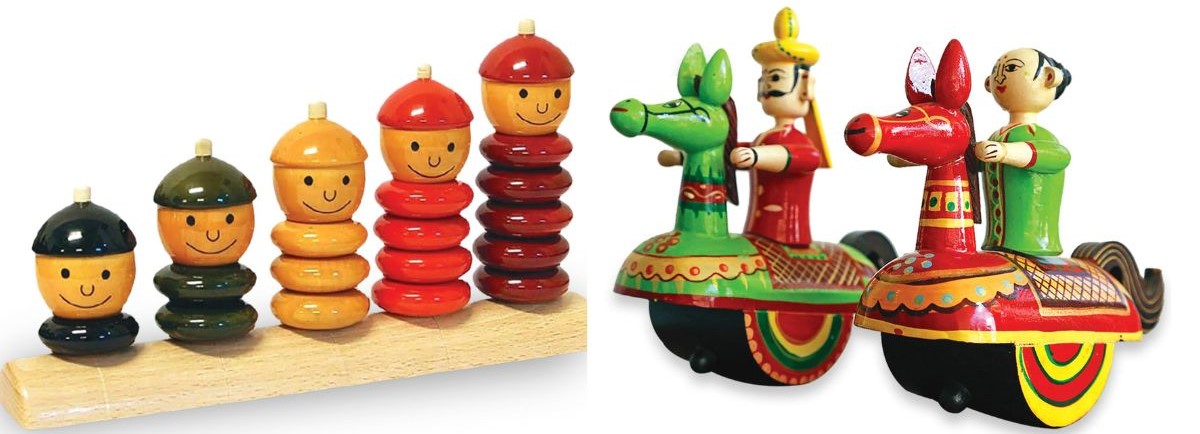
Handcrafted wooden dolls and toys made by Channapatna artisans
These unique toys are not only popular within India but also across the globe, with exports going to nations like Japan and the United States. Their popularity significantly increased when Michelle Obama, the then First Lady of the United States, bought them during her trip to India in 2010. The toys have been integrated into educational initiatives by organisations such as Microsoft, emphasising their adaptability as both toys and educational resources.
“The toy town of Karnataka, Channapatna, is part of our tourism itineraries, and most of the tourists, Indian or foreigner, visit this town and buy toys,” says Mahalingaiah.
Visitors experience toy-making workshops along with local artists working from their homes, handcrafting toys from blocks of wood, and also visit Channapatna Crafts Park to explore the work of over 3,000 traditional artisans.
“The Department of Tourism of Karnataka distributes Channapatna Toys as gifts in most of the Travel Trade Exhibitions and Road Shows to visitors and foreign tour operators regularly. It is promoted online and offline and has a special mention on the department’s website,” adds Mahalingaiah.
Also Read: From Bean to Brew: Coffee story of Karnataka
He says that Channapatna toys are more than just toys; they are a symbol of India’s rich cultural heritage and a testament to the skill and craftsmanship of the local artisans. “It is important to preserve this legacy and ensure that these toys continue to be made in their traditional form for future generations to enjoy,” he adds.
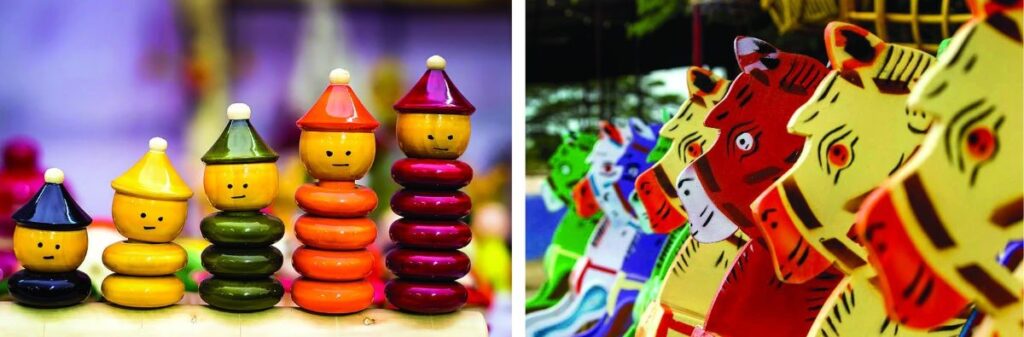
Vibrant Channapatna toys featuring traditional dolls and animal figures
At a time when more than 85 pc of the toy market in India is import-driven, mainly from China, owing to their low prices and wide selection, the thriving crafts of Channapatna serve as a key reminder of the value of indigenously-made and hand-crafted goods. However, the competition from the imported toys has greatly affected local craftsmen who find it difficult to compete with less expensive, mass-manufactured options.
The change in consumer preferences towards automated and branded toys, in addition to video games, has also led to a decrease in demand for conventional handcrafted toys.
Also Read: Gotipua: A gendered artistry
With difficult market conditions and the onslaught of imported products, a number of artisans in Channapatna have quit their ancestral profession and taken up other sources of livelihood and as a result, their numbers have declined significantly from 3,500 in the 1990s to approximately 1,200 now. The locals say that the younger generation is not inclined towards learning their familial craft because of insufficient exposure and training.
Many craftsmen have left toy production for more secure positions like garment factory employment or even as a daily wage worker because of financial uncertainty.
Traditional wooden dolls reflecting Channapatna’s distinctive craft style
But the artisans remaining in the field have ensured that their excellence allows them to face the strong competition from foreign toys and the increase of digital entertainment such as video games. For them, Channapatna toys have succeeded in establishing a unique position for themselves. The craftsmen of Channapatna have embraced contemporary preferences by integrating innovative designs and methods, guaranteeing that their offerings stay pertinent in a swiftly evolving market.
Manufacturing
The various stages of manufacturing these toys include procuring seasoning the wood and then cutting it into the desired shapes. The wooden models are then pruned and carved to create the toys. Once the woodwork is completed, the toys are painted and then polished to obtain the finished product.
Vegetable dyes are used in the colouring process to ensure that the toys and dolls are safe for use by children. According to the state government officials, over 6,000 people in Channapatna, working in 254 home manufacturing units and 50 small factories, are engaged in the making of these toys.
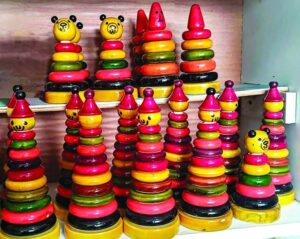
Stacked wooden toys showcasing the colourful artistry of Channapatna
The Karnataka Handicrafts Development Corporation (KHDC) provides assistance with marketing efforts. Most oldest and popular manufacturing unit Bharath Art and crafts help develop innovative products. Although classic dolls and figurines still hold popularity, artisans have started making toys designed for mathematical games and puzzles, attracting a wider audience.
In a realm of widely manufactured plastic, Channapatna provides a physical link to youth and a recollection of a vibrant tradition. When you are looking for a gift next time, think about a Channapatna toy, which is a slice of history and a demonstration of the lasting strength of Indian artistry.
