Defence forces across the world are adopting AI, but important ethical questions remain
Artificial Intelligence (AI) has changed the ways of the human society in thousands of highly visible ways, from shopping and travel to work and health. But away from such applications used openly by hundreds of millions people, AI is increasingly being used in covert operations by defence and law and order forces across the world for a variety of objectives, from increasing the attacking and defensive capabilities of the militaries to monitoring the wider society, often in violation of privacy laws.
For military generals and strategists, AI has come as a boon and a bane, depending on the capabilities that they possess vis-à-vis their counterparts from rival nations. The recent conflicts have provided several examples of the use of AI in real-time warfare, from AI-enabled drones identifying targets in Ukraine to AI-assisted intelligence systems processing surveillance data in Israel and predictive maintenance tools used by the US military.

Bhavishya Pandit
The current levels of usage, however, are just the tip of the proverbial iceberg in the real potential of AI in the battlefield. Anthropic, an American AI firm and developer of the Claude family, recently unveiled Mythos, a platform that could hack into any system currently in existence. The claim sent the US Department of Defense scurrying to seek unique and absolute control over the platform, which Anthropic has so far resisted, saying that while AI offers significant military advantages, it also raises concerns over autonomous weapons, cybersecurity and accountability, making responsible adoption a key challenge for defence planners.
Also Read: Artificial Intelligence: Transforming design, manufacturing and operations
Global AI race picks pace
The world’s leading military powers are rapidly integrating AI into defence planning and operations. The United States is deploying AI across intelligence analysis, logistics, autonomous systems and commandand-control networks, with the Department of Defense managing hundreds of AI-related programmes and accelerating the adoption of AI for national security.
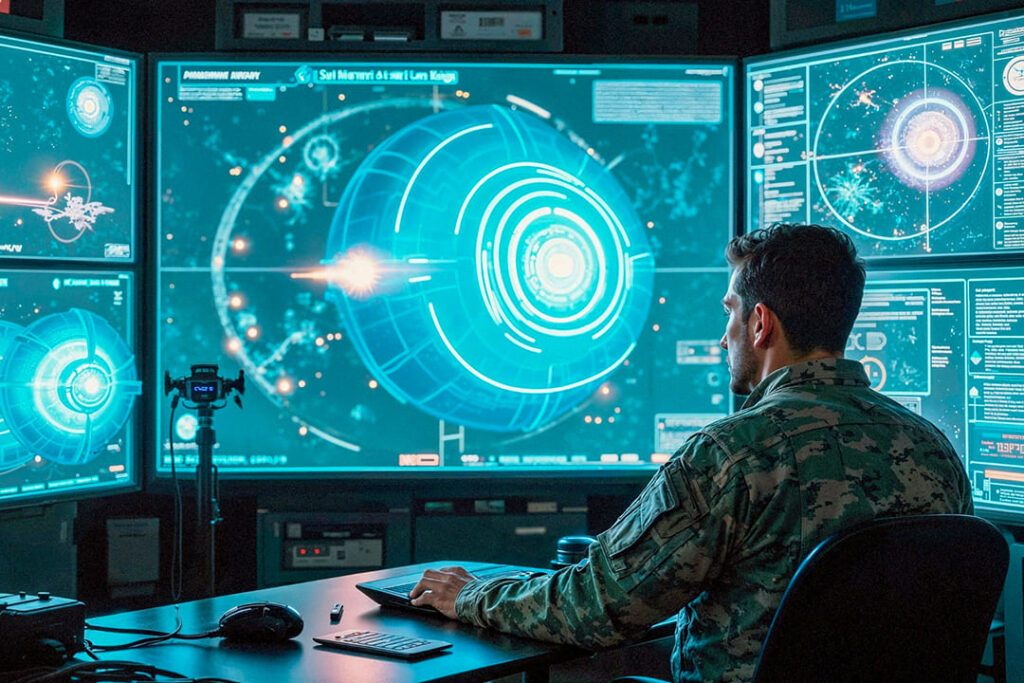
A wide variety of AI tools are being deployed by defence forces to speed up their responsiveness (Representative image)
China has made AI central to its military modernisation strategy through its doctrine of ‘intelligentised warfare’, which aims to integrate AI, robotics, autonomous systems and big-data analytics across military operations. Beijing is also pursuing military-civil fusion to leverage commercial AI innovation for defence applications.
Russia, drawing lessons from the Ukraine conflict, has prioritised AIenabled autonomous systems and unmanned platforms, viewing AI and drones as key components of future warfare.
For its part, India has also stepped up its efforts to integrate it across defence operations.
Following the recommendations of the 2018 Defence AI Task Force, the government established the Defence AI Council (DAIC) and Defence AI Project Agency (DAIPA) to drive AI adoption across the armed forces.
Through its Centre for Artificial Intelligence and Robotics (CAIR), the Defence Research and Development Organisation (DRDO), the primary defence R&D firm in India, is developing indigenous capabilities in autonomous systems, surveillance, cybersecurity and decision-support technologies. India is also promoting private-sector participation through initiatives such as Innovations for Defence Excellence (iDEX), with a growing ecosystem of defence-tech startups working on AI-enabled military solutions.
Also Read:Drone Warfare: Redefining military conflicts with precision and swarm tactics
From information superiority to decision superiority
Modern warfare generates enormous volumes of information from satellites, drones, radars, electronic sensors and intelligence networks. Human operators often struggle to process such data within operational timelines. AI addresses this challenge by rapidly analysing information, identifying patterns and providing commanders with actionable insights.
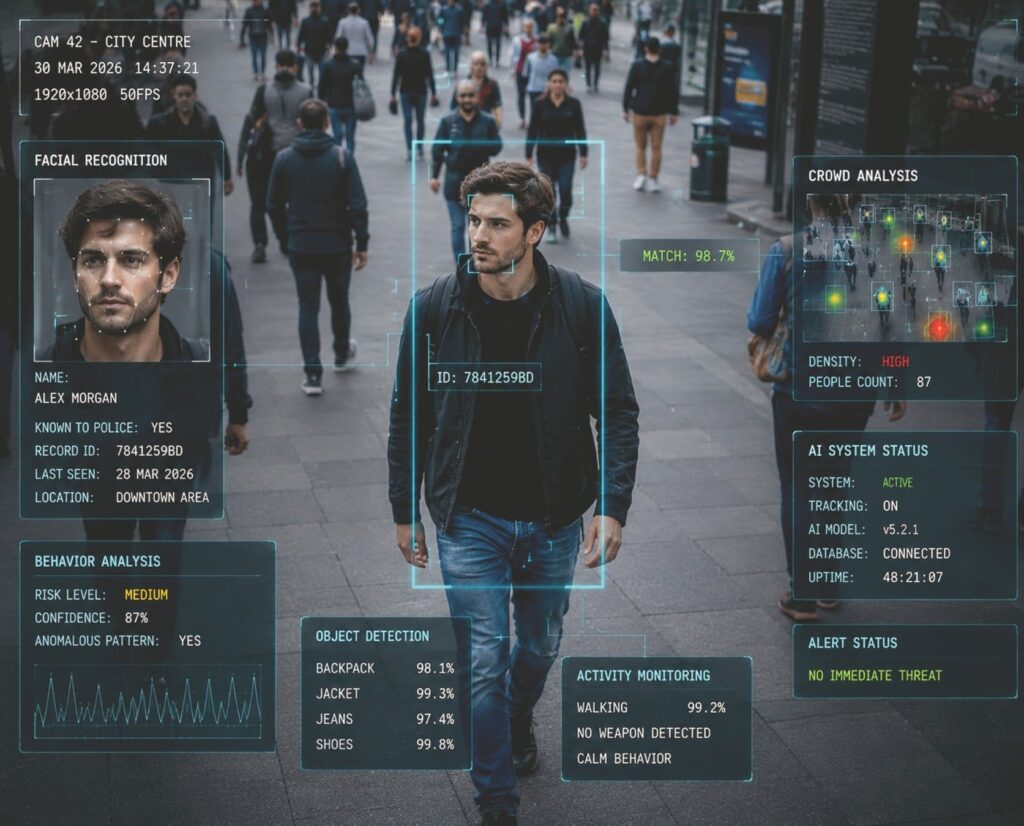
One of the most common uses of AI is in facial recognition (Representative image)
Today, AI is used for target recognition, intelligence fusion, predictive maintenance, logistics optimisation, cybersecurity and mission planning. Advanced algorithms can analyse satellite imagery, identify suspicious activities and monitor large geographical areas continuously.
According to Ranjith Palanisamy, Embedded Software Engineer at Data Patterns (India), a Chennai-based firm that provides defence and aerospace electronics solutions, three AI applications are likely to have the greatest impact on future military operations, namely Autonomous Target Recognition (ATR), predictive multi-source intelligence fusion and AI-enabled command decision support systems.
“AI-enabled ATR systems can simultaneously process electrooptical, infrared, synthetic aperture radar and hyperspectral sensor feeds, classifying and geo-tagging targets with sub-second latency. Meanwhile, graph neural networks and transformer-based models are enabling intelligence fusion across signals intelligence, imagery intelligence, human intelligence and open-source intelligence at a scale that increasingly makes human analysts the bottleneck,” Palanisamy tells Biz@India.
Bhavishya Pandit, Senior Data Scientist at 66degrees, a firm that provides AI support to businesses, says that the most impactful military AI applications are often those that improve operational efficiency rather than headline-grabbing autonomous weapons.
“The biggest value is in sensor fusion, air defence, and predictive maintenance. A pattern I keep seeing in AI work is simple, the systems that win are not the most flashy, they are the ones that cut decision time and reduce operator load, and that is exactly where the US DoD and NATO are pushing AI now. In India, Akashteer is a live example of that logic in air defence,” Pandit tells Biz@India.

Amita Kapoor
“AI is certainly transforming modern warfare, but the real transformation is happening at the level of intelligence, decision-making, coordination and resilience. The most valuable applications today are in intelligence, surveillance and reconnaissance, satellite and drone imagery analysis, sensor fusion, cyber defence, electronic warfare, predictive maintenance, logistics and decisionsupport systems. These may not be glamorous applications, but they are the backbone of modern military effectiveness. AI allows armed forces to process enormous volumes of data much faster than human teams can do manually, reducing uncertainty and improving situational awareness,” Amita Kapoor, AI expert and Founder of NePeur, an Artificial Intelligence Consulting firm based in Bengaluru, tells Biz@India.
Also Read: Daher to develop MALE drone demonstrator for French Defence Ministry
Autonomous systems reshaping warfare
One of the most visible applications of military AI is the development of autonomous and semi-autonomous platforms. AI-powered drones, robotic ground vehicles and unmanned naval systems are increasingly performing missions that were traditionally carried out by soldiers and pilots.
Military researchers are also exploring manned-unmanned teaming concepts, where autonomous systems work alongside soldiers, pilots and commanders. Such collaboration allows militaries to extend operational reach while reducing risks to personnel. AI is also improving missile guidance, electronic warfare and air-defence systems.
India’s growing AI defence ecosystem
India’s military AI ecosystem now extends beyond government laboratories. More than 1,000 defence technology startups are active in areas such as drone surveillance, autonomous platforms, battlefield analytics and cyber defence.
India’s operational experience is beginning to demonstrate the value of AI in military operations. In May 2025, during Operation Sindoor, the conflict with Pakistan, military officials highlighted the use of AI-enabled multi-sensor data fusion and real-time intelligence processing to support mission planning and execution.
AI is also being deployed in border monitoring, maritime domain awareness and strategic infrastructure protection. Systems capable of analysing satellite imagery and identifying unusual activities are reducing the time required to convert raw data into actionable intelligence.
Drawing lessons from recent conflicts, Pandit says the value of AI becomes most apparent in contested environments where communications and traditional command structures face disruption.
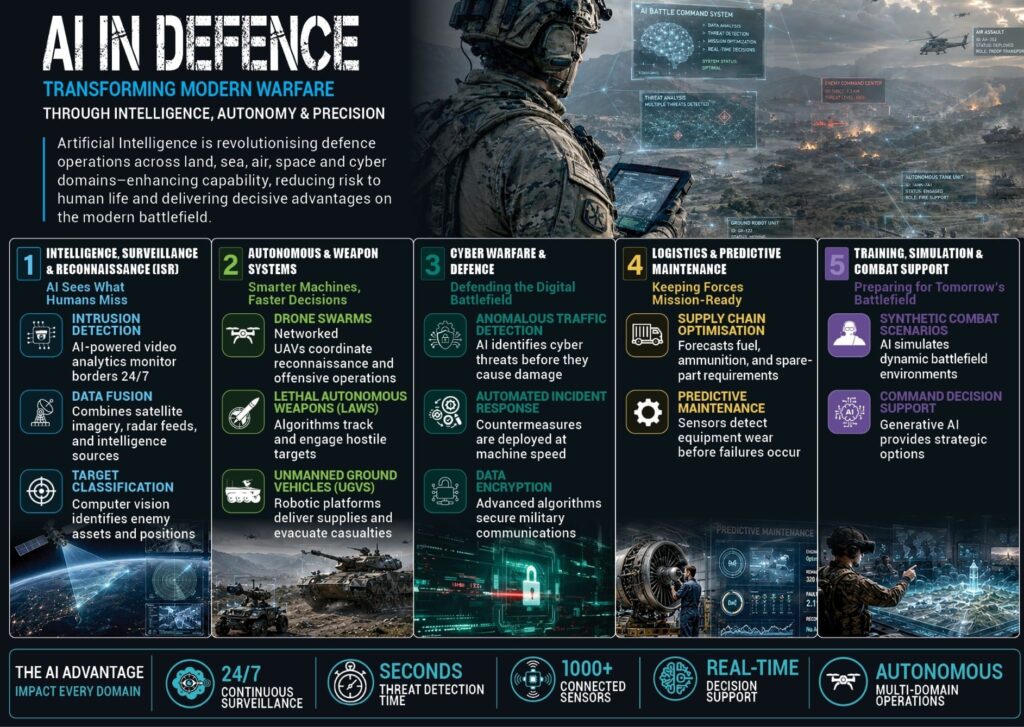
AI in defence transforming modern warfare through intelligence, autonomy and precision (Infographic: Media India Group/Hitesh Mehta)
“Ukraine is the clearest lesson. AI matters most when the battlefield is jammed, noisy, and changing fast, because autonomy and computer vision can keep systems useful when manual control gets disrupted. That is why the real metric is not just how many drones you have, but how fast you can adapt the stack under electronic warfare,” adds Pandit.
Also Read: Thales delivers world’s first autonomous drone system to French Navy
Cybersecurity and emerging threats
The military significance of AI extends beyond conventional warfare. Cybersecurity has emerged as one of the fastest-growing defence applications.
Modern military networks face constant threats from cyberattacks, electronic warfare and information operations. AI can identify anomalies, detect malware, monitor network activity and respond to threats far more quickly than traditional systems. Machine-learning models can continuously adapt to evolving attack patterns, improving resilience against sophisticated adversaries.
Palanisamy argues that AI is fundamentally changing cyber defence by moving beyond traditional signature-based detection methods.
“Signature-based intrusion detection is fundamentally a reactive architecture. Against state-level adversaries employing zero-day exploits, polymorphic malware and living-off-the-land techniques, this architecture provides detection only after exploitation, which is operationally too late,” he says.
However, he says that adversarial threats are evolving equally rapidly. Generative AI is already accelerating sophisticated spear-phishing campaign production and automated vulnerability discovery. Defensive AI model retraining cadence must therefore outpace adversarial adaptation cycles.
AI systems themselves are becoming targets as adversaries attempt to manipulate data, deceive algorithms or compromise autonomous platforms. Protecting AI systems is therefore becoming as important as deploying them.
Recognising these challenges, India launched the Evaluating Trustworthy Artificial Intelligence (ETAI) Framework in 2024. The framework establishes standards for reliability, transparency, robustness and resilience against adversarial attacks, ensuring that military AI systems can be trusted in critical operations.
Ethics of kill-by-AI
As highlighted by Anthropic in its refusal to handover its products to the US DoD, despite its advantages, AI raises significant ethical, legal and strategic concerns.
The biggest ethical dilemma is the emergence of autonomous weapons capable of selecting and engaging targets, with limited human intervention. Critics argue that delegating life-and-death decisions to algorithms creates complex ethical and legal challenges.

Ali Zia Kabir Choudhary
According to Ali Zia Kabir Choudhary, a human rights lawyer based in Delhi, the central concern is not whether machines can identify targets more accurately than humans, but whether they should ever be entrusted with the authority to decide who lives and who dies.
“Every society has recognised that the power to take life carries a corresponding burden of moral responsibility. Autonomous weapons challenge that principle at its foundation. The danger is not that machines will become evil. The danger is that human beings will gradually cease to feel responsible for the violence carried out in their name,” Kabir tells Biz@India.
Kabir argues that humanitarian law is built on the principle that lethal force is exercised by human agents who can be held accountable for their actions. While AI systems can calculate probabilities and process information rapidly, they cannot possess conscience, exercise moral judgement or bear legal responsibility.
He says that meaningful human accountability must remain attached to every lethal decision, with a clear chain of responsibility extending from battlefield commanders to political authorities authorising the use of such systems. “Technology may assist human judgment, not replace human responsibility, autonomous systems should operate within clearly defined limits, be subject to rigorous legal and technical review and include effective human override mechanisms,” Kabir adds.
Also Read: The natural cost of Artificial Intelligence
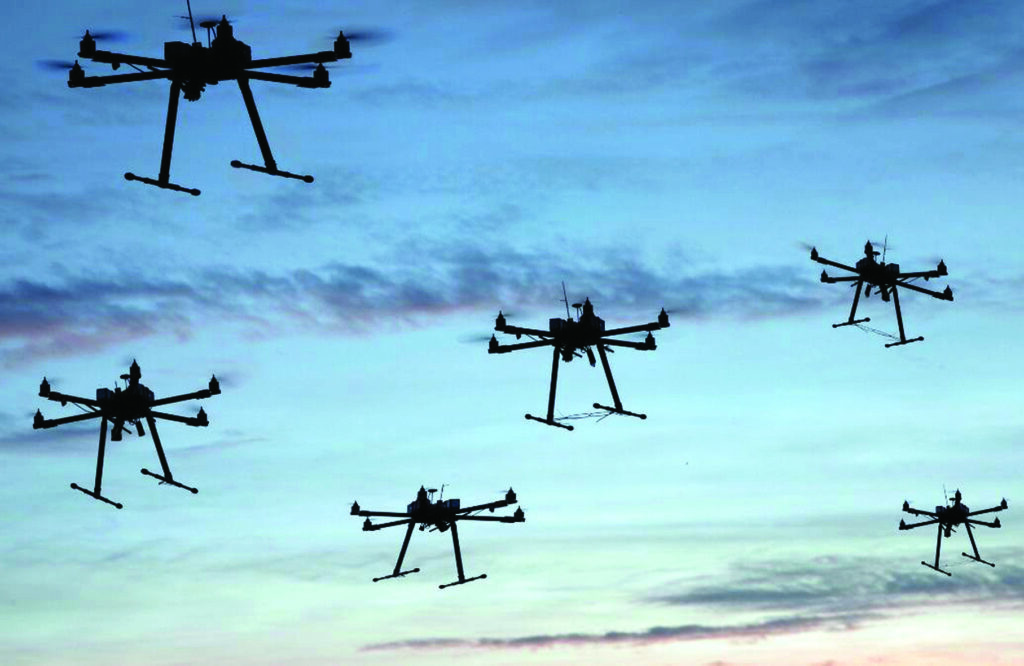
Drones are a prime example of rising usage of AI (Representative image)
Some AI experts agree. Kapoor emphasises that human judgement must remain central to military decision-making despite advances in AI.
“AI can make military operations more informed, precise and efficient, but decisions involving the use of force must remain under human control,” she says.
The possibility of an AI-driven arms race further complicates matters. As countries compete to develop increasingly capable autonomous systems, reduced human oversight and faster decision cycles could increase the risk of miscalculation during crises.
Looking ahead, Palanisamy expects warfare to become increasingly shaped by what he describes as ‘AI-enabled mosaic warfare’, where distributed manned and unmanned systems are coordinated through AI orchestration layers rather than traditional hierarchical command structures.
“The decisive competitive variable is not which side has the most capable AI model at a given point in time. It is which side can retrain, validate and redeploy updated AI decision models faster than the adversary can adapt to them. Software speed is military capability,” he says.