
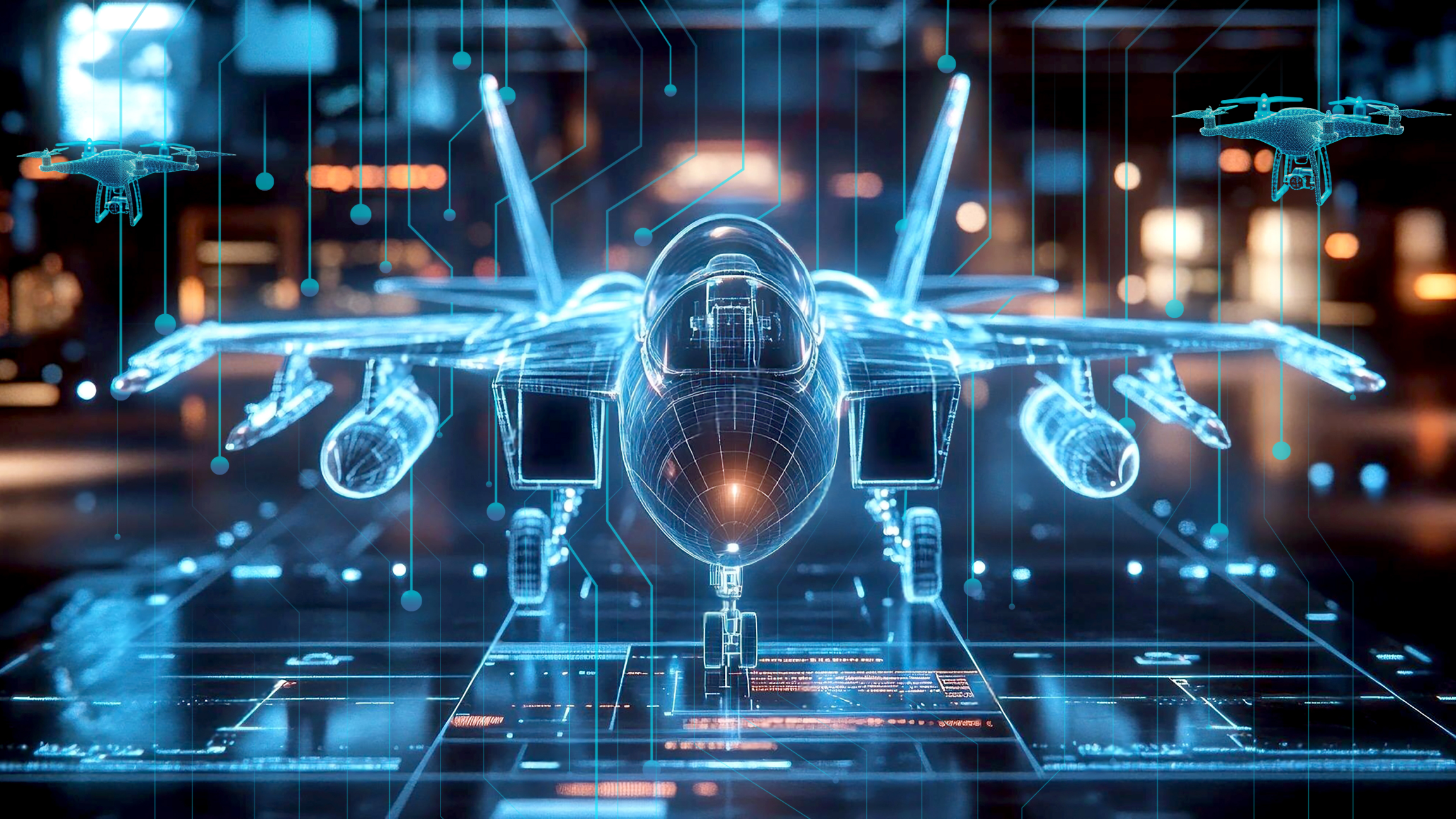
Artificial Intelligence is already improving sustainability, efficiency and safety in the civil sector
The aerospace sector is at a turning point globally as AI redefines operations from manufacturing
Artificial Intelligence, which is the buzzword for practically every sector of the economy and increasingly of human society, has also made its impact on the defence industry and so far, unlike several other spheres of economy, its impact has been positive and welcomed by the users.
“I have seen the cockpit transform from a panel of dials and switches to a digital nerve centre where Artificial Intelligence (AI) quietly works behind the scenes,” a pilot of the Indian Air Force (IAF) tells Biz@India on condition of anonymity.
“AI has completely changed how we plan and carry out our missions. We can now foresee threats, optimise mission routes and dynamically adjust to changing circumstances thanks to AI-driven predictive analytics and real-time data fusion. Predictive maintenance driven by AI, for instance, has decreased our aircraft downtime by as much as 30 pc, increasing fleet readiness and availability. AI helps process enormous volumes of sensor data during operations, which helps us make quicker and better decisions, a critical skill in high-stress situations,” he adds.
Civil aviation: Efficiency, sustainability and safer skies
The use of artificial intelligence in aircraft is fast turning into reality rather than a pipe dream, changing the way both military and commercial aviation function. The aerospace sector is at a turning point globally as AI redefines operations from manufacturing to flight management and streamlines workflows.
By 2025, the European Aviation Safety Agency (EASA), the safety regulator of the European Union, anticipates certifying the first AIbased aircraft systems, which would be a significant milestone in the incorporation of machine intelligence into the fundamentals of aviation. Using machine learning, deep learning and neural networks, AI in aviation can be broadly divided into model-driven and data-driven applications, enabling everything from computer vision to natural language processing.
AI is already improving sustainability, efficiency and safety in the civil sector. Automated baggage screening and sophisticated passenger identification are two ways AI-powered computer vision systems are enhancing airport security.
In the cockpit: Fuel savings and real-time decision-making
Artificial intelligence-enhanced Flight Management Systems (FMS) are minimising environmental impact, cutting fuel consumption and optimising routes in flight operations. To make real-time adjustments that result in smoother, more cost-effective flights, these systems evaluate enormous volumes of data, including weather, air traffic and aircraft performance. AI is also essential to predictive maintenance, which lowers operating costs and downtime while improving safety by evaluating sensor data to predict equipment failures before they happen.
Another frontier technology, safety risk modelling, uses AI to examine weather patterns, human factors and past flight data to help operators and regulatory bodies avert mishaps before they happen. With the industry applications of AI expanding rapidly, aeronautical schools have started integrating the subject in their syllabi.

Bipin Kumar Dwivedi
“The aeronautics institutions conduct Flight Data Processing System (FDPs) focussing on advanced technologies, including unmanned aerial vehicles (UAVs). These programmes cover topics such as UAV design, avionics hardware, communication systems and practical training, providing faculty and students with exposure to AI-driven aerospace innovations,” Bipin Kumar Dwivedi, CEO, School of Aeronautics, located at Neemrana, about 110 km from New Delhi, tells Biz@India.
While UAVs often steal the spotlight, the broader context is clear: AI is being applied in aerospace education training future engineers on predictive maintenance, fault detection, and immersive training simulations.
“AI algorithms analyse data to predict equipment failures, enhancing safety and efficiency. Deep learning models assist in identifying defects in aircraft structures, improving inspection processes. AI-powered simulations provide immersive training experiences for maintenance personnel,” Dwivedi adds.

Srishti Rawal
The integration of AI is not limited to the classroom or the hangar. “AI is accelerating multidisciplinary design optimisation by automating geometry generation, evaluating performance via simulation (CFD/ FEA), and selecting materials using data-driven heuristics. In manufacturing, AI enhances robotic drilling, painting, and real-time quality inspection through vision-based defect detection. On the operations side, AI models optimise flight paths and surface routing by processing weather, traffic and fuel data. From my perspective, the most impactful uses are those reducing iteration cycles, improving throughout, and minimising fuel and delay costs using adaptive decision-support algorithms,” Srishti Rawal, Aerospace Engineer and student of Masters in Science (MSc) in Industrial Engineering specialising in Human Factors in Aviation at Montreal in Canada, tells Biz@India.
AI-powered condition-based maintenance uses sensor telemetry, such as temperature, vibration and pressure, to forecast failures before they happen. Robotic arms equipped with automated vision systems can identify sub-millimeter flaws in the fuselage, wings and turbine parts, increasing detection precision and cutting down on inspection time.
“In human-system integration, I have observed that AI reduces diagnostic load on technicians and improves turnaround reliability, especially when integrated into digital MRO platforms with standardised decision workflows,” Rawal adds.
Thus, the result is a shift from reactive to predictive maintenance, where downtime is minimised and reliability is enhanced. Yet, the adoption of AI in aviation is not without challenges. The biggest challenge is the amount of data that is available for AI modelling.
“Safety-critical systems require traceability, but deep learning models often lack explainable logic paths. Moreover, AI trained on limited operating envelopes may fail under rare conditions. From an engineering standpoint, failure modes must be bounded and fallback logic must always be in place. In cockpit systems, I have seen firsthand that any loss of system transparency undermines pilot trust, especially under high workload or time-critical operations,” says Rawal.
Safety regulators who are in charge of certification are reacting. Traditional frameworks like DO-178C were designed for deterministic software, but EASA is formalising AI safety assurance with guidelines on static (pre-trained) AI models. Before AI can be completely trusted in the cockpit, several obstacles must be addressed, including the lack of established validation techniques for training data-sets, the requirement for runtime monitors and the absence of standards for AI verification under corner cases.
“Despite challenges, AI brings major benefits to aviation by enhancing pilot awareness through integrated data streams like traffic, terrain and weather. For example, AI can label obstacles on displays in low visibility and reduce taxi route deviations by integrating digital maps. Future AI could flag violations or suggest reroutes while keeping pilots in control. AI should act as a transparent, interpretable sensor, supporting, not replacing, human decision-making,” Rawal says
AI in defence aircraft
India is using AI to improve its strategic autonomy and close operational gaps
AI in aircraft has a future that extends beyond the civil sector. The stakes are even higher in defence aviation. A battlespace full of threats and information confronts the modern fighter pilot. AI-driven avionics systems are revolutionising the cockpit by controlling intricate situations with numerous components and displaying only the most important information on sophisticated helmet displays. Real-time decision support is now possible through the integration of AI with sensing, navigation and pilot-vehicle interfaces thanks to multicore processors and open system architectures.
“By combining information from several sensors, including radar, LiDAR and EO/IR cameras, into a single operational picture, artificial intelligence (AI) greatly improves situational awareness. Our upcoming AMCA fighter jet’s AI-powered electronic pilot offers automatic target identification, decision support, multi-sensor data fusion and a combined vision system for low visibility navigation. This enables us to more precisely identify, monitor and rank threats, even in environments that are contested or have low visibility,” says the pilot.
AI plays a part in defence not just in the cockpit but also in the hangar and supply chain. By anticipating potential equipment failures, AI-powered predictive maintenance systems reduce unscheduled downtime and maintenance costs. Engineers can extend aircraft lifespan and mission dependability by simulating stress conditions, anticipating failures and optimising performance through the use of digital twin technology, which builds real-time virtual replicas of aircraft. Squadrons are always ready for deployment with little delay thanks to these capabilities.
It remains difficult to integrate new AI systems with legacy platforms, though. Concerns about data reliability and the necessity of strong cybersecurity to prevent hostile intervention are constant. Because AI systems may not always be able to interpret unclear or unfamiliar situations as well as a human pilot, human oversight is still required, especially in high-stakes situations.
“Although AI has many benefits, there are drawbacks as well. It can be difficult to integrate new AI systems with legacy platforms. Data dependability and the requirement for strong cybersecurity to thwart hostile intervention are other issues. Furthermore, human oversight is still necessary, particularly in high-stakes situations, as AI systems might not always be able to interpret unclear or unfamiliar situations as well as a human pilot,” says the IAF pilot.
AI development in defence aviation is not occurring in a vacuum. For example, India is using AI to improve its strategic autonomy and close operational gaps through projects like CATS and ALFA-S, which create autonomous swarm drones and robotic wingmen. Even though these advancements are noteworthy, manned aircraft, where human-machine cooperation is viewed as the ideal situation, remain the focus, keeping the human operator at the centre of decision-making.
“AI is developing quickly, and projects like CATS and ALFA-S are already producing robotic wingmen and autonomous swarm drones. These systems are capable of performing intricate tasks like precision strikes, electronic warfare and reconnaissance with a degree of autonomy. Our squadrons are always prepared for deployment with little delay thanks to these capabilities. However, I think human oversight will continue to be essential for the foreseeable future due to the unpredictability of combat and the ethical ramifications. Human-machine collaboration is the ideal scenario, in which AI enhances our capabilities while humans maintain ultimate authority and accountability,” adds the pilot.
