
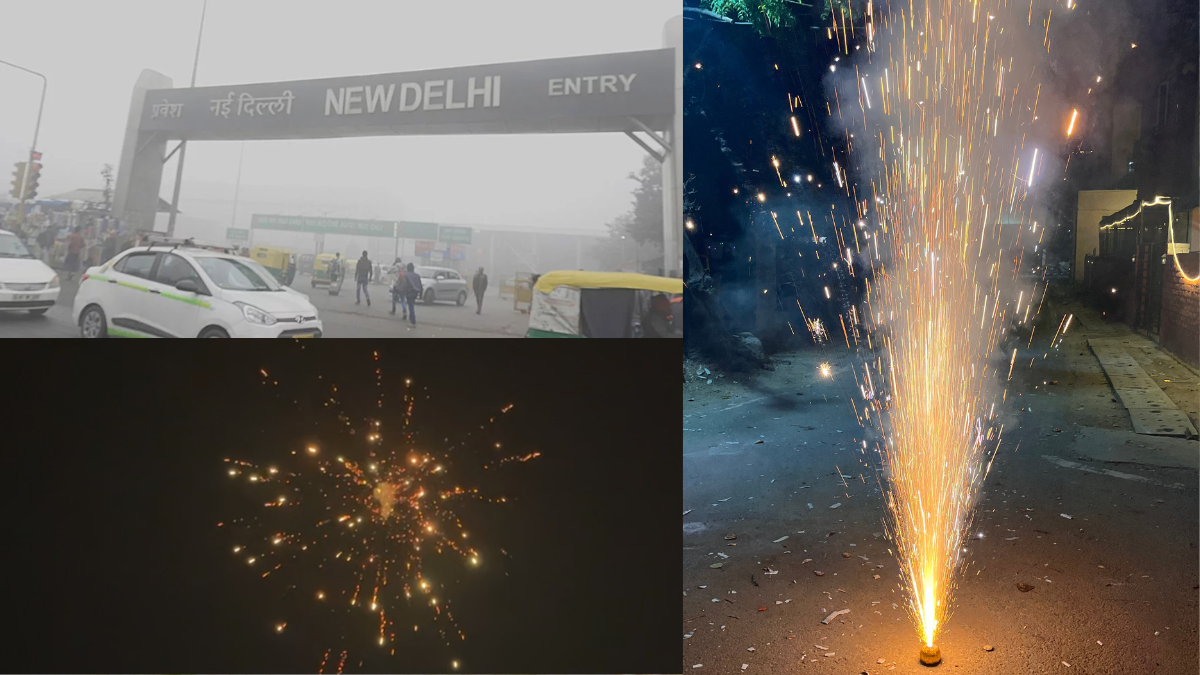
In the early hours after Diwali, Delhi woke up to a grey‑blue haze thick enough to dim headlights and sting the eyes on October 20 (Photos: MIG)
In the early hours after Diwali, Delhi woke up to a grey‑blue haze thick enough to dim headlights and sting the eyes on October 20. The city’s Air Quality Index (AQI) hovered in the severe category, between 470 and 520 across several neighbourhoods, according to the Central Pollution Control Board (CPCB). Visibility plunged below 500 metres, while emergency rooms filled rapidly with patients suffering from breathlessness, coughing and wheezing.
According to international air quality monitoring agencies like IQAir, Delhi was the most polluted city the day after Diwali. Gurugram and Noida recorded AQI readings above 500, while Anand Vihar and Jahangirpuri saw hourly PM2.5 levels touching 840 µg/m³, among the highest globally measured that night.
‘Green’ crackers turn skies grey
Last week, the Supreme Court lifted its total ban on use of firecrackers in Delhi and allowed the use of so‑called “green crackers”. But come Diwali day and the city’s skies lit up with tens of thousands of crackers, green or not, and that display of the fireworks continued well past midnight. CPCB’s real‑time monitoring showed particulate levels jumped 25–30 pc in the four hours following Diwali night, with fireworks contributing nearly a third of the PM2.5 surge, mirroring trends from previous years.
According to the Delhi Pollution Control Committee (DPCC), over 570 FIRs were filed and 320 people detained for violations, yet as the air quality shows enforcement remained ineffective.
‘The air feels like poison’
Suffering the impact of the celebrations, many residents of the capital say that a total crackdown, not halfway measures would help in preventing such peaks in pollution, which have worsened over the years.
“I have lived in Delhi all my life, but these post‑Diwali mornings are getting unbearable. You stay indoors, buy air purifiers, hydrate plants, nothing helps. The air feels like poison now,” Aruna Sethi, a 42‑year‑old housewife living in South Delhi, tells Media India Group.
Her family, she adds, celebrated without crackers for the third year in a row. “What is the point of following rules when half the city is lighting bombs? My parents start coughing the moment we open a window. You cannot even walk on the terrace,” she adds.
Others like Deepak Tiwari, a shopkeeper in Karol Bagh, called for perspective, saying pollution is a year-round issue.
“People blame Diwali, but pollution doesn’t start or end in one night,” he said. “Every day we sit in traffic for hours, factories keep running, and stubble fires burn for weeks. We cannot just target faith or festivals,” Tiwari tells Media India Group.
Yet, Tiwari concedes the situation is worsening.
“Even my children fall ill now by late October. Maybe it is time every colony celebrates together at one controlled site. Crackers are tradition, but we cannot keep choking ourselves,” Tiwari added.
Hospitals under pressure
Major government hospitals such as LNJP, AIIMS, and Ram Manohar Lohia reported a 20–25 pc rise in respiratory cases within 24 hours after Diwali. Paediatric wards were among the worst hit and Safdarjung Hospital noted a 15 pc increase in asthma‑related admissions compared to the pre‑festival week.
Experts from the Indian Chest Society have warned that repeated exposure to toxic air could trigger chronic bronchitis, cardiac strain, and reduced lung capacity, even among the young and healthy.
Cracking the chemistry
Meteorological conditions worsened the mix. With wind speeds below 4 km/h and temperature inversions forming by midnight, pollutants remained trapped close to the surface, creating what the India Meteorological Department (IMD) termed a “pollution bowl” over the National Capital Region (NCR).
“When people light fireworks under stagnant air, the pollution inflates exponentially,” Verhaen Khanna, President of the New Delhi Nature Society, an environmental organisation based in New Delhi, tells Media India Group.
“Imagine sealing a banquet hall and bursting crackers inside, that is pretty much Delhi on Diwali night,” Khanna added.
Adding to the problem of pollution is the disappearing green cover over Delhi. Khanna points out that Delhi loses five trees every hour, with over 85,000 trees felled between 2020 and mid‑2025, while compensatory plantations have fallen short by nearly 40 pc.
“Trees reduce pollution for free, but look at how we treat them. No wonder residents need masks more than umbrellas,” he says.
Policy on repeat mode
The city’s protocols read like an annual checklist, construction bans under the Graded Response Action Plan (GRAP), odd‑even vehicle schemes, school closures, and water sprinklers rolled out within days. Yet, the Commission for Air Quality Management (CAQM) reports Delhi’s winter AQI averaging 350–370 since 2021, showing little long‑term improvement.
“Lockdowns and odd‑even days are temporary painkillers. You have got to fix the root cause, vehicles, stubble, industry, and construction. Prevention is cheaper than emergency treatment,” Khanna adds.
Meanwhile, the environment ministry’s State of Forest Report 2023 noted Delhi’s green cover at 23.06 pc, down from 23.48 pc two years earlier.
Experts argue that cleaner transport, tighter crop‑residue management, and stronger enforcement under the National Clean Air Programme (NCAP), which targets a 40 pc reduction in PM2.5 by 2026 pc are the only way out. The initiative has yielded a modest 7–8 pc improvement and that too at select NCR stations, but enforcement remains inconsistent.
For now, Delhi’s skyline serves as its annual reminder, every burst cracker and burning field shapes the air its residents must breathe, long after the festival lights fade.
