
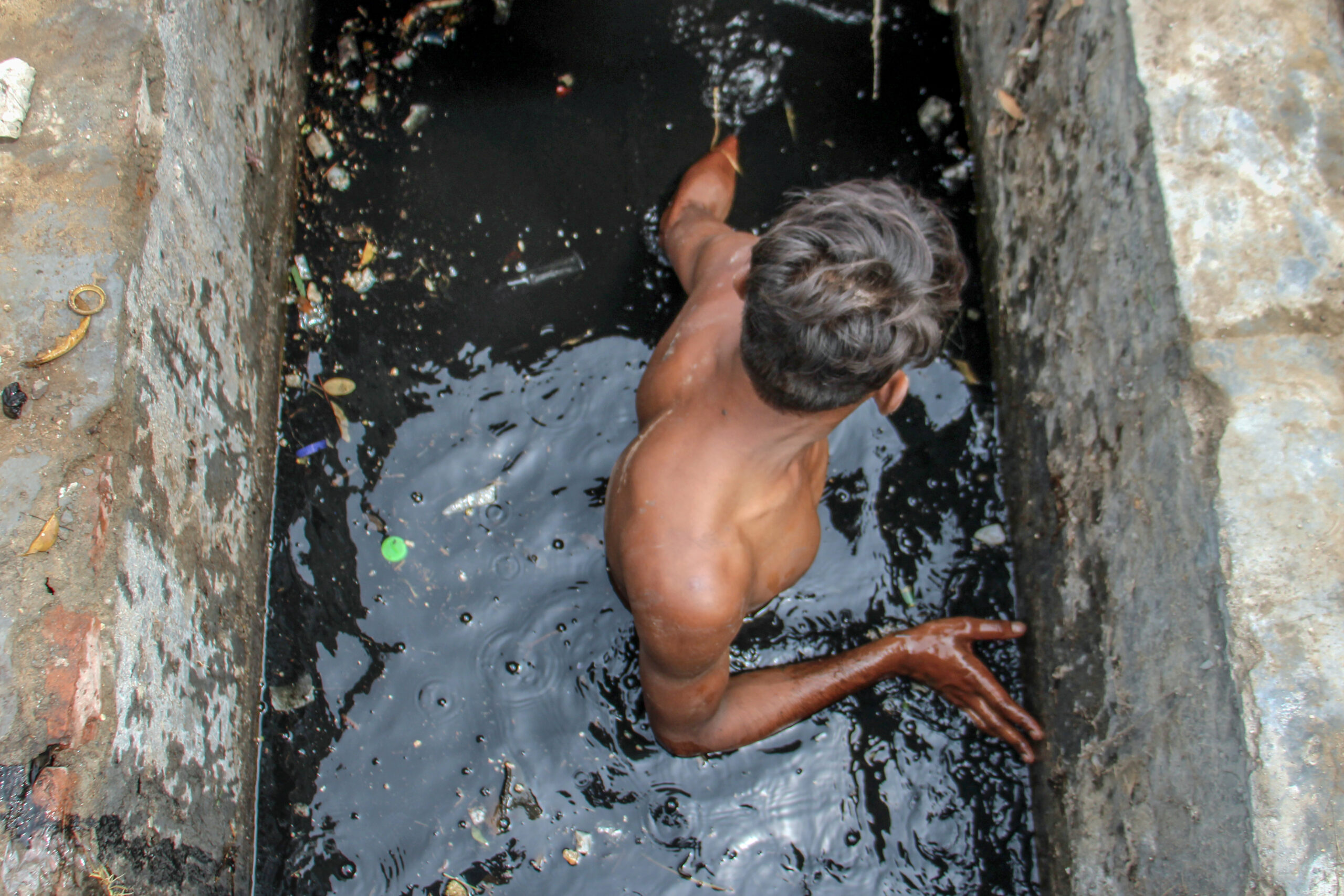
Manual scavenging is defined as the manual cleaning, carrying, disposing, or handling of human excreta from dry latrines, sewers and septic tanks (Photo: Media India Group)
Officially, on paper, manual scavenging, or the practice of cleaning deep sewers and septic tanks, is banned in India, but in reality, it is still widely practiced. Despite the legal prohibition and repeated judicial directives, manual scavenging continues in Delhi and other cities, raising serious concerns about the implementation and enforcement of the law.
Officially, manual scavenging is defined as the manual cleaning, carrying, disposing, or handling of human excreta from dry latrines, sewers and septic tanks. It has been officially banned since 1993 under the Employment of Manual Scavengers and Construction of Dry Latrines (Prohibition) Act. The law was further reinforced by the Prohibition of Employment as Manual Scavengers and Their Rehabilitation Act, 2013, which not only criminalised the practice but also mandated comprehensive rehabilitation for those engaged in it.
Yet, the persistence of manual scavenging, especially in Delhi, underscores a troubling gap between legal pronouncements and administrative action. Despite these clear directives, the ground reality in Delhi tells a different story. Safai karamcharis, or sanitation workers, continue to be seen entering sewers and septic tanks without protective gear or mechanised support.
“Every time I go down a manhole, I know I am risking my life. We are told the machines are there, but most of the time, we are sent in with just a rope and a bucket. The law says we should not be doing this work, but who will feed my children if I refuse? I have seen friends die inside these drains, but there is no other job for us. We are invisible to the authorities until someone dies,” Ramesh Kalyant, a manual scavenger in New Delhi tells Media India Group.
The Supreme Court’s recent order was prompted by continued reports of deaths during sewer cleaning operations, including an incident in Delhi where two men lost their lives just days before the ruling. The bench, led by Justices Sudhanshu Dhulia and Aravind Kumar, expressed deep concern over the cases.
“These deaths are unacceptable. People are still dying. We must now pass immediate directions to stop this practice,” the bench ruled.
Municipal commissioners and Chief Executive Officers of Delhi and other affected cities were ordered to file affidavits by February 13, detailing how and when manual scavenging would be stopped.
The Supreme Court of India, in an order on January 29, directed an immediate cessation of manual scavenging in six major metropolitan cities, including Delhi. This directive, following years of judicial intervention and legislative action, was intended to finally eradicate a practice that has long been recognised as inhumane and illegal.
But the top court’s order was not the first of its kind. In October 2023, the apex court had already issued a comprehensive judgment, directing the Union and all states to implement a phased eradication of manual scavenging, ensure full rehabilitation for affected workers and increase compensation for sewer deaths from INR 1 million to INR 3 million. The court also mandated the creation of a centralised portal to track sewer deaths, compensation and rehabilitation measures. Despite these measures, the practice remains deeply entrenched due to a combination of administrative apathy, lack of mechanisation and socio-economic inequalities.
Bezwada Wilson, a human rights activist and leader of the Safai Karmachari Andolan, has been at the forefront of the campaign against manual scavenging.
“We are collecting data across the country and will compile the same. We will find an administrative solution for the problem. If that does not work, then we will go to court. Many states are using manual scavenging. Almost all cities and towns are using safai karamcharis for cleaning of sewer and septic tanks. In rural India, almost all septic tanks are cleaned by human beings,” he tells Media India Group.
Reportedly, out of 775 districts in India, 465 have been declared “manual scavenging-free,” but data from 310 districts is still pending. Moreover, there is ample doubt about the accuracy of these claims. These proclamations are similar to claims that India is now free of open-air defecation, even though even in the capital Delhi itself, hundreds of people can be seen relieving themselves along the railway tracks every day.
Similarly, for manual scavenging, too, in Delhi, the continued deaths and hazardous working conditions of safai karamcharis suggest that the ban remains largely on paper.
