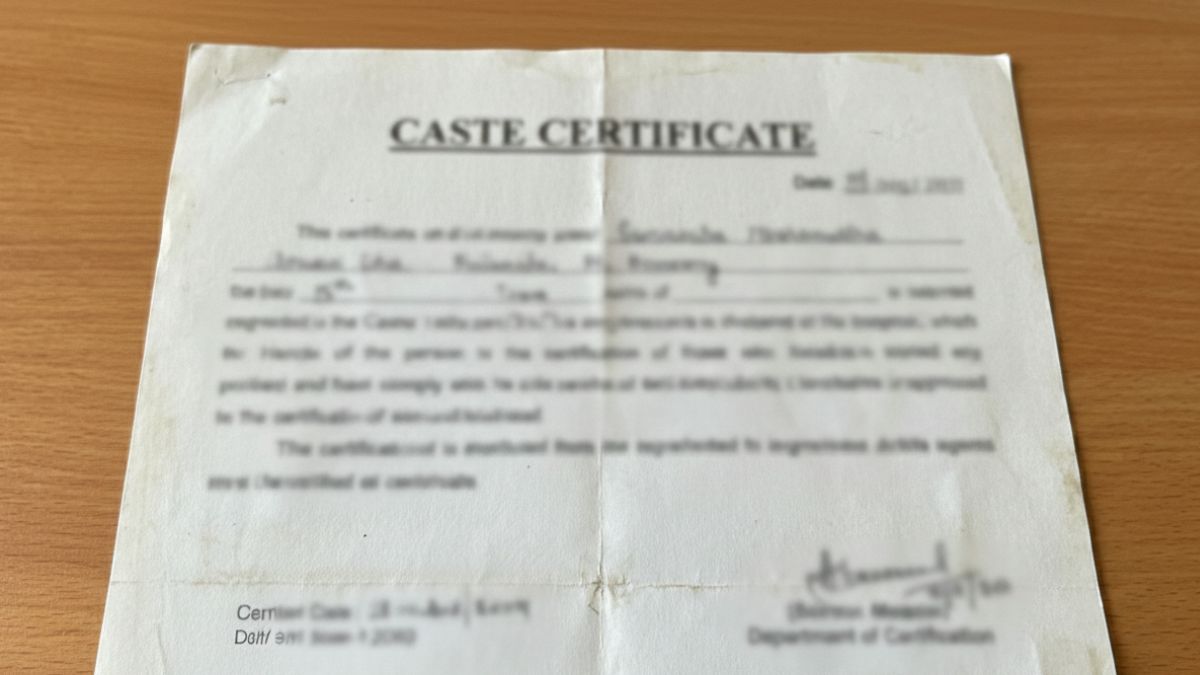
Students rationalise the use of fake certificates by citing the fierce competition
Across India, the growing trend of people ineligible for caste-based reservations turning to use of fraudulent caste certificates to secure an opening in the highly-competitive world of higher education, government jobs or other socio-economic privileges is no longer just whispered about. For some young aspirants, it has become a calculated strategy and one they describe with surprising candour.
Over the past decade, hundreds of appointments and admissions being cancelled following the discovery of fake caste certificates. In 2025, the central government acknowledged that verification exercises were ongoing across multiple recruitment agencies and educational institutions, following complaints that general category candidates had falsely claimed Other Backward Castes (OBCs), Scheduled Castes (SC) or Scheduled Tribes (ST) status.
Students rationalise the use of fake certificates by pointing at the intensity of competition as every good quality and affordable seat in higher education, notably engineering, medicine or management, has at least 100,000 aspirants, while for the few government jobs going around, the numbers can be as high as 1 million applicants for each open position.
“I knew I would not clear the cutoff otherwise,” Arnav Singh (name changed), 25-year-old NEET aspirant, Delhi tells Media India Group.
“Everyone says the system is unfair to general category students. So when an agent told me he could arrange an OBC certificate, I did not see it as wrong. I saw it as a matter of survival,” says Singh.
Also read: Missing placement cells in Kashmir universities undermine job prospects for students
Statements like these reflect a mindset where pressure and perceived unfairness are used to excuse unethical behaviour. Students frame the practice as a strategic move rather than fraud, overlooking the broader social consequences.
Peer influence and social normalisation further reinforce these justifications. Candidates often report seeing friends or classmates benefit from fake certificates, which creates a perception that everyone is bending rules.
A postgraduate student who secured admission to a central university using a forged certificate echoes this sentiment.
“I come from a middle-class family. No political connections, no influence,” Aditya Kumar (name changed), a management student at the prestigious Indian Institute of Management, Bengaluru tells Media India Group.
“Reserved seats felt like a closed door. People around me were already doing it. When rules do not feel equal, people stop respecting them,” says Kumar.
“When a reserved category person takes a seat with 60 pc, a genuinely disadvantaged candidate with 90 pc loses a once-in-a-lifetime opportunity, this is not a victimless shortcut. It reproduces inequality in a new form,” adds Kumar.
Official data from an older government report shows that between 2010 and 2019, over 1,084 complaints were filed about people using fraudulent caste certificates to get government jobs and 92 public servants were dismissed after such certificates were found to be fake.
Also Read: Jamia students face suspensions, detentions & threats
News reports from 2025 show dozens of fake certificates being uncovered in Gujrat, with hundreds of individuals found using them to gain admissions and jobs in the last few years. One publicised case involved 156 fake caste certificates being detected in higher education and public employment verification processes over a period of three years.
While students describe these actions as necessary for survival or career progress, the consequences fall on those who are legally entitled to the reserved seats. Genuine beneficiaries from backward communities are denied chances for education, jobs and advancement, effectively pushing them further behind.
This normalisation of unethical shortcuts not only erodes the integrity of the reservation system, but also undermines social equity. The benefits meant to uplift disadvantaged communities are instead diverted to those who already have social or economic advantages.
Family expectations add another layer to this justification. Many students report that parents encourage results over ethics, reinforcing the belief that success justifies the means.
“My parents never asked how I got the certificate. They just wanted results. In middle-class homes, success matters more than process,” adds Singh.
The impact is clear as backward communities, for whom the reservations have been created in the first place, lose opportunities and the reservation system loses its credibility and the students themselves risk their future if the fraud is discovered. While some see it as a temporary shortcut, the broader societal cost is significant and long-lasting.