
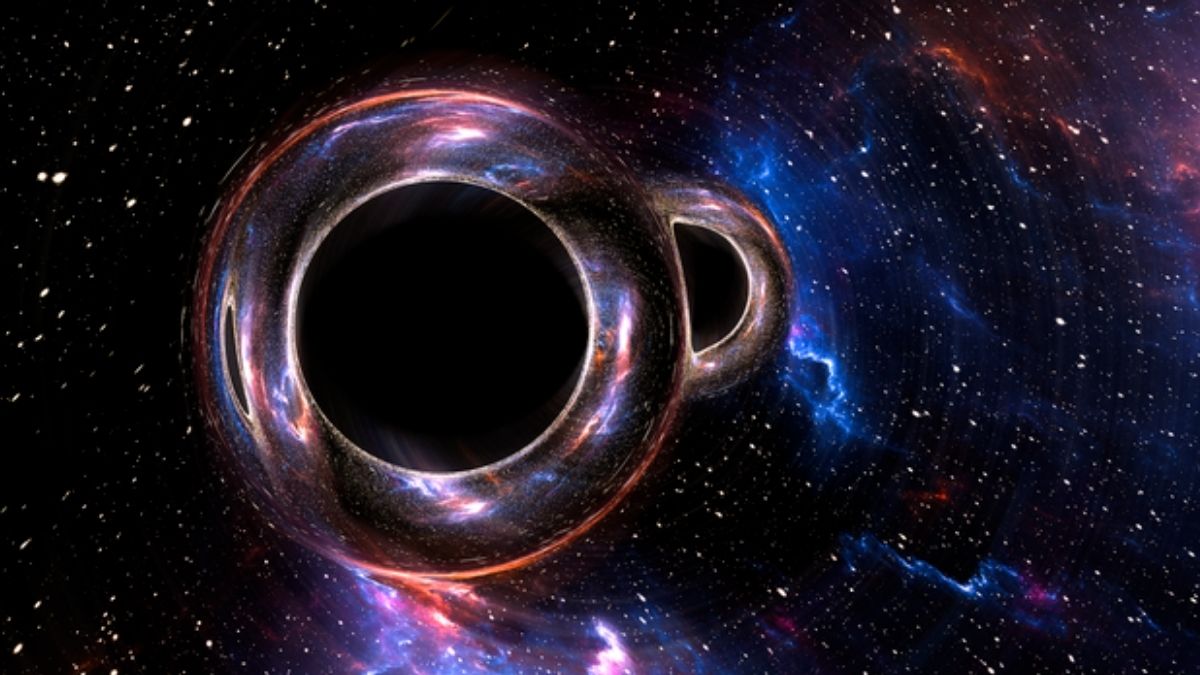
Gravitational wave detectors can now autotune signals to harmonise the universe (Photo: Carl Knox, OzGrav, Swinburne University of Technology)
To improve the accuracy and reliability of gravitational wave detection across a global network of observatories as scientists work with increasingly sensitive instruments and complex data, researchers from the international Ligo, Virgo and Kagra (LVK) collaboration have developed a new astrophysical calibration technique that uses gravitational wave signals themselves to fine-tune detector performance and correct measurement distortions.
In a press statement, LVK says that the method uses gravitational wave signals themselves to measure and correct the response of extremely sensitive instruments, ensuring that even when a detector is slightly misaligned or operating below optimal conditions, it can still accurately capture and interpret signals from events such as black hole mergers.
It adds that the gravitational waves are tiny ripples in spacetime produced by some of the most violent events in the universe. By the time they reach Earth, often after travelling for billions of years, they are extremely faint.
Christopher Berry
Christopher Berry of the University of Glasgow’s Institute for Gravitational Research, is part of the LVK collaboration and an author of the paper. “Gravitational waves are ripples in spacetime that stretch and squeeze space. They are tiny by the time that they reach the Earth, millions of years after the events that first created them,” says Berry.
“They are not something which we can hear, but our detectors can output the signals as waveforms that we can increase in pitch to listen to, with each signal producing their own distinctive chirp. Those chirps encode a wealth of information we can analyse to learn about their sources-their masses, spins, distance and location,” adds Berry.
Researchers say that the technique becomes especially important when one of the detectors in the global network is not functioning at full precision. By comparing observed signals with highly accurate predictions from Einstein’s general theory of relativity, scientists can identify subtle distortions in the data and correct them using information from other detectors in the network.
According to the statement, the LVK collaboration demonstrated this method using two exceptionally strong gravitational wave signals detected in recent observing runs. The first signal, GW240925, was observed on September 24, 2024 and came from the merger of two black holes with masses roughly nine and seven times that of the Sun, located more than a billion light-years away. The second signal, GW250207, detected on February 7, 2025, was one of the loudest events recorded in the collaboration’s decade-long observation history, originating from the collision of two much larger black holes around 600 million light-years from Earth.
The statement says that both events provided a unique opportunity to test astrophysical calibration under challenging conditions. In the case of GW240925, a temporary calibration error was identified in the LIGO Hanford detector in Washington, while for GW250207, the detector was still coming online and lacked full monitoring systems. These conditions allowed researchers to validate and refine the new calibration approach.
The statement highlights that by combining data from multiple detectors, including LIGO Livingston in the United States and Virgo in Italy, along with theoretical models from general relativity, researchers were able to reconstruct and correct distortions in the Hanford data. For GW240925, the method matched known calibration errors identified on site, while for GW250207 it provided a crucial correction method when direct calibration data was unavailable.
Ling Sun
“The loudness of these signals was remarkable, with very high signal-to-noise ratios compared to many of our other detections. These are exactly the types of signals you want to be recorded by all of our detectors. However, given the technical hitches with LIGO Hanford, we might have had to throw out the detector’s results altogether, losing a large chunk of the signal strength and our ability to precisely locate these events in the sky. By first verifying astrophysical calibration with the analysis of the September 2024 detection, we were much more prepared to deal with the more significant problems with the February 2025 data,” says Ling Sun, Research Fellow, and paper’s editorial chair, Australian National University.
According to the LVK team, accurately calibrated data is essential for determining black hole properties and improving sky localisation of cosmic events. The addition of astrophysical calibration significantly improves the precision of identifying where in the sky these events occur, especially when observations are combined across multiple detectors.
The statement adds that by combining data from multiple detectors, including Ligo Livingston in the United States and Virgo in Italy, along with theoretical models from general relativity, researchers were able to reconstruct and correct distortions in the Hanford data. For GW240925, the method matched known calibration errors identified on site, while for GW250207 it provided a crucial correction method when direct calibration data was unavailable.
According to the LVK team, accurately calibrated data is essential for determining black hole properties and improving sky localisation of cosmic events. The addition of astrophysical calibration significantly improves the precision of identifying where in the sky these events occur, especially when observations are combined across multiple detectors.

Daniel Williams
“These discoveries demonstrate that, over our decade of work since the first detection, we have developed a comprehensive understanding of our entire analysis pipeline, from the signals themselves to the detector behaviour. In the rare instance that something goes wrong with one detector, we now have robust backup methods to compensate and leverage data from the other detectors to give us the best-quality results,” says Daniel Williams, Institute for Gravitational Research, University of Glasgow.

Stephen Fairhurst
“It is remarkable that these massive cosmic events can not only be measured by our instruments but actually used to check our measurements. Being able to use astrophysical calibration so successfully during our fourth observing run is a demonstration of the maturation of the detector’s capabilities and our ability to get the most out of every detection. Improving the quality of our results on sky localisation will also help us test key concepts like the expansion rate of the Universe, a value which is still being debated by scientists,” says Professor Stephen Fairhurst, Ligo Scientific Collaboration’s Spokesperson, Cardiff University.
“We are moving from the era of first discoveries to the era of precision gravitational wave astronomy. We can be confident that our next observing runs will continue to build our rapidly-growing catalogue of gravitational-wave discoveries, and expand our understanding of the Universe,” says Williams.
The statement adds that research across the UK, including contributions supported by UKRI’s Science and Technology Facilities Council, continues to strengthen global efforts in gravitational wave science, with institutions such as the Universities of Birmingham, Cambridge, Cardiff, King’s College London, Nottingham, Portsmouth, Sheffield, Strathclyde, University College London, Queen Mary University of London, and the University of the West of Scotland playing key roles in advancing the field.
